Author Archive

Dr. Doug’s Key Book Summaries and Answers from The #140edu Conference in NYC

Monday, August 1st, 2011

On August 3rd, I was on a panel moderated by Shelly Terrell at the prestigious #140edu conference at the 92nd Street YMCA in Manhattan. Click here for the video. Here are links to my book summaries that you should read if you want to better understand what’s wrong with most schools today. I have also included my answers to Shelly’s questions. Click the title above to see them.

Drive: Daniel Pink http://bit.ly/jl7ara

The Myths of Standardized Tests: Harris, Smith, & Harris http://bit.ly/lJLUNR

Catching Up or Leanding the Way: Youg Zhaohttp://bit.ly/mrUNnj

Managing the Millennials: Espinoza, Ukleja, & Rusch http://bit.ly/n8KVCY

Readicide: Gallaghar http://bit.ly/qk7oNY

Failure of the Standards Movement: Stedman http://bit.ly/pr6rxk

Share this:
Share this page via Email Share this page via Stumble Upon Share this page via Digg this Share this page via Facebook Share this page via Twitter Share this page via Google Plus

Always On: How the iPhone Unlocked the Anything-Anytime-Anywhere Future and Locked Us In

Friday, July 29th, 2011

Always On: How the iPhone Unlocked the Anything-Anytime-Anywhere Future and Locked Us In by Brian X. Chen (© 2011, Da Capo Press: Cambridge, MA), is an insightful look at technology’s all-in-one revolution and its consequences. Will we give more control to individual companies and sacrifice privacy and freedom in the process? This is the first book to take on the possible future that products like the iPhone may portend. Brian writes the regular Apple column for Wired Magazine. In order to write this book, Chen interviewed many of the top technology thinkers, innovators, and researchers.

Share this:
Share this page via Email Share this page via Stumble Upon Share this page via Digg this Share this page via Facebook Share this page via Twitter Share this page via Google Plus

Nurture Shock: New Thinking About Children Revised

Friday, July 22nd, 2011

Nurture Shock: New Thinking About Children by Po Bronson & Ashley Merryman (©2009, Twelve Hachette Group: New York, NY) deals with many issues that concern educators and parents today. Included are praise, sleep, puberty, honesty, obesity, rebellion, bullying, and how parents should respond. This well research book is a must for every professional development library and a must for concerned parents.

Share this:
Share this page via Email Share this page via Stumble Upon Share this page via Digg this Share this page via Facebook Share this page via Twitter Share this page via Google Plus

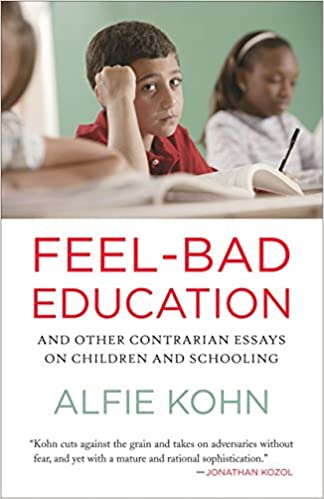
Feel-Bad Education: And Other Contrarian Essays on Children and Schooling by Alfie Kohn

Wednesday, July 13th, 2011
Feel-Bad Education

Feel-Bad Education: And Other Contrarian Essays on Children and Schooling by Alfie Kohn (Beacon Press: Boston, MY ©2011) is his twelfth book where he argues that our schools are in the grip of a “cult of rigor” where harder is confused with better. Joy and meaningful learning are at risk. In nineteen recently published well-researched essays, Kohn invites us to think beyond conventional wisdom. He questions much of what schools reflexively do and makes the reader understand why many current reform efforts are misguided. If you believe that NCLB and Race to the Top efforts make sense, you need to read this book. It will give parents and educators alike a fresh perspective they can use to shake the system for the better. Click the button below to purchase from Amazon.

”Well, Duh”: Obvious Truths We Shouldn’t Ignore

  • If we agree on something, why do schools function in a contrary manner? Kohn gives us more than a dozen. If you have more, let him know. 1) We require students to memorize material they soon forget. You are more likely to retain the knowledge you acquire pursuing a project than preparing for a test. Professional development also often involves the worst passive practices. 2) Knowing facts doesn’t make you smart and fact-oriented learning may interfere with your becoming smart. 3) If kids have different abilities, why to we teach them all the same? Lock-step curriculum and uniformity are valued by many leaders. 4) Students are more likely to learn if they are interested. Education isn’t like bad-tasting medicine. If we were turned off by an educational approach, perhaps we shouldn’t use it. 5) Students are more likely to be interested if they have some say.

More Duhs

  • 6) Just because something raises test scores doesn’t mean it should be done. Also, the more time you spend preparing for a test, the less meaningful the results will be. 7) Students are more likely to succeed if they feel known and cared about. They also need to be healthy and well-feed. 8) We want children to develop in many ways, not just academically. 9) Harder work isn’t necessarily better. It is likely to be frustrating. Pressure will also cause students to seek easier tasks. 10) Kids aren’t short adults. We have seen an increase of developmentally inappropriate instruction with more sit-still-and-listen for younger children. 11) Policies that benefit large corporations aren’t necessarily good for children. 12) It’s substance not labels that matter. If your PLC focuses on cramming for tests, what good is it?

Progressive Education: Hard to Beat-Hard to Find

  • While progressive education has many definitions, Kohn notes that it usually features hands-on learning, multiage classrooms, mentor-apprentice relationships, attention to the whole child, learning in a caring community, and an organization that features problems and projects rather than lists of facts and separate disciplines. Learning is active and the flexible curriculum considers the children’s interests. Kohn sites research that shows progressive education as more productive and efficient. Unfortunately, progressive education is also rare. It is harder to do and more demanding on the teachers. Teachers must give up total control and be comfortable with uncertainty. The pressure of NCLB testing is also a barrier even though there is no evidence that it works.

Challenging Students to Challenge

  • In this chapter Kohn touts the idea of teaching by doing and encouraging students to critically challenge ideas they encounter. Teachers should let students watch them write so they can see the process in action. Critical thinking helps students spot fallacies and develop a set of analytical thinking skills. Teachers, however, are more likely to focus on compliant behavior rather than raising rebels who can disagree as long at they have rational. How many kids would need treatment if excessive compliance was considered a disorder? Students need to also challenge their own beliefs so they can reorganize their thinking in light of new evidence. This is Constructivism 101. Making students feel comfortable challenging the status quo requires the right classroom culture. Unfortunately, many professors who espouse this approach use traditional teaching methods themselves.
Share this:
Share this page via Email Share this page via Stumble Upon Share this page via Digg this Share this page via Facebook Share this page via Twitter Share this page via Google Plus

Managing the Millennials – Revised in my new format

Thursday, July 7th, 2011

Managing the Millennials: Discover The Core Competencies for Managing Today’s Workforce by Chip Espinoza, Mick Ukleja, & Craig Rusch is a must read for leaders, teachers, and parents who have to deal with a generation raised at a very different time. It is based on abundant research and a two-year study conducted by the authors.

Espinoza, Ukleja, and Rusch

  • Chip Espinoza: CEO of GeNext Consulting – Leadership teacher at California State University, Long Beach
  • Mick Ukleja, PhD: President of LeadershipTraQ and founder of Ukleja Center for Ethical Leadership at California State University, Long Beach
  • Craig Rusch, PhD (in social networks): Professor of Anthropology at Vanguard University in Costa Mesa, California.

The Generations

  • Before the boomers there were the builders. They were the generation who experienced the great depression and the second world war. They were the first generation to enter college in big numbers. Hard work, delayed gratification, and automatic respect for authority were common. They often spent their entire career at one company.
  • Then came the baby boomers. They were born from 1946 to 1964 and number about 80 million. They grew up with the Vietnam War, the Cold War, the Civil Rights Movement and Women’s Liberation. They grew up with television and rock and roll and were the first with common access to recreational drugs. The moon landing gave them confidence that they could do what they set their minds to. Technology expanded, but they used it mostly to do more work, not less.

The Next Generations

  • Generation X: Born between 1965 and 1977, this generation experienced a tripling of the divorce rate and both parents working. MTV, video games, and computers all made their mark. They used technology for a work-life balance and grew accustomed to moving around and autonomy. They could easily do their work on the beach.
  • The Millennials (Generation Y): Born between 1978 and 1996, they make up more than 25% of the population and have been shaped by terrorism, cell phones, and social networking. Technology is an integral part of their lives and they crave instant feedback. They are use to parents who praise them and tend to abstain from sex and drugs more than Gen X. They work well in teams and like diversity.
Share this:
Share this page via Email Share this page via Stumble Upon Share this page via Digg this Share this page via Facebook Share this page via Twitter Share this page via Google Plus