
Author Archive

Treating ADHD with Music Therapy by Charles Carpenter

Sunday, January 14th, 2018

Music Therapy

The Power of Music

  • Say it’s been a bad day. You had struggles at work or school. You were late to an important appointment or you had a falling out with a friend. What is one thing that can make it better? For most people, putting on the right music can help make things better no matter how hard a time they are having. That’s the power of music.
  • Music therapy harnesses that power as a way to use it as a therapeutic tool. It’s a non-invasive treatment used to stimulate parts of the brain to produce results. With the help of music, therapists can help people with issues such as chronic pain, mood disorders, and other serious conditions including autism, depression, and Alzheimer’s disease. For children with attention-deficit/hyperactivity disorder, or ADHD, music therapy can be a helpful tool to strengthen social skills, ease hyperactivity, increase focus, and reduce impulsiveness.

Music Therapy and ADHD

  • One of the theories behind music’s efficacy for treating ADHD is its inherent structure. Music is made of patterns, mostly its rhythm, but also in lyrical structure and repetition in melodies. Music has a clear beginning, middle, and end. Listening to it helps a brain with ADHD stick to a linear path. Doing that again and again trains the brain to be more comfortable sticking to an idea all the way through. The child with ADHD learns to plan, anticipate, and react.
  • Listening to music helps the ADHD patient become more collaborative and social as well. Listening to classical music, for instance, teaches a child that all contributing instruments in the orchestra are necessary to create a cohesive piece. Participating in band becomes a real life application where they take turns, anticipate changes, and become better at picking up other people’s cues.
  • When the brain hears music, synapses begin to fire. Neurochemicals such as dopamine increase, which helps regulate attention, increase motivation, and improve memory. This can help balance the ADHD brain without the use of drugs. Over time, the chemicals and synapses build up and activate to improve overall brain function.

How to Interest Your Child in Playing Music

  • If you think music therapy–in particular, learning to play an instrument– could be a helpful tool for helping manage your child’s ADHD, there are several ways you can increase his or her interest. The most important thing is picking the right instrument. Start with something basic as to not intimidate or overwhelm your child. If he or she is interested in brass instruments, they can start with a student trumpet to learn how to read music and improve their fingering. As their skills advance, you can trade up instruments.
  • You are the biggest source of structure in your child’s life. When it comes to encouraging a skill, it’s important to show your child that you are involved as well. The more actively engaged you are, the less likely they will lose interest and become distracted. While they will undoubtedly have to learn songs they are not interested in at school, encourage them to learn their favorite tunes as an extracurricular activity. This will make the experience more their own, and less a lesson plan, and will pique their interest.
  • Music has the power to change your mood and even alter your brain chemistry. Music therapy is the practice of using that power to help make life better for people with mood disorders, chronic pain, and other serious conditions. Children with attention-deficit/hyperactivity disorder (ADHD) benefit from the structure, social aspects, and brain chemistry boosting effects of music. To hold your child’s interest in playing music, start small with a simpler instrument that will not overwhelm them. Stay active and interested in their development and encourage them to have fun with music by learning to play songs they love outside of formal lessons.

Charles Carpenter

  • Charles is the father of a son with ADHD who loves to share the benefits of music therapy with other parents of children with ADHD. He created Healing Sounds because he believes in the healing therapeutic power of music, and wants to spread the word. He is located in San Antonio, TX and you can email him at information@healingsounds.info. Thanks Charles.
Share this:
Share this page via Email Share this page via Stumble Upon Share this page via Digg this Share this page via Facebook Share this page via Twitter Share this page via Google Plus

The Testing Charade: Pretending to Make Schools Better by Daniel Koretz

Tuesday, January 2nd, 2018

Testing Charade

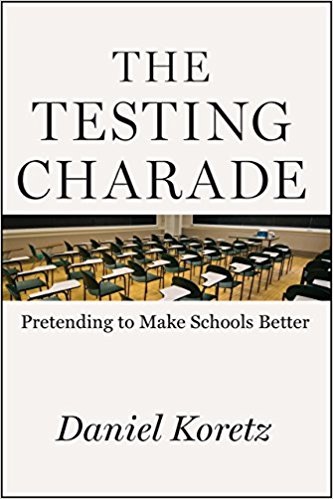
The Testing Charade: Pretending to Make Schools Better by Daniel Koretz covers the unintended negative consequences of the test-based school and teacher accountability system forced on schools by federal legislation. In addition to outright cheating, he also points out how test prep leads to bad teaching and how non tested subjects are given short shrift. As policymakers remain in denial about the failure of this system, it is works like this that give us hope.

1. Beyond All Reason

  • Pressure to raise scores on achievement tests dominates American education today. In this book Daniel Koretz shows how it has lead to cheating, cutting corners with test prep that features bad instruction, and failure. Teacher evaluation is a mess with some teachers being judged by scores from students they didn’t teach. Test prep has lead to score inflation that is not echoed on NEAP tests. NCLB was a train wreck waiting to happen and it’s replacement, ESSA, is only a small step in the right direction. This book should help us all redouble our efforts to fight a system that has had a large negative impact on our national education system.

2. What Is a Test?

  • Achievement tests are like political polls in that they only test a small portion of the domain represented by the course or grade level. Most of the domain remains untested. Tests focus on factual knowledge as it is easy to test. Some things like critical thinking and problem-solving can be assessed, but not by standardized tests. Sampling content to be tested has three consequences. First is the error or uncertainty of the resulting scores. This can result in scores varying wildly from year to year for a given teacher. Second is that the sample skills tested are not fully representative of the entire domain.
  • The final and biggest consequence is that even the test makers warn that test scores should only supplement all of the other assessments teachers use. Unfortunately, such warnings are ignored by policymakers or never heard in the first place. This leads to many teachers only teaching the tested content while depriving students of other useful instruction.

3. The Evolution of Test-Based “Reform”

  • In 1983 the National Commission on Excellence in Education published A Nation At Risk, that viewed our education system as containing a rising tide of mediocracy noting short school years, a weak teaching force, and undemanding curricula. This seems to have initiated the push toward state-mandated testing. This shifted the focus away from holding students accountable for scores to using students’ scores to hold educators accountable.
  • In the 1990s the pay-and-punish approach became popular where schools were rewarded or punished as a result of test scores. In 2002 NCLB made this system national in scope. Schools were required to make Adequate Yearly Progress for all student groups of significant size. Obama’s administration made things worse by tying test scores to teacher evaluations. Due to gridlock in Washington, NCLB wasn’t updated until 2015 with the Every Student Succeeds Act (ESSA). This gives states more flexibility, which may make things better at least in some states. The focus on test scores will most likely remain.
  • The system fails for three reasons. 1) It focuses on a narrow slice of practice and outcomes. 2) It is a very high-pressure system. 3) There is no room for human judgment. Teaching is far too complex a job to evaluate without any judgment, and many things we value in schools aren’t captured by tests. If expectations were too low prior to 1983, it’s clear that today expectations are unrealistic for many of the students the laws were designed to help.
Share this:
Share this page via Email Share this page via Stumble Upon Share this page via Digg this Share this page via Facebook Share this page via Twitter Share this page via Google Plus

Happy New Year – Check Out My New Book

Monday, January 1st, 2018

May your 2018 be all you and those you love expect and need. Take time to rest and recharge, and set some new goals. One of my goals for 2017 was to finish and publish a book. I hope you will consider picking up a copy and sharing it with anyone you know who has the power to make some needed changes. It’s time to move past one-size-fits-all instruction and a failed test-based accountability system among other things. Join me in this vital fight.

Thanks so much for your support and if you are looking for some New Year’s diversion, check out my previous posts and archives. Happy New Year and God bless.

Rocket Science Book

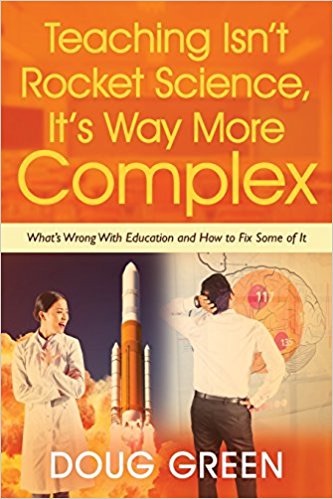
Teaching Isn’t Rocket Science, It’s Way More Complex: What’s Wrong with Education and How to Fix Some of It by Doug Green

Share this:
Share this page via Email Share this page via Stumble Upon Share this page via Digg this Share this page via Facebook Share this page via Twitter Share this page via Google Plus

Counting What Counts: Reframing Education Outcomes by Yong Zhao & Friends

Tuesday, December 19th, 2017
Counting

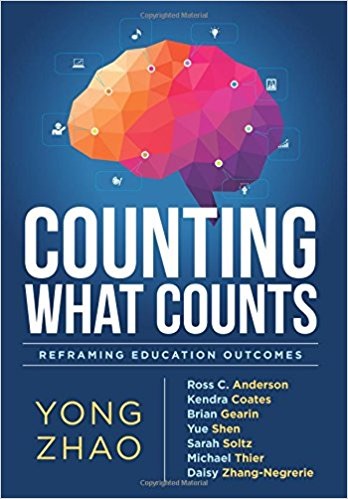
Counting What Counts: Reframing Education Outcomes by Yong Zhao and friends takes on the current system with its focus on standardized tests and their sole focus on cognitive skills. Chapters are devoted to defining a variety of non-cognitive skills that are connected with success in life and the current status of how to assess them. They make a case for a new paradigm that would move the system towards more personalized learning and assessment with more focus on non-cognitive skills. Be sure to add this fine book to your professional development library.

Introduction – The Danger of Misguiding Outcomes: Lessons From Easter Island – Yong Zhao

  • Yong uses the story of how the natives of Easter Island overexploited the resources in a race to build ever bigger statues. He compares this to the current race to produce students with excellent tests scores. Here he makes the case that the obsession with test scores has and will continue to damage our education ecosystem. It has resulted in cheating, teaching to the test, focusing on students on the pass/fail border, and limiting the focus on subjects not tested. We are destroying teacher autonomy as we ignore real challenges like poverty, unsafe neighborhoods, and unequal access.
  • We are striving to produce a homogeneous population rather than supporting diverse talents. Routine knowledge and skills are stressed and they can easily be outsourced or automated. There are many negative side effects that are not considered unlike drug companies that must evaluate and publish side effects of their products. Creativity and non-cognitive skills are ignored. Students good at taking tests might not be good at anything else.

1. Numbers Can Lie: The Meaning and Limitations of Test Scores – Yong Zhao

  • Humans are too complex to be reduced to a single number, and such numbers should not be used to make life-changing decisions. Research indicates that IQ tests have limited predictive power. Personality variables like high and stable self-esteem appear to be decisive for life success. SAT and ACT tests are much less predictive of college success than a student’s high school GPA. After many years, the Common Core Standards don’t appear to make students college ready, while motivation, time management skills, and awareness of postsecondary norms and culture do.
  • A look at international tests shows that U.S. students have been bad at test taking for a long time. Such scores would suggest that by now the U.S. would be an economic backwater, but the facts suggest otherwise. It’s possible that countries that obsess about tests more than we do have discouraged the cultivation of creative and entrepreneurial spirits.
Share this:
Share this page via Email Share this page via Stumble Upon Share this page via Digg this Share this page via Facebook Share this page via Twitter Share this page via Google Plus

Ways To Prepare Students For Jobs That Don’t Exist Yet by Catrin Cooper

Friday, December 15th, 2017

Dream Job
Ways To Prepare Students For Jobs That Don’t Exist Yet by Catrin Cooper will help students, parents, and anyone with a job at risk of automation understand the type of skills and knowledge they need to develop as old jobs disappear and new ones take their place. Educators should also pay attention to these concepts as they develop future lessons.

Introduction

  • A decade ago, social media manager was just an imaginary job title to most of us, and so was mobile app developer. With the increasing popularity of social media and the accelerating pace of technology, most of the children today will have jobs that don’t exist yet. This makes it difficult for kids to know what to study when it comes to future careers. So, how can you prepare your kids for a future career that no one can predict yet? The answer is to give young people the vital skills to adapt.

Complex problem-solving skills

  • Scientific knowledge and literacy, as well as numeracy, are still vital. However, executives from world’s leading companies think that complex problem solving is the number one job skill in 2020 and beyond.
  • Kids with strong problem-solving skills can have a promising career. Problems are always the center of what people do at work each day. Being a problem solver is vital to your success. With this skill, you can solve a problem quickly and effectively.
  • Students must learn how to use tools and techniques that can enhance their approach to solving the problems faced by teams and organizations. If you are more successful at solving problems, you will be more successful at what you do. It’s vital to build a reputation as one who can handle tough situations in a positive way.

Critical thinking

  • Can you analyze how you think and present evidence for your ideas? Mastering this skill will give you better control of your learning and empathy for other points of view. It is self-directed and self-disciplined thinking. It can help you in communicating effectively and solving problems more efficiently. Critical thinking is a vital skill so that you can think clearly and rationally. This skill is vital in research, blockchain in real estate, finance, and the legal profession. However, it is not restricted to these areas. If you can think well and solve problems, then you have an asset that you can use for any career that you wish to follow.
  • This skill involves logic and reasoning. You need to use it to interrogate a problem, consider solutions to the problem, and weigh the pros and cons of every approach. A few years from now, organizations will see individuals with critical thinking skills as highly employable.
  • How can critical thinking be integrated into a curriculum? Essay writing is a tried-and-tested method to help students engage in the critical thought process. But there are other more tools available.

Collaborative skills

  • Humans could not have risen to prominence by working alone. That’s why students have to learn how to collaborate with others and develop that skill. In a modern workplace, teamwork is increasingly vital. Having social skills is also critical. Over the years, companies have put more emphasis on the interpersonal skills of their employees.
  • Learning how to collaborate with others is vital in any work environment, and it is a skill that humans are still better at than robots. Keep in mind that in a workplace, interaction is critical. Workers support one another’s strengths, and they adapt flexibly to various circumstances. This non-routine communication is always a human advantage.
  • But to coordinate with others, you need to have strong communication skills. It is a skill that requires awareness of people’s strengths and weaknesses. Furthermore, you need to practice working with different personalities.

Creativity

  • There are always new products and new technologies. Thus, employees will need to be more creative to benefit from those changes. Although robots can help us in getting what we want and put some at risk of losing their jobs, they are not as innovative as humans.
  • In the future, creativity is a key skill when looking for a job. Just because you consider yourself as a non-creative person, you should remember that it is not exclusive to musicians, artists, and writers. Creativity means that you can connect the dots using diverse information to pull ideas together to have a new idea.

People management

  • Even though most tasks in the future are automated and utilize advanced AI, employees will still be a critical part of a company. That’s because humans are more creative than robots. They are better at reading one another. Plus, they support each other’s ideas and energy. Unfortunately, humans get sick and distracted.
  • Hence, companies will need managers and team leaders who know how to motivate their teams and maximize their productivity. In that way, they can easily respond to their needs. To be a great manager, you need to enhance your emotional intelligence and learn how to delegate tasks. Furthermore, you should develop your management style. Consider taking a leadership course or two and pick up some leadership books.

Ability to help people

  • Having a service orientation is a skill that most companies will need today and in the future. If you have strong skills in this area, you can easily spot and anticipate the future needs of customers. Businesses in the energy department, for instance, would face consumer concerns about carbon footprints, food safety, and labor standards. Companies will have to learn to anticipate new consumer values so that they can translate these issues into product offers.
  • With a service orientation, you can step into the minds of users and know what they value, dislike and fear most. From there, you can develop new products or adapt a service to future proof your brand.

Being flexible

  • This is about being a mental gymnast. Cognitive flexibility is about how quick you can swing and twirl back and forth from one system to another. You need to be limber to see new patterns and make a unique association of ideas easily. To flex your cognitive muscles, you should learn new things every day and learn new ways to think. For example, you can learn an instrument or try an art class. Or you can read The Economist or The Economic Review to know about financial markets.
  • When you expand your interests and go outside your comfort zone, you are embracing people who are challenging your worldviews. Doing it every day will prepare you for a job that does not exist yet. And your brand will thank you for it.

Negotiation skills

  • Robots may be good at automating jobs, but they do not have social skills, which will be a more important skill in the future. Humans are better at social interaction. We’re also better at negotiations than robots. Even if you are in the technical department, you need to show better interpersonal skills and be able to negotiate with clients, teams, and managers.

Catrin Cooper

  • Catrin is blogger and freelance writer from New York. She’s always ready to cover topics related to personal development, marketing, and education. Feel free to contact Catrin at catrincooper99@gmail.com. Her guest posts are free so don’t miss an opportunity to add some value to your blog.
Share this:
Share this page via Email Share this page via Stumble Upon Share this page via Digg this Share this page via Facebook Share this page via Twitter Share this page via Google Plus