Archive for the ‘Book Summaries’ Category
Monday, December 24th, 2018
Get It Done: The 21-day Mind Hack System to Double Your Productivity and Finish What You Start by Michael Mackintosh offers sound advice for people prone to procrastination and who suffer from the endless disruptions that exist in our hi-tech world. If this sounds like you be sure to get a copy along with one for your school’s professional development library.
Introduction
- This book is aimed at creative entrepreneurs but I believe that educational leaders can learn from it as well. It makes very big promises, but depending on where you are it should help you focus on what’s important, increase your productivity, and finish your most important projects. It also reminds us all to build in time for rest, relaxation, and celebrating our accomplishments.
Part I – 11 Essential Mind Hacks to Make Things Happen
- 1. The Prolonged Pain or the Short-Lived Pain: If you continue doing things that are inefficient and less effective you are inviting long-term pain. Change in the near term can be painful too, but if it leads to success you won’t have to deal with it in the long-term.
- 2. The Defining Choice: Acting differently and thinking differently is a choice. Keep in mind it is the only way you are likely to get different results.
- 3. The 80/20 Rule: This rule states that 80% of your input or effort leads to 20% of your outputs or results. Therefore, the opposite has to be true that 20% of your effort leads to 80% of your results. The trick is to identify the activities that produce 20% of your output and either do them less or do them when you are not so sharp.
- 4. Good is Good Enough: The old saying “the perfect is the enemy of the good” applies here. It is important sometimes to stop when you have reached the good enough point in a job unless it’s a job that has to be perfect like a computer program.
- 5. The Delusion of Time Management: The idea here is that you only have NOW in terms of doing something. Even if you are thinking about the future you are doing it NOW. Trying to micromanage your schedule is not likely to lead to great productivity. Rather than thinking about managing time, think about managing your thoughts, words, actions, energy, and focus. As you move through the day ask if what you are doing is moving directly toward your goals. Make your most important work a priority. Organize your day to make the most of your energy. If you are a morning person like me, save the most important work for the morning. (Doug: Yes, I’m writing this in the morning.) Recognize when you are a tired, hungry, or distracted and do what it takes to recharge. It’s not how much time you put into something, it’s how much high-quality energy you invest.
- 6. The Resistance: You can’t do something new, significant, and meaningful without resistance so get ready for it. Some can come from your lower self that is comfortable with the status quo. Be alert and look for it within and without so you can take it on.
- 7. Fears and Hallucinations: Fears can be real or irrational. They can be healthy and necessary for success. They can also arise when it’s not required. Unconscious fears include the unknown, failure, and not being good enough. Once you identify them you can accept that they only exist in your mind. This should help prevent the destructive worry that come with them.
- 8. Focus: You don’t want to try to make all of your dreams come true at the same time. The idea here is to bring one idea to completion before you begin another one. Fear could be part of the problem for people who try to do too many things at once.
- 9. How to Overcome Self-Doubt: This can sabotage you before you begin. Michael suggests that you focus on the people who will be helped if you complete what you are doing and realize that self-doubt, like most fears, is also irrational.
- 10. Do It Now: Everything happens in the now, and now won’t last forever. This should help you get going and avoid procrastination.
- 11. Do Less Work to Get More Done: You don’t do your best work when you work too hard. You are more likely to make mistakes and quality is likely to go downhill. Be sure to build rest and recharge into your game plan. Sleeping on a problem or just taking a walk can help you solve it. You are also more likely to screw up your family life and other important relationships. You still have to work hard, but working too hard can even make your sick.
Posted in Book Summaries, Business Books, Leadership Books | Comments Off on Get It Done: The 21-day Mind Hack System to Double Your Productivity and Finish What You Start by Michael Mackintosh
Monday, June 22nd, 2020
Girls and S*x: Navigating the Complicated New Landscape by Peggy Orenstein tells the real story of what it’s like being a girl from middle school to college in today’s highly sexualized climate. Peggy scoured current research and had in-depth interviews with over seventy high school and college girls to compile this gripping and sometimes discouraging story. I first listened to the book on Audible prior to buying the physical cook for this summary. I just got Boys and S*x and will post my summary soon. I use the asterisk to avoid having Google Ads not post ads for these reviews.
Introduction
- For this book Peggy interviewed more than seventy young women between the ages of fifteen and twenty, which is when most become sexually active. The group was diverse in terms of religion, politics, race, family composition, wealth, and sexual identification. They were, however, self-selected but all were hungry to talk about things like masturbation, oral sex, orgasm, and the complicated terrain of the hookup culture. Fully half experienced something on the coercion to rape spectrum.
- Despite seismic changes in expectations and opportunity, they are still subject to the same old double standard. Sexually active girls are “sluts” while boys are “players.” Good girls are shamed as virgins and prudes. Here the opposite of a negative is still a negative. Peggy found that the conversations changed her. In preparation, she also reviewed the literature and talked to psychologists, sociologists, pediatricians, educators, journalists, and other experts.
1. Matilda Oh Is Not an Object – Except When She Wants to Be
- At least some boys are very abusive with language, social media use, and even physical touching. Authorities often make things worse with actions that blame the victim. Blaming girls’ clothing for the thoughts and actions of boys, for example, is counterproductive and only a step from “she was asking for it.” Girls often engage in self-objectification, which can lead to depression and lower self-esteem. They learn that as females they need to project sex appeal. In addition to striving to be smart, nice, and friendly, they need to do it all while looking ‘hot’. As a man, Bruce Jenner used his body to win gold. As a woman, Caitlin Jenner displayed her body for attention.
- Girls are also more likely to use social media to show off their bodies with or without sexy clothing and are quick to tell each other they look hot. They are twice as likely to be coerced to send sexts as early as middle school, and many consider it to be safe sex. Thanks to celebrities like Kim Kardashian, the butt has become the latest body part to reduce women to objects. Unfortunately, Kim and her fellow divas encourage young girls to package their sexuality.
- The behavior of many popular celebrities like Miley Cyrus has lead to many young women dressing and behaving like the people they see on screen. Seventy percent of prime-time TV now contains sexual content. Movies also affect how girls and boys behave when they get together for parties.
- The role of pornography has also had an impact. Almost all boys watch it, which changes their expectations when it comes to having real sex. A lot of porn scenes feature the denigration of women as well. Like it or not, porn has a very large role in sex education for this generation. For many, it’s how they learn what sex is. To them, things like oral and anal sex are the norm. Porn also adds to the objectification of girls promoted by other media. Competing with porn stars can cause some girls to believe that they need to put on a show to keep a partner’s interest.
Posted in Book Summaries, Education Books, Leadership Books | Comments Off on Girls and S*x: Navigating the Complicated New Landscape by Peggy Orenstein
Saturday, July 18th, 2020
Grading, Reporting, Graduating…and the Law by Miriam Kurtzig Freedman is a quick read that can help educators and parents learn about what the law requires so that parents can get their children what they deserve and so educators can obey the law and stay out of trouble as they provide their students with the services they are entitled to. Every school should have several copies.
Introduction: You’re kidding! Another law book for educators and parents! We’ve had enough!
- The goal here is to bridge the gap between the worlds of law and education and I feel that Miriam succeeds. The Every Student Succeeds Act (ESSA)requires that states develop a multiple-measure accountability system for all students. Schools need to communicate in plain language about how their children are doing. It needs to include WHAT the student studies and the level of difficulty. The law also prevents the school from reveling the students’ status. Each course has its own standards, while each child has their own needs. About 80% to 90% of students with disabilities have mild to moderate needs and can be taught in the regular classroom. That is the group that this book mostly deals with. The other 10% to 20% have profound needs, have alternate assessments, and alternate standards.
What are the legal requirements for grades and report cards, and setting policy for all students, general and special education?
- Although federal mandates have increased, education is a power that the constitution has left to local and state control. They must set clear standards, and if they do, the courts will back them up. This book contains many summaries of important court cases that help with understanding what schools must do and how to do it. Schools act as their state’s agents to provide public education and each student has the right to due process. Diplomas are property rights, but promotion and retention are not. Due process requires that high-stakes tests are also fair tests in that they measure what students had the opportunity to learn.
- States and local schools develop policies for these issues: class selection and eligibility, grades and report cards, promotion and retention, attendance requirements, gifted/talented programs, transcripts, honors, diplomas, graduation requirements, graduation ceremonies, waivers, and whatever else the school deems necessary. They proactively define course content, difficulty, performance standards, and how students are graded.
Getting more specific about grading policies and promotion/retenion
- Schools are in charge of determining grading Standards and policies. In order to earn regular grades, special education students need to meet the same standards even if their learning is adapted. Courts and hearing officers do not generally have the authority to change grades. Modified grades can be given if a student’s work is substantially different from general education standards even if they are in regular education classes. Such decisions are part of each student’s IEP. Weighted averages can be used if different courses in the same discipline have different degrees of difficulty. How difficult a course is for a particular student doesn’t matter. Schools must have clear course selection policies. Objective promotion and retention policies also need to be in place. Students should be retained for not doing the work, not because of a disability. Attendance policies apply equally to all students.
For students with disabilities: Section 504, ESSA, and the IDEA
- You can’t discriminate against any student simply because of their disability. Students are “otherwise qualified” if they can meet the essential requirements of a course or program. Fundamental alterations lower the standard or requirement. They don’t level the playing field, (accommodations) they change the game (modifications).
What are accommodations and modifications?
- You give students accommodations so they can meet regular course standards and requirements. You use modifications to lower the standards and requirements when necessary. These terms are often misused. Together they are things schools do for students with disabilities that they don’t do for general education students. Tests must accurately reflect what a student knows or is able to do in order to be valid. Accommodations provide access to students without lowering standards. They must not invalidate test scores. Schools may add accommodations to report cards, but not to transcripts. They should not result in adjusted grading and should not offer an unfair advantage.
- Modifications provide access also, but they do so by lowering standards and expectations. Modified curricula are not allowed. Rather, modifications are made on an individual basis as part of constructing IEPs. Both report cards and transcripts should record the use of modifications. Be careful about going overboard. This idea is to assist the children to learn, not to do the work for them.
Report cards, transcripts, honors, graduation, and diplomas: What’s okay?
- There are situations where schools do too much in the way of accommodations. An example would be giving a student a calculator rather than teaching him basic math computations. Accommodations and modifications should be designed to help the student reach his IEP goals, not pass a test or course. Students can be denied access to gifted programs as long as the criteria are objective. They cannot exclude students simply because they are classified or ELL. The same is true for school honors.
- A student’s special education status may be revealed on the report card as only parents see it. It can not be revealed on a transcript as it is seen by third parties. Focus on what the student studied and achieved, not WHO the student is. Any deviation from course standards must be spelled out in the IEP. Parents must be informed in Plain English. IEPs and 504 plans rise to the level of federal law and districts must implement them, so don’t promise what you can’t deliver.
Graduation requirements: Graduation, ceremony, diplomas
- Graduation requirements are set by the state and include courses, graduation tests, and attendance. Services end at graduation. All IEP goals need not be met for a school to graduate a student. Also, meeting all IEP goals does not guarantee a diploma. Parents must receive written notice prior to graduation. The contents of such notice are listed in this chapter. Transition planning must occur prior to graduation. Schools have the discretion to develop their own commencement ceremony criteria. They can also award a variety of diplomas to accommodate students who can’t earn a regular diploma.
Miriam Kurtzig Freedman
- Miriam is an attorney and former teacher who works with people who want better schools. As an immigrant to America at elementary-school-age, she was empowered by public schools and works to help educators teach all children. She works for the Boston firm of Stoneman, Chandler, & Miller where she gives lively and practical presentations, training, and consultations. She co-founded Special Education Day, authored eight books, and has written for many national publications. If you are interested in her presentations visit schoollawpro.com and contact her at miriam@schoollawpro.com.
Posted in Book Summaries, Education Books, Leadership Books | Comments Off on Grading, Reporting, Graduating…and the Law by Miriam Kurtzig Freedman
Monday, February 8th, 2021
Grasp: The Science of Transforming How We Learn by Sanjay Sarma with Luke Yoquinto tells the story of teaching and learning during the last hundred plus years. They explain what works and what doesn’t. They make it clear that learning should be spaced rather than crammed at the last minute, that different concepts should be interleaved, and that the effort one uses to retrieve memories helps reinforce them. While we need to teach hard facts, we also need to let students use their hands to wield them. This book is a must-read for teachers and learners alike and would make a great textbook for any introduction to education course.
Introduction: The Adventure Begins
- The big metaphor used here is the educational winnower. From the beginning, education is designed to sort students into gifted programs and elite schools. We think we are testing aptitude when we are mainly testing a student’s environment and experiences. At the end of the trail is the opportunity to innovate, which mostly ends up in the hands of males from wealthy homes (patent-holding inventors). In addition to gender, the great winnowers include poverty, expectations, and environments that lack access to language and feature lots of stress. In our efforts to standardize education we have made it too damn hard. We need to shed the myth that serious learning must be difficult and use what we know about the brain to make it more user friendly so we can save more students from the winnowing process.
Part One: Learning Is Science and Science Is Learning
1. The Learning Divide
- Through the lens of a robotics course at MIT we learn that any education scheme worth its salt must not only deliver knowledge but do so in a way that is highly engaging. It must activate that knowledge so its owner can do real work in the world. Next Sanjoy plots the path that education took from the beginning of the twentieth century away from the holistic approach of John Dewey towards the reductionist path of Edward Thorndike. This lead to standardized education where repetition ruled based to an extent on behaviorism. IQ tests were used to sort students into tracks and if you weren’t sorted into the college track, you weren’t going to be prepared for college. Not only is this approach racist and classist, but it also conflicts with how people really learn.
2. Layer One: Slug Cells and School Bells
- It is well established that spacing out your study rather than cramming all a once leads to more retention. This is even true for invertebrates without brains. Here we encounter Eric Kandel’s work with the large neurons in sea slugs. This lead to a Nobel prize for describing the connection between memory and the action of individual neurons. Repetition creates more connections known as synaptic strength. The concept of interleaving suggests that while you are putting space between learning efforts on the same content, you should work on learning another subject. It seems that universities feature a few high-stakes tests each semester with no return to the content in subsequent semesters in many disciplines. This goes against what we know about the spacing effect. Corporations, however, seem to know better as they teach and test frequently. This is due to the fact that their employees must understand the key concepts.. It’s clear that frequent low-stakes quizzes that continually call back earlier material promote efficient learning.
Posted in Book Summaries, Education Books, Leadership Books | Comments Off on Grasp: The Science of Transforming How We Learn by Sanjay Sarma with Luke Yoquinto
Monday, August 7th, 2017
Grit: The Power of Passion and Perseverance by Angela Duckworth shares her research and the work of others on the subject and explains that what we eventually accomplish depends more on our passion and perseverance than on our innate talent. This work can help you find your own passion and develop it. This is a vital book for parents, teachers, and human beings in general. Make sure your school library has at least one copy for starters.
1. Showing Up
- Angela starts with the story of her visits to West Point’s summer session for incoming freshman known affectionately as Beast Barracks. Due to the high dropout rate of plebs, the question was: what qualities are the best predictors of who makes it and who goes home early? The only metric the Army had was the Whole Candidate Score. It combined SAT/ACT scores, class rank, an expert appraisal of leadership potential, and performance on objective measures of physical fitness. The problem was that this score had no predictive value when it came to surviving the first summer or the full four-year program.
- What candidates needed it seems, was a never give up attitude, which had nothing to do with ability. When Duckworth heard this she decided to create an instrument to measure it. She then created the Grit Scale, which is included on page 55. She found that it was a good predictor for West Point. It also turned out to be a good predictor for other accomplishments such and earning college degrees. She found that there was no relationship between IQ and grit.
2. Distracted By Talent
- As a teacher early in her career Duckworth discovered that talent for math was different from excelling in math. She also found that her weakest students sounded smart when talking about things that interested them. She found that Americans endorse hard work five times more than intelligence. However, teachers are more likely to lavish attention on students they think are talented. Another problem is associated with tests for talent, which like tests for grit are imperfect.
3. Effort Counts Twice
- After being chided by her advisor while working on her PhD in psychology, Duckworth came up with two equations. Talent x Effort = Skill, and Skill x Effort = Achievement. Note that effort is included in both equations. While this theory does have a place for natural ability, it shows how effort is more important. This chapter gives examples of famous people who felt they succeeded thanks to their compulsive effort. In addition to talent and effort, there is also a place for opportunities and luck on the road to success. Encouraging parents with money are a prime example of opportunities.
Posted in Book Summaries, Business Books, Education Books, Leadership Books | Comments Off on Grit: The Power of Passion and Perseverance by Angela Duckworth
Monday, May 28th, 2012
Growing Up Global: Raising Children to Be At Home in the World (©2009, Ballantine Books: New York, NY) by Homa Sabet Tavangar will help you prepare children for today’s increasingly interconnected world. This is a hands-on, one-of-a-kind parenting toolbox that will give children a vital global perspective. This is a book that parents, grandparents, and educators can turn to again and again for inspiration and motivation as they strive to open the minds of children everywhere. It will also help adults gain global awareness as becoming a world citizen is a lifelong process. As it’s never too late to get started, you can start by clicking below to purchase this outstanding resource from Amazon. Every school and home should have one.
Tags: Growing Up Global, Homa Tavangar, Raising Children
Posted in Book Summaries, Education Books | Comments Off on Growing Up Global: Raising Children to Be At Home in the World – Book Summary
Wednesday, February 3rd, 2016
Goodbye, Grades; Hello, Growth
- When she started her new system, Starr found that her lower-level students liked the idea of not being judged as they lacked success with the traditional system. Rather than assigning additional nightly homework, students just continue working on the projects they were working on in class. Top students had to realize that top grades had little to do with learning and were more about their need to feel smart. Portfolios of work are key here and you can make YouTube videos to display student work. When grades are required, you can let the students work with you to determine grades together. More important is ongoing feedback from the teacher and other students.
Hack 1: Shift the Grades Mindset
- Changing how students think won’t be easy and will take time. Starr teaches seniors who have been living in a grading culture for a long time. In essence, you need to promote a growth mindset. For more on this topic see my summary of Carol Dweck’s Mindsets. Expect ongoing discussions and be ready to redirect the conversation to remind students that learning has no grades. Ask “what did you learn, what can you do now you couldn’t do before, and how do you know.” Be sure to make the standards clear, give examples of mastery, and use frequent feedback. Students should submit reflections and self-evaluations about what they learned compared to the standards. Eventually Starr’s students stopped worrying about grades and became more excited and eager to try things as they had been when they were younger.
Hack 2: Promote Buy-In
- Throwing out grades is a big change. Many people won’t get it right away so get ready for a lot of push back. You need to reach out to administrators first to get their support. Next you need to set up sessions to roll the idea out to other teachers and perhaps look for a beta team to roll it out with you. If that works you can later look to expand the effort to the entire school. Parents are next at the same time you work on changing student thinking. You should be able to find parent leaders who can be a big help once you persuade them. In addition to your own written and spoken explanations, you can provide links to articles by others who have tried it. Starr includes some in this book. Don’t expect the push back to stop and there are sure to be stakeholders who you don’t win over.
Hack 3: Rebrand Assignments as Learning Experiences
- You need to avoid assignments and tests that don’t allow for creativity and student growth. Chances are that some or most of your old lesson plans will have to be overhauled or discarded. Assignments need to allow students to show depth of learning. Allow for student autonomy and avoid single paths. Students should be able to modify the teacher’s assignments or create their own. All assignments should allow for revision (iteration). The lack of grades makes this possible. Expectations need to be tailored to each student so that all are capable of success. Try to find out what students are interested in or passionate about and try hard to fit that in. Try to connect everything to content and skills previously experienced. What’s the point of learning something if you don’t use it? When students have something ready to show, be sure that everyone can see it. This will help convince skeptics.
Hack 4: Facilitate Student Partnerships
- When the teacher is the only one in the room giving feedback, students miss opportunities for growth. Also, teaching what you know demonstrates a high level of mastery. These are two very compelling reasons to promote student collaboration. You need a plan to teach students how to be peer reviewers. This should involve encouraging them to model your behavior when it comes to giving feedback. Give student groups the chance to become experts in an area that each can share with others. If students post work on a blog, make sure that others leave comments. Student feedback probably won’t be of high quality at first, but encourage them to work on getting better at it. At the end of the chapter Starr tells how this works in her journalism class.
Hack 5: Digitize Your Data
- Starr believes that many teachers spend too much time collecting data which leaves too little time for using it in a meaningful way. She recommends that you create digital forms for students to fill out so that they essentially do the work of data collection. This sounds like an efficient way to find out where each student is in the learning process. With this data in hand you can adjust your instruction. Starr includes sample form. Secondary teachers can share student data with other teachers who have the same students. Students should periodically update their data. By the end of the year you can use this data for final evaluations.
- Starr also uses her smart phone to capture pictures and short videos of students in action that can be shared with students. You should consider using a classroom Twitter hash tag which can help students and parents see what is happening. She recommends that you take a look at Google forms.
Hack 6: Maximize Time
- Time is a problem for all teachers so if it is important to coffer with each student you need to extend yourself beyond class time. Starr has students complete conference forms before she meets with them and reviews student feedback as well. Students should also have questions for the teacher ready to go. You can use an app like Voxer, which allows conversations to extend over time. In-class conferences can take place while students are working on projects. Conferences should be tightly scheduled and last 3 to 5 minutes. You can follow up electronically as needed. You may need to see some students for additional time after class. With social media, students can often get questions answered by other students.
Hack 7 Track Progress Transparently
- Starr uses a spreadsheet with column headings like assignment, feedback, standards addressed, and strategy. Students are responsible for maintaining the chart which shows transparently what they have accomplished. If you are still in the middle of a traditional grading process you can try a test run and refine as you go. Parents can view the forms the students fill out to track progress as well. The focus should be on students demonstrating how they have grown with a critical eye for where they need to go next. Starr uses the text messaging app Remind to send general announcements and after class public praise to highlight examples of student learning. Formative assessment tools like Socrative and Kahoot help to check for understanding, provide feedback, and course correct. Students also complete a weekly self-reflection Google Form so students can engage in meta-thinking.
Hack 8: Teach Reflection
- Metacognition, or thinking about your own thinking, has been a hot topic in education literature, but not often stressed formally in the classroom. In a no-grades classroom, students replace grades with their own evaluation of their learning through reflection. Questions the teacher should consider are: 1) What did I do to succeed with this task? 2) How did I overcome the challenges I faced? 3) What evidence do I have that I have met some standards? 4) What do I still need to work on? 5) How might I do it differently? You can ask them at the end of each class to consider what they have learned, and be sure to model the process for them. Part of the process should focus on how what they are doing now connects with previous learning and the real world. Teachers need to provide feedback on students’ written reflections. Students may see this as extra work and push back, so be ready to convince them how this process makes their learning more effective. (Doug: Reflection requires recall, which is more effective in building long term memory than further study.)
Hack 9: Teach Students to Self-Grade
- It is vital to include students in the evaluation process as it shows what they really know. Understanding the level of mastery achieved is the goal and each student must decide if they achieved mastery. Forms containing rubrics connected to the standards will help as will checklists. If final grades are still necessary, have each student provide and defend their grade with the teacher. (Doug: I did this when I taught leadership courses for teachers working on administrative certification.) Use the grade determined during this conversation so there are no surprises. If there is disagreement, continue the conversation. Starr is inclined to err on the side of the student’s opinion as she doesn’t think grades matter very much. Although you might think this process would lead to grade inflation, that’s not what Starr has experienced. For the most part, students work to defend their proposed grade and that only serves to increase what they learn.
Hack 10: Cloud-Based Archives
- Report cards don’t tell you much about what a student knows and can do, but portfolios of their best work do. Contributions will be more frequent and contain much more detail. They are also a tool for growth and student reflection. If a teacher can see a student’s portfolio from the previous year, they are in a good position to know what to expect next. It is also important that students share their best work with a broader audience. Starr suggests that students do class presentations on completed projects and that parents be invited. Some class time should be devoted to project work due to its importance. The work also needs to be digitized in some fashion for storage, future reference, and possible sharing on the Internet. When it’s time for college applications, you will find that admissions offices are more use to viewing portfolios than ever. (Doug: My daughter was an art major so for her the portfolio was essential. Let’s hope it becomes essential for all majors.)
Starr Sackstein
- Starr is a high school English and Journalism teacher at World Journalism Preparatory School in Flushing, NY. She is also the author of Teaching Mythology Exposed: Helping Teachers Create Visionary Classroom Perspective. She does a blog for Education Week called Work in Progress in addition to her personal blog at StarrStackstein.Com where she discusses all aspects of being a teacher. She moderates #jerdchat and #sunchat and contributes to #NYedChat. If you are looking for an energetic, high quality speaker on the subjects of blogging, journalism education, and bring your own device (BYOD), contact her at twitter (@mssackstein) or FaceBook.
Posted in Book Summaries, Education Books, Leadership Books | Comments Off on Hacking Assessment: 10 Ways To Go Gradeless In a Traditional Grades School by Starr Sackstein
Saturday, November 4th, 2017
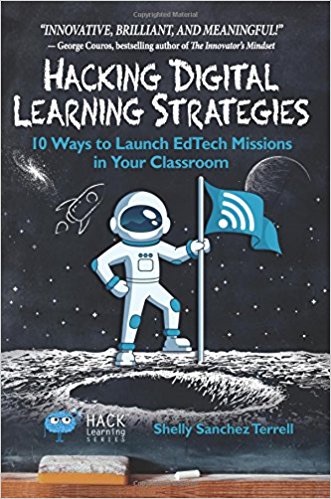
Hacking Digital Learning Strategies: 10 Ways to Launch EdTech Missions in Your Classroom by Shelly Sanchez Terrell offers specific lesson plans for integrating technology and engaging students in real-world activities. This book has everything you need including cautions that can help you avoid unexpected problems. Every school should grab a copy to pass around. Then get one for each teacher.
Introduction: Mission-based learning to inspire students
- Technology has empowered our students, who now have the potential to learn anything in exciting ways. Students like to connect and share and now they can. They can also do scary things such as bullying and posting inappropriate images. While they navigate the digital world it’s time to guide them to make more meaningful choices. This book outlines ten missions to inspire students to reflect on their responsibilities as citizens navigating the digital and physical worlds. We should tie school lessons and activities to meaningful purposes that go beyond making good grades or passing tests.
Mission 1. Design a Game Walkthrough: Create a tutorial and teach others how to play.
- Shelly starts with a story of how she decided to let her ESL students teach the world’s religions to each other. She knew they knew more than she did. It was totally hands-on as the students dressed in customary attire, played music, and showed artifacts. They practiced dances, learned songs, and participated in rituals. Everyone learned so much, including Shelly! She learned that learning is more powerful when students take the reins. Unfortunately, traditional teaching doesn’t work this way.
- For this mission, your students will create a video tutorial about one of their favorite activities – playing games. Producing a video walkthrough develops students’ reading
and writing skills with digital media. Students learn how to write simple, clear, and concise instructions. Like all of the missions in this book, Shelly provides plenty of detail so teachers should be ready to go. Teachers should have some exemplars to show students, involve students in giving and receiving feedback, and the idea that they can always make their work better. She recommends posting student work online and like all missions provides potential obstacles such as complaints from parents and administrators.
Mission 2. Go on a Selfie Adventure: Define yourself through images.
- Taking selfies is an important part of a student’s sense of self, self-belief, and self-esteem. When students post selfies, they realize that their peers will perceive and rate them. Selfies they take often focus on their physical features and fail to capture their
important moments, experiences, struggles, and successes. To complete this mission, students must take selfies that meet different challenges. Each challenge shows students how to capture better selfies that more effectively tell the stories of their lives. Each selfie also guides young content creators to build a strong digital identity.
- Provide at least five criteria for this selfie mission. Possible challenges include taking a selfie with a pet, a favorite book, a favorite teacher, a hobby, or a favorite food. Instruct students to take selfies at different times of the day, in different environments, and engaged in different learning experiences. They will then create a digital story that they can share with the class. Ideally, the mission will motivate kids to reflect on what makes them unique and to experience life as individuals no matter how their peers perceive them. Depending on the class, teaching photography concepts may be necessary.
Mission 3. Create a Fictional Social Media Profile: Manage your digital footprint more purposefully.
- Many schools filter and ban social media to avoid having students encounter the dark side of the internet on their watch. This means our learners are navigating the vast digital world with no guidance or support. For this mission, students create a social media profile for an historical figure and manage the posts, shares, and exchanges for at least five days. Their choices will either enhance or sully the credibility and reputation of their historical figures. After this experiment, students determine if their shares, posts, reactions, and behavior hindered their historical figures’ contributions to the world.
- Based on what they learned, the class can come up with a list of social media best
practices to protect their digital footprints and manage their digital reputations. This requires that they know the history surrounding their person as they apply it to the social media footprint. It also requires critical thinking as they evaluate their effort. Be sure that administrators and parents know what is going as some schools and parents don’t want kids on social media let along using it as a learning tool.
Posted in Book Summaries, Education Books | Comments Off on Hacking Digital Learning Strategies: 10 Ways to Launch EdTech Missions in Your Classroom by Shelly Sanchez Terrell
Wednesday, October 3rd, 2018
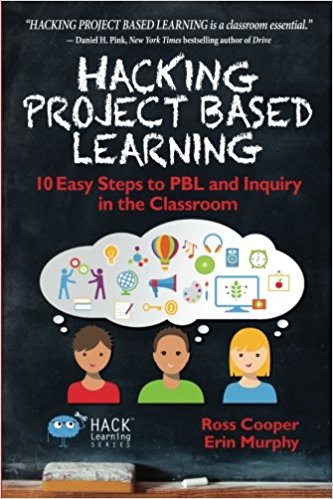
Hacking Project-Based Learning: 10 Easy Steps to PBL and Inquiry in the Classroom by Ross Cooper and Erin Murphy is a must read for any teacher interested in this mode of teaching. Their ten hacks provide a path for more student-centered learning in any classroom. Be sure to get some copies for teachers you know.
Introduction
- Project-Based Learning (PBL) is messy. The authors have done everything in their power here to de-clutter and tidy up the mess to make it as approachable as possible. PBL may not happen overnight in you classroom or school, but it won’t happen if you don’t get started. Ross and Erin started doing PBL as teachers and now support it as administrators. They will help you set the stage for students to thrive in a culture of inquiry and creativity with these ten hacks. Keys are to make student work public and for them to reflect on their work. The role of feedback is also vital.
Hack 1: Develop a Space That Promotes Risk-Taking
- Schools are designed to fill kid’s heads with information. Student questioning diminishes. The assembly line is populated by robots. We need students who can think and solve problems. They need to be driven by their curiosities. Teachers need to do what they can to bring in materials from garage sales or anywhere. They should post failed ideas. They also need to develop relationships. Make sure that things are designed for student learning rather than teacher convenience. The walls should contain student work. Bring in the real world.
Hack 2: Teach Collaboration Skills
- Starting group work without first teaching collaboration skills is a mistake. Working with others requires dialog and productive struggle. Students should know this. They should understand that collaboration is working with others in order to achieve or do something. A good way to teach collaboration is to search the Internet for collaborative experiences. Look for discussion skills, body language, transitions, and organization strategies. Students can also visit other classrooms and watch collaboration in action.
- A big focus should be on the idea that it’s possible to not like someone else’s idea without disliking the person. After early collaboration activities, students should debrief and discuss what went well and what didn’t.
Posted in Book Summaries, Education Books, Leadership Books | Comments Off on Hacking Project-Based Learning: 10 Easy Steps to PBL and Inquiry in the Classroom by Ross Cooper and Erin Murphy
Thursday, April 18th, 2013
Hacking Your Education: Ditch the Lectures, Save Tens of Thousands, and Learn More Than Your Peers Ever Will by Dale J. Stephens (©2013, A Perigee Book: New York, NY) is a handbook for people of any age who wants to take control of their own learning. Dale suggests actions you can take now and explores how school has failed almost everyone in some way. You will still need hard work and determination to thrive in the real world as this book offers an alternate approach to learning rather than an easy solution. Dale offers lots of valuable advice and many inspirational stories of success by unschoolers. Please click the icon at the bottom of any page to purchase this fine book.
Tags: Dale J. Stephens, Hacking Your Education
Posted in Book Summaries, Education Books, Leadership Books | Comments Off on Hacking Your Education by Dale J. Stephens