
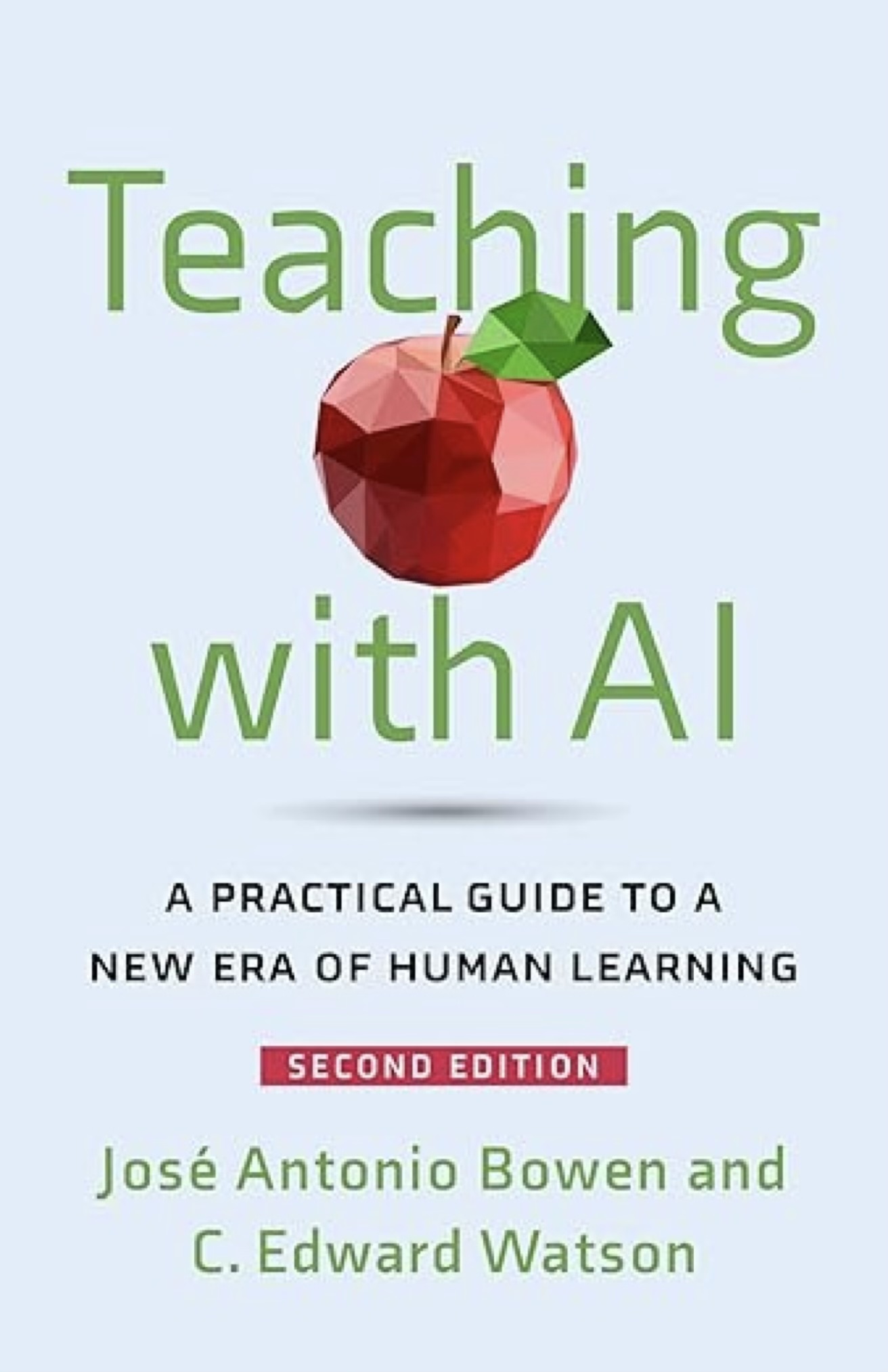
Teaching With AI: A Practical Guide to a New Era of Human Learning (2nd ed.) by José Antonio Bowen and C. Edward Watson shows teachers how they can use AI to promote critical thinking. It offers a vision of how we can use it to take students to a higher learning level as it provides specific examples that teachers can use right now. Every school leader needs to read this now or risk becoming obsolete.
Part I: Thinking with AI – 1. AI Basics
- AI is the ability of commuter systems to mimic human intelligence. GPT stands for generative, pre-trained, transformer. This is because they generate new sentences, images, and ideas. If an AI system is pre-trained on text that contains bias and hate, it’s output will reflect these sources. Parameters in the system will result in the transforms we see. The first public access to a functioning GPT was on November 30, 2022.
- Which model should we use? The big three are ChatCPT from OpenAI, Gemini from Google, and Claud from Anthropic. In any case, your university or school district should have a subscription so you can use the paid version and the phone app. AI literacy will be an essential work- and life-skill for faculty and students. We need to integrate AI literacy into our classrooms, but first we need to understand how it is changing work and future careers.
2. A New Era of Work
- The authors see the impact of AI as being similar to the industrial revolution. They see it changing the nature of work for everyone. AI will eliminate some jobs. Those who can work with AI will replace those who can’t. It is emerging as a more collegial thought partner. It will allow doctors to engage in more eye contact. The number of doctors using it jumped from 38% in 2023 to 66% in 2024.
- There is considerable anxiety across the professional spectrum. 170 million jobs will be created while 92 million will be lost. Younger workers are more likely to be experimenting and seeing productivity gains. 66% of business leaders say they wouldn’t hire someone without AI skills. AI can process more data without getting tired, so it scales. AI-assisted breast cancer screenings detected 20% more cancer with no increase in false positives. When used to teach writing, it helps the weakest writers the most. This is like how spell checkers helped the worst spellers. It’s more than an assistant, it’s a collaborator and you are the boss. Humans are still better when facing new situations.
3. AI Prompting
- Good users of AI ask better questions, evaluate answers, and repeat. If you teach critical thinking, you are already teaching AI literacy. If you are already an expert, you have a tremendous advantage using AI. General principles for prompting include: longer prompts with more details, asking for more than you need, iterate and rarely accept the first answer, provide context such as your audience, specify the level of expertise you want, asking to show thinking, and asking to innovate.
- Be sure to specify the output type such as essay, list, or lesson plan for example. Specify the style you want such as academic, marketing, or archaic. There are two pages of sample prompts here. If you need citations, tell it the format like APA. You can even have it give you feedback on the quality of your prompt.
4. Reimagining Creativity
- Creativity depends on the quantity of ideas. The authors feel that AI will, therefore, make us all more creative. AI can help you generate examples, analogies, entry points, or explanations for teaching a new subject. If you only need one good idea for a paper, project, or dissertation, AI can be your friend.
- There are examples here of how specific AI tools have helped advance science. The best creatives can beat AI but, average thinkers will be beat by AI. Asking the right question will still be a valuable human skill. Teams of humans with an AI partner outperform human teams. AI literate students will use it to become better thinkers.
5. AI Literacy
- AI literacy requires asking better questions and evaluating the answers. AI skills, therefore, overlap substantially with the core tenets of liberal arts education. Critical thinking, teamwork, and communication are essential learning skills for work and life. 19% of higher education institutions have set up majors or minors in AI. The need to teach AI literacy is an opportunity to rethink the way we present general education.
- Key is seeing AI as something you work with, not something that does the work for you. Everyone is AI’s boss. A knowledge of the various AI tools in necessary so you know which one to use. Many institutions have purchased access to special versions of AI systems that offer FERPA compliance. Is yours? To be an effective AI boss you need to know something about the domain you are exploring. You will also need editing skills, which differ from standard writing skills.
Share this:


DrDougGreen.com If you like the summary, buy the book