
Music is often one of the first subjects skipped in homeschooling. Not because parents don’t value it – most do, deeply – but because teaching music can feel overwhelming. You’re already managing subjects like math, reading, science, and history. Adding music lessons on top of that can seem like too much.
But here’s the good news: you don’t have to be the music teacher.
Your role is simply to create a routine where music becomes a regular part of your child’s week. The actual teaching can come from different places – online lessons, tutors, apps, videos, or classes. What matters most is building a system that helps your child keep showing up and practicing consistently.
The real question is: how do you make music a regular part of the week without it becoming stressful?
Why This Actually Matters
Before getting into the how, it’s worth being clear about the why – because the research
on music education in childhood is genuinely striking.
A large-scale longitudinal study published in Frontiers in Neuroscience found that structured music lessons significantly enhance children’s cognitive abilities – including language-based reasoning, short-term memory, planning, and inhibition and that these improvements directly translate into better academic performance across other subjects.
A review published in Frontiers in Psychology synthesised decades of research and found that children who undergo musical training show better verbal memory, improved reading ability, stronger executive function, and that learning an instrument in childhood may even predict academic performance and IQ in young adulthood.
And it goes further than academics. A Department of Education study of 25,000 middle and high school students found that consistent involvement in instrumental music correlates with significantly higher maths proficiency by grade 12. Schools with music programs also have attendance rates of 93.3%, compared to 84.9% in schools without.
For homeschool families, who already choose education precisely because they believe
in personalised, intentional learning, music isn’t a nice extra. It is, as one educator puts
it, “not just a luxury – it’s a powerful tool for supporting overall development.”
The One Thing Most Families Get Wrong
The most common mistake homeschool families make with music isn’t skipping it. It’s treating it like a special event.
Music practice that only happens when there’s extra time, or when a lesson is scheduled, or when someone feels motivated – doesn’t build skill. It builds frustration. Kids don’t progress, parents feel guilty, and eventually the instrument moves to the corner and stays there.
Studies show that short, consistent practice sessions are more effective than occasional marathon ones. And the keyword is consistent. Not long. Not intense. Consistent.
The best homeschool schedules aren’t rigid hour-by-hour timetables – they’re rhythms. They’re organized around anchors in the day rather than clock times: after breakfast, before lunch, after the dog walk. Music fits into that rhythm exactly the same way. It just needs a designated anchor, not a formal lesson plan.
The Weekly Music Rhythm: A Practical Framework
Think of the weekly music time across three distinct modes. Not every session needs to
do all three. But across a week, all three should happen.
1. Listening – passive exposure to music, building the ear
2. Playing – active instrument practice, building skill
3. Exploring – open, unstructured musical play, building love
Here’s how they fit into a week.
Monday – Listening Day
Start the week by simply playing music. This is the lowest-friction entry point possible: no instruments, no lessons, no prep.
Put something on during breakfast, during a nature walk, or while your child colours or reads. Daily listening counts as music education – it trains the ear, builds familiarity with rhythm and structure, and develops musical taste long before a child ever touches an instrument.
Rotate intentionally across the week and month. Classical one morning, jazz another, folk, blues, world music. Ask one question: “What do you notice about this music?” Then leave it alone. You’re not running a seminar. You’re opening a door.
Time required: 15-20 minutes, entirely passive.
Practical tip: Create a rotating playlist – one new composer or artist per week. By the end of the year, your child has been introduced to 52 musical voices.
Tuesday and Thursday – Practice Days
These are the active instrument days. The goal is focused, short, consistent repetition – not marathon sessions.
How long depends on age, and getting this right matters more than most parents realize:
● Ages 5-8: 10-15 minutes per session, 3-4 days a week. Young children fatigue quickly – physically and mentally. Short is not a compromise; it’s the correct approach.
● Ages 8-12: 15-30 minutes per session, 4 days a week. Students who consistently reach 75-100 minutes of practice per week progress significantly faster than those who don’t.
● Teens: 30-45 minutes per session, 5 days a week. At this stage, the quality of focused practice matters more than total time.
For younger children, especially, the repetition method often works better than a set timer. Instead of “practice for 10 minutes,” try “play that section 5 times.” Put five marbles in a bowl and move one across each time they complete it. The tactile – countable goal is easier for young children to engage with than an abstract time limit. What makes a practice session good versus bad isn’t length – it’s focus. Phones off, TV off, one clear goal per session. Even 15 focused minutes beats 45 distracted ones. Time required: 10-45 minutes depending on age.
Practical tip: Anchor practice to a fixed point in the day – right after lunch, or before screens in the afternoon. Predictability is what turns practice from a battle into a default.
Wednesday – Theory and Listening Together
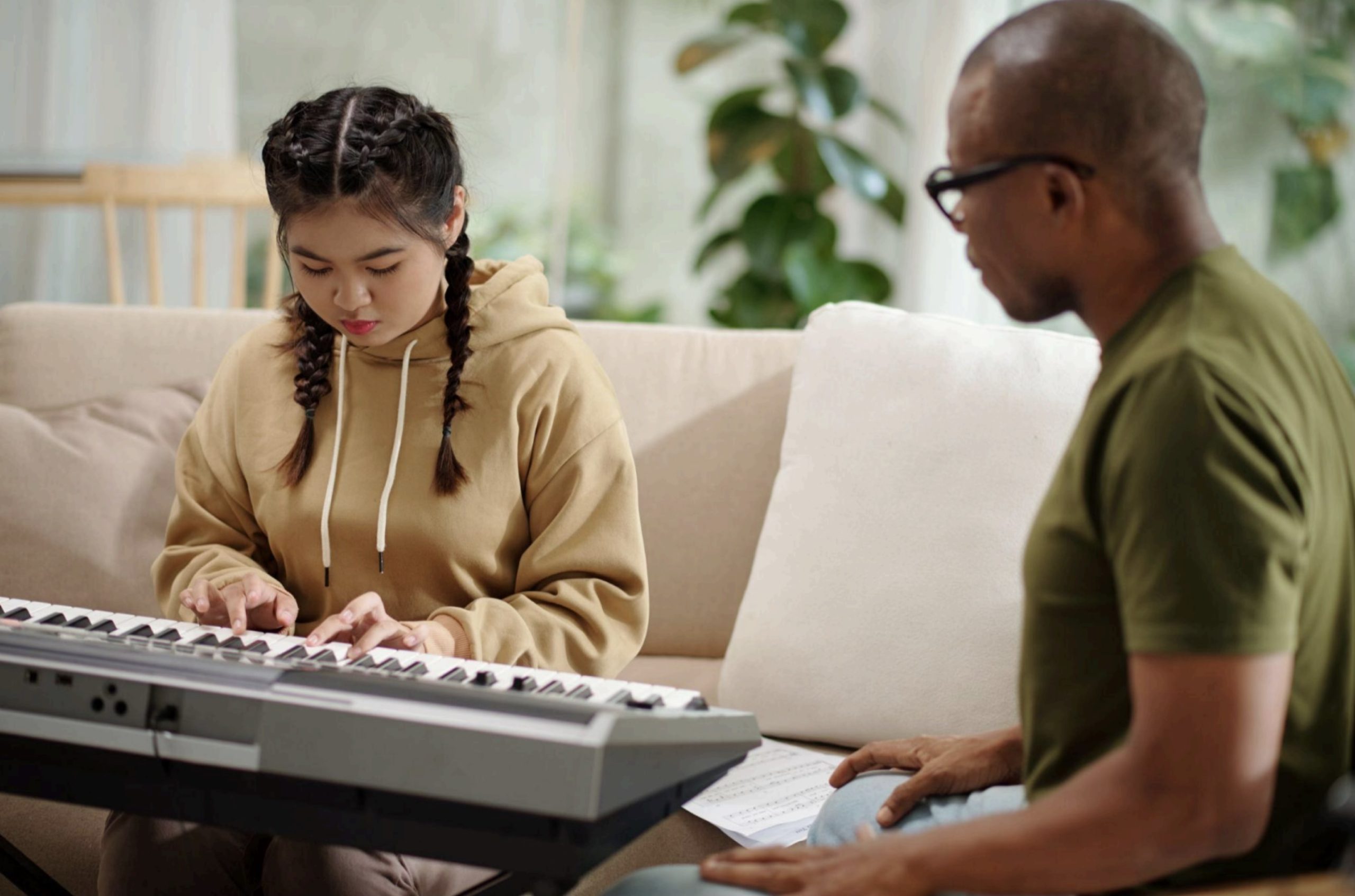
Wednesday is a lighter day – no instrument required. This is where you weave in the broader context of music: a short video about how a symphony works, a story about a composer’s life, a simple music theory concept like what makes a major chord sound happy and a minor chord sound sad.
You do not need to read music, play an instrument, or explain musical terms confidently to do this. You are not the teacher on Wednesday. YouTube, documentaries, and dedicated music appreciation curricula are the teacher. You are just the one who presses play and sits beside your child.
This is also a natural day to ask your child what they want to explore. What kind of music do they like? What instrument have they always wanted to try? What song do they wish they could play? Following that thread, even briefly, keeps music feeling chosen rather than assigned.
Time required: 20-30 minutes.
Practical tip: The Naxos Music Library and SmartMusic are two widely-used resources for guided music listening and theory for home learners.
Friday – Free Play and Exploration
Friday is unstructured. No assignment, no goal, no right answer. Your child picks up the instrument (or doesn’t) and just plays.
This matters more than most people think. Kids who only practice because they have to, often lose interest over time. But kids who also get to explore, experiment, and enjoy music for fun are much more likely to stick with it.
Free play is where curiosity grows. When a child spends time figuring out a song on their own, just because they want to, they’re building something lessons alone can’t teach – a personal connection to music.
Time required: As long or as short as they want.
Practical tip: Leave the instrument out and accessible on Fridays. The barrier of getting it out of the case is often enough to prevent spontaneous play.
The “I’m Not Musical” Problem – And Why It’s Not the Problem You Think
One of the most freeing things a homeschool parent can hear is this: you do not need to be musical yourself to give your child a rich music education.
Your child doesn’t need you to be a music expert. They just need your support, consistency, and encouragement to keep music part of the weekly routine. But there is one thing children do need from a real music teacher: feedback on their playing.
It’s easy to go months inside a homeschool music routine without anyone ever giving specific, honest feedback on what a child is actually doing wrong – and wrong technique, left uncorrected, becomes a habit.
This is the exact gap that Wiingy fills well. Parents can connect their child with experienced music tutors for one-on-one lessons and personalized feedback. Even occasional sessions can give children the expert guidance they need to keep improving with confidence.
You handle the rhythm. Let an expert handle the refinement.
Weekly Music Rhythm at a Glance
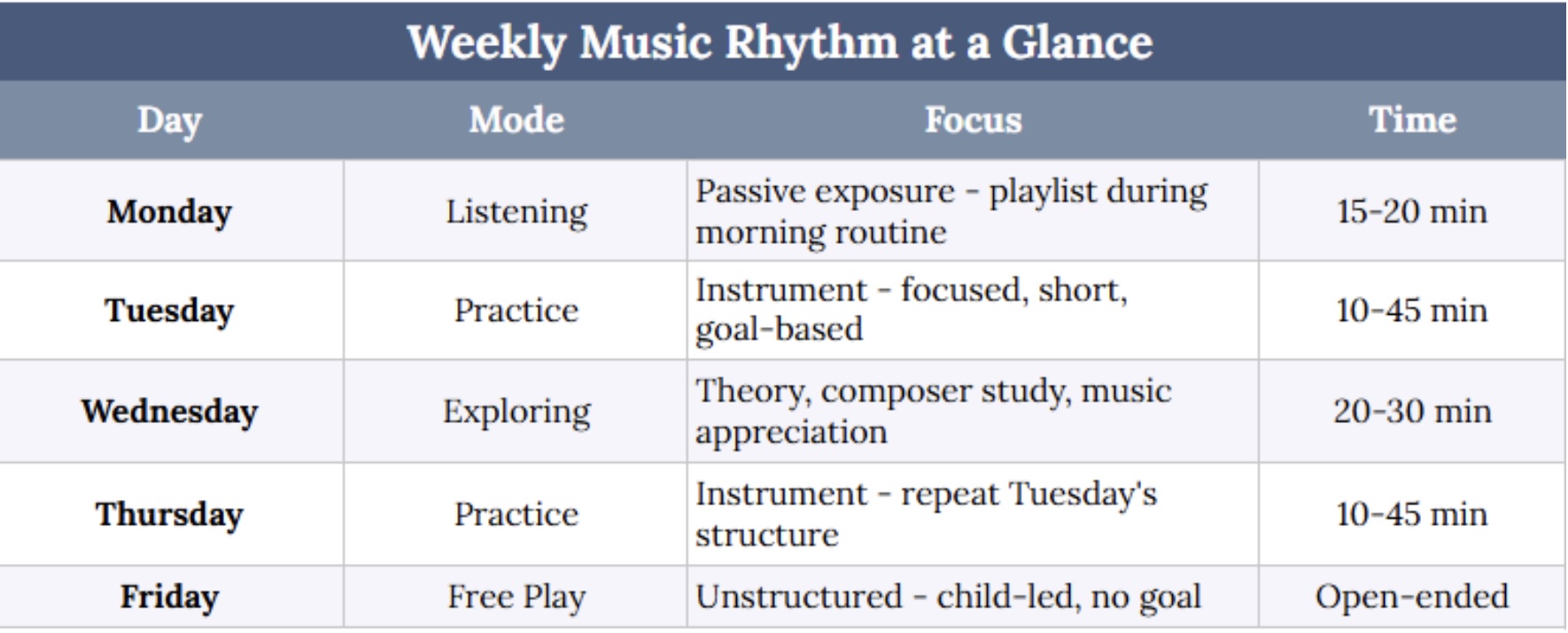
Total weekly commitment: roughly 1–2.5 hours, spread across five lightweight
touchpoints.
How to Fill the Social Gap in Homeschool Music
One real limitation of homeschool music education is what some call the ensemble gap: traditional schools offer choirs, bands, and orchestras. Playing alongside others teaches listening, timing, and musicianship in ways solo practice simply cannot replicate.
The fix isn’t complicated, but it does require intention:
● Search for local homeschool music co-ops or youth ensembles in your area
● Arrange small informal “jam sessions” with other homeschool families
● Look into community youth orchestras or church choirs that welcome homeschoolers
● For older students, online ensemble platforms now allow students to record and layer parts together remotely
To combat the ensemble gap, look for local youth groups or set up your own small jam circles with other families. If you can’t find anyone in person, try finding groups to collaborate with online. This is worth prioritising – not weekly, but at least once a month.
When the Routine Falls Apart
Homeschool schedules should work for you, not the other way around. Illness, travel, a particularly intense week in another subject, a child going through a motivation dip – all of these will interrupt the music rhythm at some point.
The rule when that happens is simple: don’t try to catch up. Just restart. Music doesn’t have to happen every single day to make a difference. Missing a week doesn’t mean you failed. One of the benefits of homeschooling is flexibility. The goal
isn’t perfection – it’s creating a year where music stays part of your child’s life more often than not.
If your child keeps resisting practice for weeks, it’s worth paying attention to. It doesn’t always mean they should quit. Sometimes learning becomes difficult right before real progress happens. But it may mean something needs to change – the instrument, the teaching style, or the way practice is structured.
The Bigger Picture

3.7+ million children are currently homeschooled in the U.S – approximately 6.73% of all school-aged children, a figure that has more than tripled since 1999. These families are already doing the hard work of building an education from scratch, one week at a time.
Music is one of the most valuable parts of a child’s education. Not just because it can create musicians, but because regular exposure to music helps improve focus, creativity, emotional growth, and overall learning.
You don’t need a perfect system. You don’t need to be musical. You need a weekly rhythm with enough consistency that music becomes a feature of your family’s life rather than something you keep meaning to get to.
Pick your anchors. Put the instrument out. Press play on Monday morning.
The rest follows from there.
The instrument in the corner doesn’t need a perfect lesson plan. It needs a family willing to make space for it.
Ekta Saha is the Lead Content Marketer at Wiingy, an online tutoring platform offering personalized 1-on-1 lessons in music, languages, and math. With an MBA in Marketing, she specializes in educational content strategy, digital PR, and research-backed storytelling to help learners discover new skills and opportunities. Outside of work, she enjoys learning piano, singing, and exploring indie and acoustic music. You can email her at ekta.saha@wiingy.com.