Author Archive

Good men are hard to find.

Monday, February 15th, 2010

Women have been outperforming men in school for some time. Now the numbers are in and their better performance in schools is paying off in the work place. In terms of pay and employment, women have made big gains at the expense of men. According to an article by M. P. McQueen in the February 12, 2010 “Wall Street Journal”, by 2007, women were earning 35% more bachelor’s degrees and 66% more associate’s degrees than men. While women still make less than men, they are catching up as their pay increased 5.3% last year compared to 3.4% for men. These numbers are even more unbalanced for blacks where women earn 92% more bachelor’s degrees and have a 13.3% unemployment rate compared to 17.6% for black men.
Steady increases among women with college degrees over the past two decades seems to be paying off in the current economy as women for the first time surpassed the number of men holding payroll jobs. “Men have traditionally needed less education, because guys could get good jobs in construction without a master’s in Education and women couldn’t, so education substitutes for that,” said Claudia Goldin, a Harvard University economist.
Women started catching up by the 1960s, and by the 1980s they were earning more bachelor’s degrees than men, and a growing share of graduate and professional degrees. Woman earn more college degrees in all fields except the physical sciences, math, engineering, business and economics. I think the message here is that males can either work harder in school or work harder to find a good woman who can bring home the bacon.

Click here for the McQueen article.

Denialism – Irrational Thinking is Common – Michael Specter

Monday, January 25th, 2010

Denialism: How Irrational Thinking Hinders Scientific Progress, Harms the Planet, and Threatens Our Lives by Michael Specter deals with how large sections of our society are in denial about things that science supports. Included are topics like child immunizations, genetic engineering of our food supply, alternative medicine, and race-based medication. The following quote should give you some idea of what to expect:
“Denialism is not green or religious or anti-intellectual, nor is it confined to utopian dreamers, agrarians, or hippies. It is not right- or left-wing; it is a fear expressed as frequently and with as much fervor by Oxford dons as by bus drivers.”
Although the book is science centered, you don’t have to be a scientist to follow it.

Click here to see the excerpted summary of this book.

Share this:
Share this page via Email Share this page via Stumble Upon Share this page via Digg this Share this page via Facebook Share this page via Twitter Share this page via Google Plus

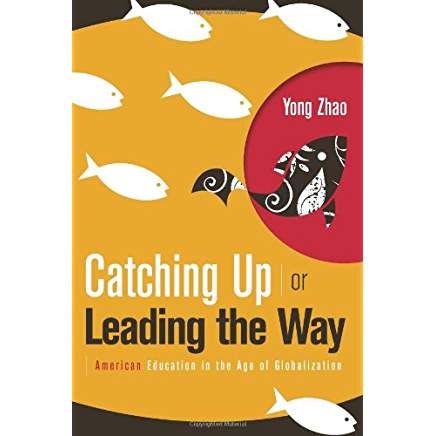
Catching Up or Leading the Way Yong Zhao

Monday, January 4th, 2010
Catching Up

Catching Up or Leading the Way: American Education in the Age of Globalization by Yong Zhao (©2009, ASCD: Alexandria, VA) tells the story of how China seems to want an education that America seems eager to throw away. This is one that respects individual talents, supports divergent thinking, tolerates deviation, and encourages creativity. At the same time, the US government is pushing for the kind of education that China is moving away from. This is one that features standardization of curricula and an emphasis on preparing students for standardized tests. He wonders why Americans who hold individual rights in high regard would let the government dictate what children should learn, when they should learn it, and how they are evaluated.

Meet Yong Zhao

  • Dr. Zhao grew up in China and immigrated to the US in the 1990’s. Yong Zhao is currently Presidential Chair and Associate Dean for Global Education, College of Education at the University of Oregon, where he also serves as the director of the Center for Advanced Technology in Education (CATE). He is a fellow of the International Academy for Education. Until December, 2010, Yong Zhao was University Distinguished Professor at the College of Education, Michigan State University, where he also served as the founding director of the Center for Teaching and Technology, executive director of the Confucius Institute, as well as the US-China Center.

Get My Kid Out of Here

  • Zhao relates a story about his son who told him that he figured out how to get a better score on Michigan’s NCLB tests. His strategy was to stop being creative and imaginative. Instead he would follow the scoring rubric, that was analyzed and taught by his teacher. His score did improve but for this and other reasons the Zhaos decided to move him to a school that was not governed by NCLB.
  • The most serious consequence of NCLB is that it leads to homogenization of talents. While the intention is to ensure every child receives a good education, the problem is that NCLB practically defines good education as being able to show good scores in a limited number of subjects. As schools conform to standardized curriculum, children are deprived of opportunities to develop talents in other areas. If it works, we will develop a group of individuals with the same abilities, skills, and knowledge. American needs a citizenry of creative individuals with a wide range of talents to sustain its tradition of innovation. Reforms aimed as saving America are putting America in danger.

The Two Gaps

  • Two gaps are commonly cited as reasons why American schools need to improve. One is the performance gap between whites and minorities, primarily blacks and Hispanics. The other is the gap between average performance of American students and students from other first world countries. Zhao cites work by Berliner (2006) in pointing out that we didn’t need NCLB testing to tell us where to find failing schools since the common characteristic they share is poverty. There is strong evidence to support the idea that even a small reduction in family poverty significantly improves school behavior and student performance. Test bias also contributes. When tested for creative and practical abilities, minorities do much better.
Share this:
Share this page via Email Share this page via Stumble Upon Share this page via Digg this Share this page via Facebook Share this page via Twitter Share this page via Google Plus

It would be funny if it weren’t true.

Sunday, December 27th, 2009

An article in the NY TImes (12/27/2009) sites a department of Education estimate that in order to apply for part of the $4 billion in federal Race to the Top grant money, a state will need to spend 681 hours to fill out the application. If you haven’t seen the application it is available below. I can’t imagine anyone reading it all without being compensated, but a quick scan is likely to be amusing or depressing depending on your personality.

Click here to see the article..

Click here to see the Race to the top application..

Share this:
Share this page via Email Share this page via Stumble Upon Share this page via Digg this Share this page via Facebook Share this page via Twitter Share this page via Google Plus

Race to the Top Spoof

Friday, December 18th, 2009

Yong Zhao immigrated from China in the 1990’s. He presents an alternate view on testing and national standards. Here is a link to a funny article in EdWeek where he spoofs the application for state Race to the Top money. I also am working on a summary of his book “Catching Up or Leading the Way: American Education in the Age of Globalization.”

Here is the link for this article.

Share this:
Share this page via Email Share this page via Stumble Upon Share this page via Digg this Share this page via Facebook Share this page via Twitter Share this page via Google Plus