Author Archive
Saturday, October 15th, 2016

Combining Fun and Education: The Importance of Museums by Vee Cecil explains why museums are important to society and why they should be a centerpiece of education at home and in school.
Museums Are Important
- Museums have been a staple of Western society for centuries. They hold the rarest, most invaluable, and important artifacts from both past and present. Though some people may brush history off as boring, there is far more to see when you visit a museum.
- Some museums contain hands-on exhibits that explain science to the layperson, others hold modern works of art, and you might even find one with an extensive collection of teacups. Regardless of the theme, museums are an important part of society. There are several compelling reasons to visit and support museums in your local area and around the world.
They Preserve Cultures
- With globalization, cultures are dying at an unprecedented rate, leaving their remains to museums. Without careful preservation of documents and artifacts, many of these cultures would be lost to history. With museums, these cultures can be remembered, preserved, and possibly even revived. With heritage programs, the information held by museums can help a group revive aspects of their culture that would have otherwise been lost. Check out The importance of preserving cultural artifacts: A look at the Metropolitan Museum of Art’s Islamic Wing by Thomas Campbell.
They Teach Kids to Be Excited About Learning
- For most kids, there is nothing more exciting during the school year than a class field trip. Trips to museums allow students to abandon the traditional, lecture-based learning, get some hands-on education, and see beautiful visual aids that would be impossible to replicate in a classroom, even as part of a video. Hands-on learning is critical to engaged learning, and even teachers may learn some tips and tricks to keeping their kids interested. Check out useful lesson plans here.
They Showcase New Ideas and Technology
- In art museums, patrons find themselves exposed to new, innovative ideas from modern artists alongside historic pieces for comparison. Science museums break down technologies, allowing the average person to grasp the complex ingenuity that goes into their everyday staples. Many museums even have apps, displaying their connection to the modern world. Exposure to new things and ideas is critical in order for a person to continue to grow and learn. Though school may end, learning should not. You can also check out six museum apps for virtual field trips.
They Are a Fun and Beneficial Option for Family Outings
- Family outings are usually kid-centric with parents sacrificing their own interest in order to please their kids. Museums, on the other hand, are interesting and fun for all involved. Children get to see their parents excited about learning, creating a positive example.
- Museums also expose kids to a number of different subjects, teaching them the importance of things like art, science, and cultural acceptance. Though a trip to a playground is positive for kids’ fitness, museums are one of the best family-friendly activities that work the mind and expand kids’ horizons.
- Museums are an extremely under-appreciated resource. They play a critical role in preserving important aspects of humanity including our art, our cultures, our past, our present, and our future. Though we have documented much of our time on this planet, the only way this history is accessible to the public is through the hard work of museums. So next time you’re thinking of something to do with your kids this weekend, look up your local museum. You might just be surprised by what you discover. Click her for 17 kid-friendly museums and hands-on attractions.
Vee Cecil
- Vee keeps busy by being a wellness coach, personal trainer and bootcamp instructor in Kentucky. She also recently launched blog where she shares her passion for health by writing about her favorite tips, activities and recipes. @vee_cecil
Posted in Guest Posts | Comments Off on Combining Fun and Education: The Importance of Museums by Vee Cecil
Monday, October 3rd, 2016
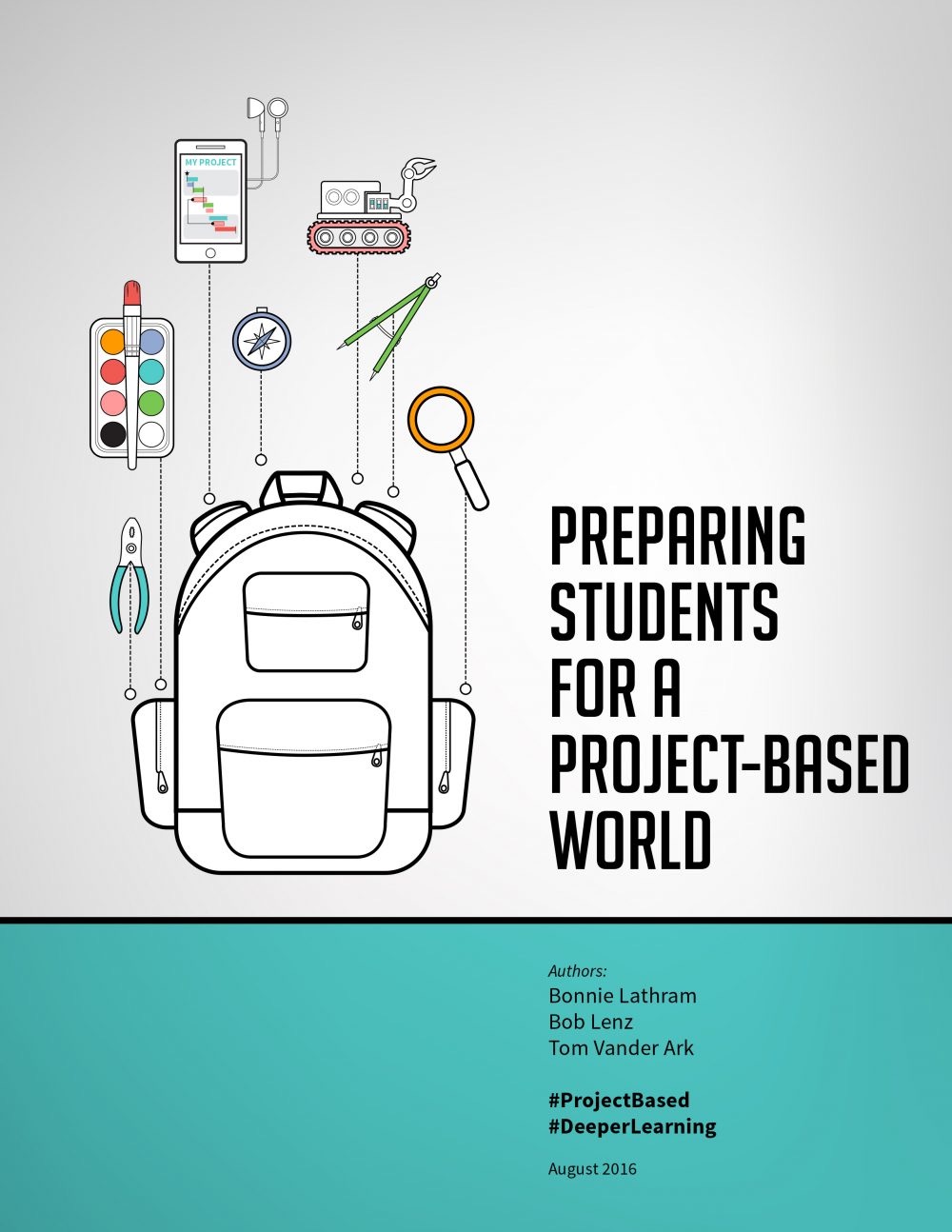
Preparing Students for a Project-Based World by Bonnie Lathram, Bob Lenz, and Tom Vander Ark spells out the rationale for introducing project-based learning as an excellent way to prepare students for college and careers. It is the first of three reports about the new economy and inequities in student preparation. The next two parts will deal with preparing teachers and students for a project-based classroom.
Introduction
- The new economy requires a lot from young people. The bar is higher and the rules have changed in five ways. 1. Anyone who can access the Internet can learn to code, build and app, and start a business. This makes competition much greater. 2. The pace of technological change requires continuous learning. 3. As robots take over routine tasks, non-routine work is organized into projects. 4. Soon 40% of workers will be freelance and people employed by companies will move frequently. 5. Value is produced by initiating and sustaining complex work applying design and problem-solving skills.
- As a result, we need to reimagine how we teach students and how we organize schools. Students need to use their own interests and passions to grow their skills, master core academic content, and learn how to collaborate with others. One way to do this is to give all students access to high-quality project-based learning.
The New Economy
- For most workers, a series of projects will mark their career. There is also an increase in gigs, which are short-term routine tasks requiring low-skills. The classic example here is Uber where anyone with a car and a drivers license can earn a modest income. Better paying jobs are just the opposite since they usually involve long-term projects, require much more skill, and pay much more. Today’s youth also has to beware of jobs subject to automation. The classic example here is tax preparation.
Inequity: Old and New
- Policy changes associated with No Child Left Behind and Race to the Top have not reduced gaps between black and white performance. Nine out of ten children from the bottom of the income ladder who graduate from college move to a higher economic bracket. Being poor, however, is an impediment to getting the education that can lift you out of poverty. Most of the jobs created since the last recession have gone to people with at least some college education. Higher college costs and stagnant wages have lowered the return on college investments so don’t go until you are ready and don’t leave without a degree.
A Project-Based World
- Technological and economic change results in a very different job market for students to face. There are six ways to prepare for a project-based world and it is vital that teachers facilitate all of them. 1. Look for real-world internships. 2. Get real-time feedback, not just grades. In your career you will get feedback so get ready for it. 3. Learn how to collaborate. 4. Project results need to be communicated so work on communication skills including public speaking. 5. Personalize your learning. This will involve applying the skills learned elsewhere. 6. Learn about project management and team leadership.
Deeper and Project-Based Learning
- Project-based learning is one way to support deeper learning outcomes. They should be demanding and require a public audience. Essential project design elements include: a focus on student learning goals and standards, meaningful problems and appropriate levels of challenge, an extended process, a real-world context, student voice and choice, time for reflection, opportunities to critique and revise, and a public presentation. This report includes exemplars using several project results.
- This chapter ends with several fallacies associated with traditional non-project-based education. These include: memorizing content is all that’s necessary, more homework increases rigor but PBL is not rigorous, and PBL only works for white middle class students. The authors claim that PBL allows students to learn and master content knowledge, demonstrate and apply knowledge and skills, and learn how to learn as they transfer knowledge to new and different contexts.
A Call For Action
- It’s clear that we need advocates in the education and business community to move forward on this vital issue. Do what you can to get this information into the hand of policy makers and engage them in conversations. Parents can also play a key role as advocates. The authors list ten elements necessary to make high-quality possible. They are: 1. Pedagogy – Combine PBL with personalized learning. 2. Accountability – Assign individual as well as team projects an make all students in a group accountable. 3. Integration – Projects should span disciplines. This may require some team teaching. 4. Badging – Students should receive badges to certify things like project management skills. 5. Voice – Students should be responsible for defining the scope and deliverables of their projects. 6. Assessment – Teachers should check in periodically to provide formative feedback and use a rubric to assess completed projects. 7. Exhibitions – Students should be able to present their work to a public audience. 8. Portfolios – Students should collect and manage artifacts in a portfolio as evidence of their learning. 9. Training – Teachers need significant training prior to implementing PBL. 10. Tech – Powerful tech tools should be available to students and teachers
The Authors
- The authors bios are included at the end of this document. Bonnie Lathram is a Director at Getting Smart where she leads large-scale education initiatives. Bob Lenz is the Executive Director of the Buck Institute for Education. Tom Vander Ark is CEO of Getting Smart and a partner at Learn Capital, an education venture fund. You can follow them on Twitter at @belathram (Bonnie) @pblbob (Bob) and @tvanderark (Tom).
Posted in Book Summaries, Education Books, Leadership Books | Comments Off on Preparing Students for a Project-Based World by Bonnie Lathram, Bob Lenz, and Tom Vander Ark
Monday, September 19th, 2016
1. What Is STEM?
- STEM education is an interdisciplinary approach to learning that removes the traditional barriers separating the four disciplines of Science, Technology, Engineering, and Mathematics and integrates them into real-world, rigorous, and relevant learning experiences for students. (See this short animation for a visual definition.) There is more of a focus on working in teams, and the problems do not have a single right answer. This is an emerging national trend and is noted for taking many teachers outside of their comfort zones. The purpose of this book is to give you a teaching toolkit filled with new ideas and know-how to help you start exploring and implementing STEM education.
- As failure is a normal part of the engineering process, it is also a part of STEM education. The students need to know that failure is expected and that the classroom is risk-free. Teachers facilitate rather than tell as students follow an engineering design process. Students connect and apply science principles and use math and technology as tools to solve an engineering problem. Rather than conduct an experiment to test a scientific hypothesis, students engineer a solution for a real-world problem. The steps are: 1. Define the problem, 2. Research, 3. Imagine, 4. Plan, 5. Create, 6. Test and Evaluate, 7. Redesign (iterate), and 8. Communicate.
- Consider adding some of these reference books to your school’s professional development library.
2. Why Teach STEM?
- STEM literacy can have a positive personal impact on the lives or our students. It can also impact our country and society in general. Businesses are asking for employees with in-depth mastery of STEM skills. Anne lists seven compelling reasons. 1. Help student develop deeper understanding of science and math concepts. 2. Promote innovative critical thinkers, which can allow creativity to flourish. 3. Students learn who to approach and solve problems. 4. They develop a sense of ethics and social conscience. 5. Students develop collaboration skills. 6. Technological literacy increases. 7. Students understand the connection between STEM education and future careers.
3, STEM Variations
- In addition to a fully integrated program that uses the engineering design process and integrates the other subjects, there are many variations that you may run in to. A common one stresses the subjects individually and may add engineering and coding courses to the standard science and math offerings. Some add a maker component to the school’s offerings. Others add the arts and call it STEAM. Anne suggests that art courses stay in play so that students will have artistic skills to use as they design projects.
Posted in Book Summaries, Education Books, Leadership Books | Comments Off on STEM by Design: Strategies and Activities for Grades 4-8 by Anne Jolly
Saturday, September 10th, 2016
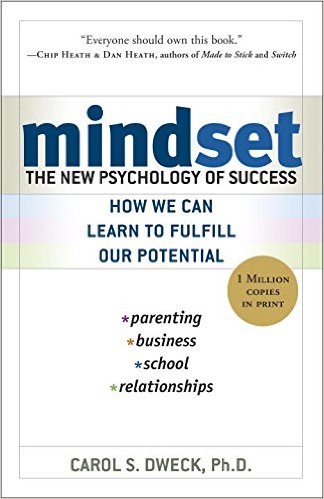
Back by popular demand is a revised summary of Mindset: The New Psychology of Success – How We Can Learn to Fulfill Our Potential by Carol S. Dweck, Ph.D. will help you learn how a simple belief about yourself guides a large part of your life. It is vital that all teachers and parents read this book.
Carol S. Dwech PhD
- Carol is one of the world’s leading researchers in the field of motivation and is the Lewis and Virginia Eaton Professor of Psychology at Stanford University. Her research has focused on why people succeed and how to foster success. She has held professorships at Columbia and Harvard Universities, has lectured all over the world and has been elected to the American Academy of Arts and Sciences. Her scholarly book Self-Theories: Their Role in Motivation, Personality, and Development was named Book of the Year by the World Education Federation. Her work has been featured in such publications as The New Yorker, Time, The New York Times, The Washington Post, and The Boston Globe, and she has appeared on Today and 20/20.
Estimating Your Own Ability
- Studies show that people with growth mindsets tend to be accurate in assessing their own abilities, even if it is unflattering. If you are oriented toward learning, you need accurate information about your current abilities in order to learn effectively. Howard Gardner is quoted as saying that exceptional people have “a special talent for identifying their own strengths and weaknesses.” They also have a special talent for converting life’s setbacks into future successes. Creativity research sees this as the number one ingredient in creative achievement. Dweck’s key message is that you can change your mindset as they are just beliefs.
Mindsets and Personality
- Beyond intelligence, fixed and growth mindsets impact your personality. People with fixed mindsets believe that they are what they are and cannot change. They want to be praised and not challenged. Those with growth mindsets want to get better and are accepting of people who point our their shortcomings. Marriages between different mindsets can fall apart as a result. Top performers in sports are those who constantly push themselves to be better. If you get a thrill from what’s easy, you may have a fixed mindset. If you enjoy what is difficult, you may have a growth mindset. You think that becoming is better than being.
What Do the Experts Know?
- If you have a fixed mindset, you think that tests and experts can somehow tell you what your potential is. Many accomplished people were thought to have little potential. Dweck lists Jackson Pollock, Marcel Proust, Elvis Presley, Ray Charles, Lucille Ball, and Charles Darwin as examples. Look for students who are energized by criticism. (Doug: My daughter studied fine arts at Pratt Institute in Brooklyn, NY. Every day she had to endure criticism of her work. As a result, she got better and better. After graduating in 2006 she immediately got work in the competitive art industry in New York City and has worked ever since.)
Tags: Carol Dweck, Mindset
Posted in Book Summaries, Education Books, Leadership Books | Comments Off on Mindset by Carol Dweck – Revised Summary
Wednesday, September 7th, 2016
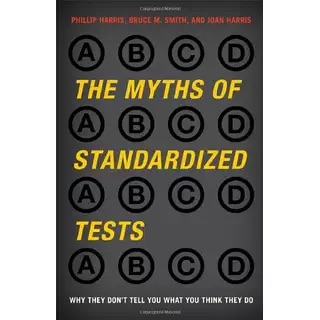
I’m still on the road, so today you get a shortened summary of The Myths of Standardized Tests: Why They Don’t Tell You What You Think They Do by Phillip Harris, Bruce M. Smith, and Joan Harris. If you agree with me that the current state tests imposed by the federal government are harmful to students and teachers, you will find ammunition here to help me fight this battle. If you want the longer summary, click here.
Scores Correlate With Wealth
- The tests rely on items closely linked to socioeconomic status and inherited aptitudes to spread out the scores. As such they tend to measure what students bring to school, rather than what they are taught once they get there.
Just Pass or Just Fail?
- Any student can go from proficient on one version to needing remediation on another. Items are chosen to spread out the scores of the test takers. Time limits spread out scores even more. As students can only sit and focus for so long, the tests can only deal with a small fraction of the domain. Some topics have to be skipped. Timed tests also produce test anxiety.
Who Wants to be Judged by a Snapshot?
- Tests depend on the idea that a small portion of a student’s behavior fairly represents the whole range of possible behavior. To draw valid inferences from a test, it must cover more than a small part of the content domain.
What They Don’t Measure
- They don’t measure goals schools pursue like creativity, critical thinking, motivation, persistence, empathy, leadership, courage, compassion, honesty, and curiosity. Students with high scores may be shallow thinkers. Important items that all students should know are left out at the expense of items that half of the students will miss. There are too many standards to use criterion-referenced tests.
Fuzzy Math
- Test scores are not clean, crisp numbers but fuzzy ranges that extend above and below the score, and 5% of the time the true score isn’t even in the fuzzy range
Are They Really Objective?
- A look at how the tests are made reveals a good deal of subjective human judgement from the people who write, edit, and assemble the test items. Setting the standards also requires judgement that occurs in a political and social context. Achievement levels are, first and foremost, policy statements.
Carrots and Sticks by Mostly Sticks
- There is excessive reliance on rewards and punishments. Research shows how rewards dampen interest in, and enthusiasm for, the activity that is rewarded.
Teachers Cheat
- “The more any quantitative social indicator is used for social decision-making, the more subject it will be to corruption pressures, and the more apt it will be to distort and corrupt the social processes it was intended to monitor.
The Narrowing Effect
- High-stakes tests have narrowed and dumbed down curricula and eliminated time spent on untested subjects by about a third, including recess. Tests also drive instruction towards items with one clear, right answer at the expense of open-ended problem solving.
True Predictors
- Nonacademic accomplishments are better predictors for future accomplishments than grades or test scores. Grades are much better predictors than tests since they often consider more qualities than test scores. The best predictors of future accomplishment are similar accomplishments.
The Back of the Bus
- We expect everyone to learn the same things, to the same level, at the same time? What is the point when everyone is unique? Our obsessive focus on academic achievement measured by tests has pushed other goals to the back of the bus.
Posted in Book Summaries, Education Books | Comments Off on The Myths of Standardized Testing – Short Summary