Archive for the ‘Education Books’ Category
Sunday, March 10th, 2013
The Little Book of Talent: 52 Tips for Improving Your Skills by Daniel Coyle (© 2012, Bantam Books: New York, NY) is a bit over 100 pages and offers specific tips for developing talent. Daniel relies on abundant research to help you copy the techniques used by the top performers in many fields. In addition to growing your own talents, this book will help parents, educators, and coaches increase the success rate of their students. Every home should have a copy, so click the icon at the bottom of any page to get yours.
Posted in Book Summaries, Business Books, Education Books, Leadership Books | Comments Off on The Little Book of Talent by Daniel Coyle
Friday, March 18th, 2011
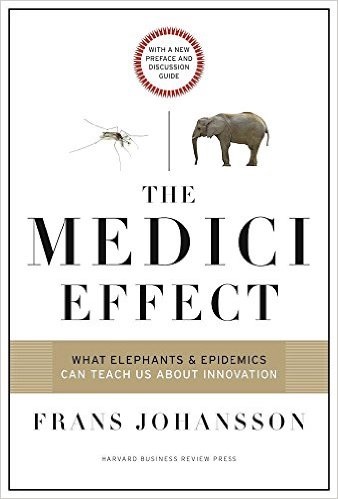
This book by Frans Johansson looks at breakthrough insights at the intersection of Ideas, concepts, and cultures. He recommends that you expose yourself to a range of cultures, learn differently, reverse your assumptions, and take on multiple perspectives. The tips on brainstorming research are worth the price alone. Johansson is a writer and consultant who lives in New York City.
Cultures Are Different
- How different cultures view a grasshopper? USA – pest, China – pet, N. Thailand – appetizer
- How different cultures view the color yellow? USA – cowardice, Malaysia – royalty, Venezuela – lucky underwear
Why Study Multiple Cultures
- Exposure to multiple cultures gives you more ways to look at an issue. Cultures can be ethnic, class, professional, or organizational in addition to geographic. This promotes open, divergent or even rebellious thinking. One is more likely to question rules, traditions, and boundaries. Languages codify concepts differently. Fluency in another language can promote varied perspectives during the creative process.
Learning Lots on Your Own
- Broad education and self-education are two keys to learning differently. Most fundamental innovations are achieved by people who are either very young or very new to the field. Learning fields on your own increases the chance of approaching them from different perspectives. Darwin: “all that I have learned of any value was self-taught.”
Prepare Your Mind
- Louis Pasteur found a forgotten culture of chicken cholera bacteria. When chickens were injected with it they got sick but recovered. These same chickens when injected with a fresh culture survived. Pasteur realized that the chickens had been immunized and that his old culture served as a vaccine.
Tags: Frans Johansson, Innovation, Medici Effect
Posted in Book Summaries, Business Books, Education Books, Leadership Books | Comments Off on The Medici Effect: What Elephants and Epidemics Can Teach Us About Innovation
Wednesday, September 7th, 2016
I’m still on the road, so today you get a shortened summary of The Myths of Standardized Tests: Why They Don’t Tell You What You Think They Do by Phillip Harris, Bruce M. Smith, and Joan Harris. If you agree with me that the current state tests imposed by the federal government are harmful to students and teachers, you will find ammunition here to help me fight this battle. If you want the longer summary, click here.
Scores Correlate With Wealth
- The tests rely on items closely linked to socioeconomic status and inherited aptitudes to spread out the scores. As such they tend to measure what students bring to school, rather than what they are taught once they get there.
Just Pass or Just Fail?
- Any student can go from proficient on one version to needing remediation on another. Items are chosen to spread out the scores of the test takers. Time limits spread out scores even more. As students can only sit and focus for so long, the tests can only deal with a small fraction of the domain. Some topics have to be skipped. Timed tests also produce test anxiety.
Who Wants to be Judged by a Snapshot?
- Tests depend on the idea that a small portion of a student’s behavior fairly represents the whole range of possible behavior. To draw valid inferences from a test, it must cover more than a small part of the content domain.
What They Don’t Measure
- They don’t measure goals schools pursue like creativity, critical thinking, motivation, persistence, empathy, leadership, courage, compassion, honesty, and curiosity. Students with high scores may be shallow thinkers. Important items that all students should know are left out at the expense of items that half of the students will miss. There are too many standards to use criterion-referenced tests.
Fuzzy Math
- Test scores are not clean, crisp numbers but fuzzy ranges that extend above and below the score, and 5% of the time the true score isn’t even in the fuzzy range
Are They Really Objective?
- A look at how the tests are made reveals a good deal of subjective human judgement from the people who write, edit, and assemble the test items. Setting the standards also requires judgement that occurs in a political and social context. Achievement levels are, first and foremost, policy statements.
Carrots and Sticks by Mostly Sticks
- There is excessive reliance on rewards and punishments. Research shows how rewards dampen interest in, and enthusiasm for, the activity that is rewarded.
Teachers Cheat
- “The more any quantitative social indicator is used for social decision-making, the more subject it will be to corruption pressures, and the more apt it will be to distort and corrupt the social processes it was intended to monitor.
The Narrowing Effect
- High-stakes tests have narrowed and dumbed down curricula and eliminated time spent on untested subjects by about a third, including recess. Tests also drive instruction towards items with one clear, right answer at the expense of open-ended problem solving.
True Predictors
- Nonacademic accomplishments are better predictors for future accomplishments than grades or test scores. Grades are much better predictors than tests since they often consider more qualities than test scores. The best predictors of future accomplishment are similar accomplishments.
The Back of the Bus
- We expect everyone to learn the same things, to the same level, at the same time? What is the point when everyone is unique? Our obsessive focus on academic achievement measured by tests has pushed other goals to the back of the bus.
Posted in Book Summaries, Education Books | Comments Off on The Myths of Standardized Testing – Short Summary
Saturday, February 26th, 2011
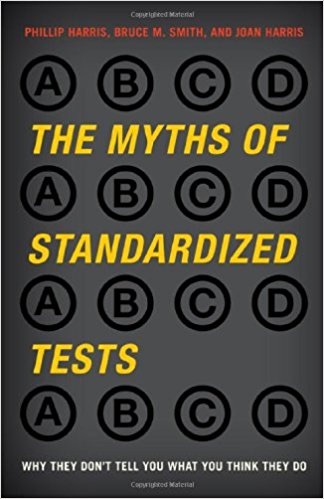
The Myths of Standardized Tests: Why They Don’t Tell You What You Think They Do by Phillip Harris, Bruce M. Smith, and Joan Harris (with a little help from ten of their friends) is a MUST read for anyone fighting the current testing system.
Phillip Harris
- Phillip is executive director of the Association for Educational Communications & Technology. He was a faculty member of the faculty of Indiana University for twenty-two years in Psychology and Education.
- Bruce M. Smith was a member of the editorial staff of the Phi Delta Kappan for 27 years and he retired as editor-in-chief in 2008.
- Joan Harris has taught grades one through three for 25 plus years. In 1997 she was recognized by the National Association for the Education of Young Children as the outstanding teacher of the year.
-
The Myths They Debunk
- High test scores at a school means it has high achievement. Test scores provide objective achievement information. Rewards and punishments based on tests motivate. Improved test scores imply improved learning. All valuable content is tested. Standardized test scores are the best form of assessment. If you move to a district with high scores you will do better.
It’s An Emergency
- The authors believe that our schools are under attack by the tests that continue to seep into our schools. They sap the energy and enthusiasm of educators and drain the life from children’s learning. Some of the motivation is commercial and some is caused by “the tyranny of good intentions.” In this book they hope to persuade you of their case and arm you with some basic understanding of standardized tests and the mythical assumptions that underlie them that are used to make policy and drive practice. The lives of our children and our future is at stake. Our schools do have problems, but they won’t be fixed by another truckload of test scores.
Tags: Bruce Smith, Joan Harris, NCLB, Obama Blueprint, Phillip Harris, Standardized Testing
Posted in Book Summaries, Education Books | Comments Off on The Myths of Standardized Tests: Why They Don’t Tell You What You Think They Do
Monday, February 5th, 2018
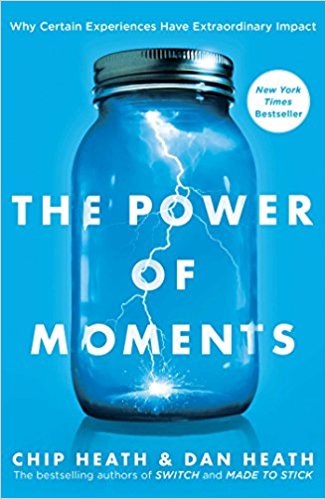
The Power of Moments: Why Certain Experiences Have Extraordinary Impact by Chip and Dan Heath makes the case that we all experience moments that make a huge difference in our lives and that there are things we can do to make them happen. You need to be aware of moments in your life and look for ways to make them happen again for yourself and those you serve. This is a must-read for any leader.
1. Defining Moments
- We all have defining moments in our lives. This book has two goals. One is to examine defining moments and identify the traits they have in common. Two is to show how to create defining moments by making use of these traits. When we reflect on an experience, we do not average our feelings over time. Rather, we focus on the high and low spots, the peaks, and the pits, along with the beginnings and ends.
- One or more of the following elements are involved. 1. Elevation: Something happens to elevate the experience from those surrounding it. 2. Insight: Here is where you suddenly realize something about yourself or the world that makes a difference. 3. Pride: This is when you accomplish something special. 4. Connections: Defining messages are social. Special moments become more special when you share them with others.
2. Thinking in Moments
- There are three kinds of situations that stand out as moments in our lives. They are transitions, milestones, and pits. The goal is to mark transitions, commemorate milestones, and fill the pits. Here the Heath’s tell some stories of how employers can make transitions like the first day on the job special, how banks can help commemorate savings and mortgage milestones, and how service providers can fill pits as soon as they show up. At the end of this section and each section in the book they include a clinic, which demonstrates how the book’s ideas can be put to use.
Posted in Book Summaries, Business Books, Education Books, Leadership Books | Comments Off on The Power of Moments: Why Certain Experiences Have Extraordinary Impact by Chip and Dan Heath
Saturday, April 23rd, 2022
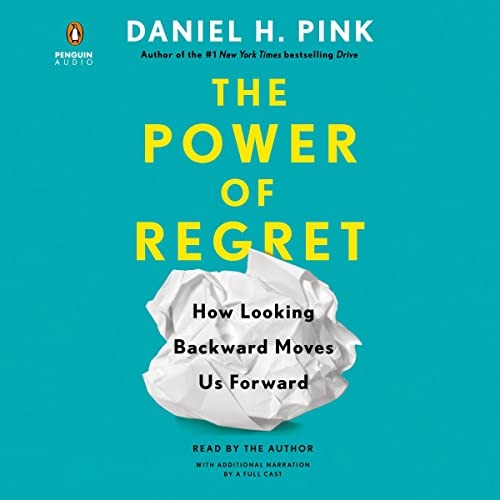
The Power of Regret: How Looking Backward Moves Us Forward by Daniel Pink deals with the power we can draw from dealing with our regrets in a thoughtful manner. Regrets deal with things you can control so you need to take action when possible to make things better and move on from things that can’t be fixed. Research shows that people who do this are healthier and happer. Thanks, Dan for this vital life lesson.
Part One. Regret Reclaimed – 1. The Life-Thwarting Nonsense of No Regrets
- Fron popular songs to literature to advice columns we hear over and over again about how successful people supposedly have no regrets. In this book, Pink shows not only that this is wrong-headed thinking, but when properly used, analysis of your regrets can serve to improve your life. We all have a portfolio of emotions and most of us try to have a bias in our lives for positive ones. That makes sense, but we also need to deal with negative emotions to help us avoid harm, be it physical or emotional. The purpose of this book is to show you how to use regret’s many strengths to make better decisions, perform better at work, and bring greater meaning to your life. Pink draws on his analysis of two massive surveys to accomplish this goal.
2. Why Regret is Human
- Regret is the unpleasant feeling associated with some action or inaction a person has taken which has led to a state of affairs that the person wishes were different. It is more understood as a process than a thing. As we mature, our brains naturally develop to experience regret. It is associated with the orbitofrontal cortex. People with lesions in this area typically do not experience regret. The same is true for people with Huntington’s and Parkinson’s disease. Reget is the most common negative emotion as things you regret are your own fault. They are things where you had control and constantly involve some comparison.
3. At Least’s and If Only’s
- These are two types of counterfactuals. When you think at least, you are thinking about how things could have been worse. When you think if only, you are thinking that an outcome could have been better if you had done something different. Most people engage in if only thinking much more than at least thinking. If only thinking degrades our feelings now, but it can improve our lives later. This is one way regret can help us do better tomorrow.
4. Why Regret Makes Us Better
- If you actively regret something you are not likely to do it again. A central finding is that regret can deepen persistence, which almost always elevates performance. Even thinking about other people’s regrets may confer a performance boost. Regret, however, does not always elevate performance. Lingering on regret for too long can have the opposite effect. Setbacks can supply fuel for future performance. Making mistakes and learning from them via regret is a path to growth.
- When it comes to things you regret it is key that you not wallow in them or dodge them altogether. Doing so will just make things worse. These feelings should result in thinking that results in future action that makes things better or avoids further pain. Think of this action as an evaluation that can be instructive. In short, if you make a mistake you need to ask yourself “what can I learn from it.” (Doug: This is a guiding principle for me.)
Posted in Book Summaries, Business Books, Education Books, Leadership Books | Comments Off on The Power of Regret: How Looking Backward Moves Us Forward by Daniel Pink
Wednesday, September 19th, 2012
The Principal as Instructional Leader: A Practical Handbook, 3rd ed. (©2013, Eye On Education: Larchmont, NY) by Sally J. Zepeda offers savvy advice, practical tools, and examples from real schools to help both new and experienced principals and their assistants improve teacher effectiveness and boost student achievement. The focus is on improving observations, assessing school culture and climate, addressing marginal teaching, and supporting adult learning. Practicing principals and principals-in-training should read this book. Be sure to click the icon at the bottom of any page to purchase.
Tags: Sally Zepeda
Posted in Book Summaries, Education Books | Comments Off on The Principal as Instructional Leader: A Practical Handbook by Sally Zepeda
Sunday, November 8th, 2020
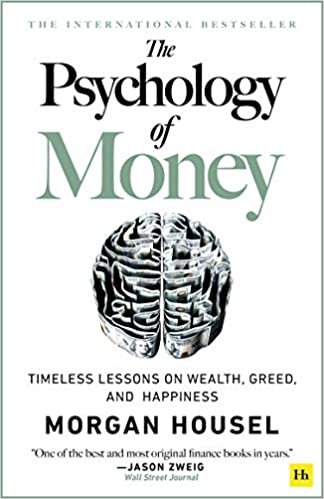
The Psychology of Money: Timeless Lessons on Wealth, Greed, and Happiness by Morgan Housel explains the psychology of spending and saving for anyone who has to deal with money and life. This is an excellent nontechnical study of this most important topic for high school students on up. If you want to acquire enough wealth to feel independent this book is for you. You can skip to chapter 20 to learn what Morgan and I do with our money.
Introduction
- We start with stories of a janitor who invested what he could in blue-chip stocks and died with an estate worth $8 million dollars and a successful businessman who went bankrupt by overspending on houses and wasting money. The premise of this book is that doing well with money has little to do with how smart you are and a lot to do with how you behave. It’s more about psychology and not so much about physics.
1. No One’s Crazy
- The decisions we make about money depend heavily on our experiences and the environment we grew up in. Although the first currency dates back to about 600 BCE, most of our current financial instruments only arrived after World War II. Prior to that time, most people worked until they died. Now we all expect to retire and have to save and invest for that day. Since modern instruments are so new, we aren’t crazy, we are just essentially newbies at it.
2. Luck & Risk
- Bill Gates attended a high school that had better computer access than most graduate schools. This allowed him to become an expert who wrote a program to do the school’s schedule among other things. Were it not for this unprecedented access he claims there would be no Microsoft. Meanwhile, his best friend who also became a computer wiz died in a mountaineering accident before he finished high school. The point here is that luck and risk are siblings. He shares other stories of people who took risks and made it big like Vanderbilt and Rockafellar who felt they had enough power to ignore some laws and indeed they did. Not all success is due to hard work and not all poverty is due to laziness. Keep this in mind when judging people. (Doug: Better yet, don’t judge people.) The world is too complex to allow 100% of your actions to dictate 100% of your outcomes.
3. Never Enough: When Rich People Do Crazy Things
- When you are young taking some modest financial risks makes sense as you have time to recover. At some point, you may need to decide that you have enough and scale back your risk. Morgan cites Bernie Madoff and Rajat Gupta as very successful investors who didn’t know when to say enough and ended up in prison after running a Ponzi scheme and engaging in insider trading. The ideas that the best games to play in a casino are none of them and that the Lotto is a tax on the poor are also instructive.
Posted in Book Summaries, Business Books, Education Books | Comments Off on The Psychology of Money by Morgan Housel
Monday, October 1st, 2012
The Reading Workout: A 30-Day Plan That Turns Teenagers into Readers by Chris Beatty offers straightforward advice that respects the intelligence of its readers and fosters a love of reading. It will take readers beyond the soulless world of standardized tests and provide them with a foundation for academic success. Each of the 30 daily chapters takes less than five minutes and can be used many ways, even by non teens. Be sure to click the icon at the bottom of each page to purchase copy(s) for your favorite teens and adult readers who want to love reading.
Tags: Chris Beatty, Reading Workout, The Reading Workout
Posted in Book Summaries, Education Books | Comments Off on The Reading Workout: A 30-Day Plan That Turns Teenagers into Readers by Chris Beatty
Monday, January 5th, 2026

The Righteous Mind: Why Good People Are Divided by Politics and Religion by Jonathan Haidt is essentially a textbook on morality and how it has impacted our political life. If you want to understand why we are so divided and what we can do about it, this book is for you. Although he has worked for democrat administrations, he has managed to make this book very fair and balanced. It belongs in your library.
Introduction
- Rodney King’s quote from 1992 “Can we all get along” is compared to a lesser known quote of his. “We all can get along. I mean, we’re all stuck here for a while. Let’s try to work it out.” So why are we so easily divided into hostile groups, each one certain of its righteousness? This book deals with this big question and human morality in general, which has made civilization possible. Get ready for a tour of human nature and history from the perspective of moral psychology. The author’s hope is this the book will help us all get along.
Part I Intuitions Come First, Strategic Reasoning Second – 1. Where Does Morality Come From?
- There are many studies that show how morals are largely a function of culture. Christian and muslim cultures, for example have different moral beliefs about how women should be treated. Another part is self-constructed as children develop. Kids can spot harm when they see it and uniformly think it’s wrong. People also have gut feelings, particularly about disgust and disrespect, that can drive their reasoning.
2. The Intuitive Dog and Its Rational Tail
- People reason and people have moral intuitions. The author makes a case that reason is the servant of the passions. Intuitions come first, strategic reasoning second. Social Institutionalism adds a social context. If you ask someone to believe something that violates their intuitions they will look for some reason not to believe you. If you agree with the author that institutionalism might be true, then let’s keep going.
3. Elephant Rule
- Johnathan uses the metaphor of the elephant and the rider where the elephant is our intuitive automatic response and the rider is our reasoning brain. Studies show that brains evaluate instantly and constantly. Social and political judgements depend on quick intuitive flashes, bad smells, and tastes can influence our judgement. Psychopaths reason but don’t feel, and babies feel but don’t reason.
- Intuition is where most of the action is when it comes to moral philosophy, but reason matters. Friendly conversations are more likely to change your mind than aggressive arguments. We have evolved an inner lawyer that uses our brain power to find evidence to support what we want to believe rather than an inner scientist or an inner judge.
4. Vote for Me (Here’s Why)
- Our moral thinking is much more like a politician searching for votes than a scientist searching for truth. People invest their IQ in buttressing their own case rather than in exploring the entire issue more fully and evenhandedly. Now that we have access to search engines on our cell phones, we can call up a team of supportive scientists for almost any conclusion.
- The partisan brain has been reinforced so many times for performing mental contortions that free it from unwanted beliefs. Extreme partisanship may be literally addictive. Each reasoner is really good at one thing: finding evidence to support the position he or she already holds, usually for intuitive reasons. Conscious reasoning functions like a press secretary who automatically justifies any position taken by the president. The worship of reason is a delusion.
Posted in Book Summaries, Education Books, Leadership Books | Comments Off on The Righteous Mind: Why Good People Are Divided by Politics and Religion by Jonathan Haidt