Archive for the ‘What can Dr. Doug do for you?’ Category

Tony Blair on Leadership: Lessons for the 21st Century

Monday, February 17th, 2025

Boook
Tony Blair on Leadership: Lessons for the 21st Century summarizes what Tony has learned as prime minister of the UK from 1997 to 2007 and consulting with leaders in many other countries as head of the Tony Blair Institute. Although this book is written for aspiring politicians, I believe that each short chapter contains timeless lessons for leaders and potential leaders in any field.

Introduction

  • When leaders take over, most listen carefully as they know they have a lot to learn. The second stage occurs when they have become acclimated and start to think they know everything. In the final stage, they realize that what they know is not the sum total of the necessary knowledge associated with their leadership scope.
  • Tony has concluded that the key attributes of leadership are the same whatever the leadership position. While politics has its place, it isn’t the same as leadership. Giving people what they want is not always what they need. Leaders need to do what is in the best interests of the lives they touch.

Part I: Taking Power – 1. Be the Leader with the Plan

  • You must have a plan. It needs to contain your destination, milestones, and priorities and accurately describe the essentials of what you want to achieve. Priorities are essential as if you try to do everything, you just might do nothing. Change takes time and you will need to consider mid-course corrections as you move along. Not all of what you plan is likely to work as intended.

2. Make the Center Strong

  • The skill set you need as a leader is not the same as the skill set that gets you the job. A strong center is needed to initiate and carry though on a change. The most important person is the one who runs your schedule. Leaders are constantly being asked for their time and if they can’t say no, they need someone who can. Meetings and events can be real time suckers. Leave them as soon as you can. Be sure to make time for yourself to recharge and time for your family.

3. Prioritization: Try to Do Everything and You Will Likely Do Nothing

  • Once you get your leadership position, ask what you would like to accomplish the most. You can work back from these items to set your priorities. Tony sees five as a good number. Your followers will all have their pet projects. While they may not be at the top of your list, they don’t need to know that. Priorities have to be doable. Be sure to perform a feasibility check on each one. This process may not be easy, but it deserves your attention along with all of the uplifting rhetoric of hope you can summon.

4. Good Policy Is (Nearly) Always Good Politics

  • Always put policy first and politics second. Avoid maters of ideology and convenience when crafting policy. Policy should be evidence-based. Work hard to do research so you know what you are talking about. Always think about a topic as if you were the person most impacted. Good policy strives to make change that will last rather than a quick splash. Be sure to look outside of your organization (country/school) for bright ideas and be sure to think ahead.

5. It’s All About the People

  • The people Tony refers to here are the people who directly report to you. They need to be smart, hard working, loyal to you and to each other, and able to handle stress. Internal debate is healthy, not disruptive. Don’t reject someone just because they are smarter than you. Be sure to promote your most talented people. They are more likely to challenge you if you don’t. Effort you put in to finding the right people may be the most important thing you do..

6. Curb Your Bureaucracy by Cultivating It

  • As a leader, you will have a bureaucracy to deal with so you need to get to know what it does and doesn’t do. bureaucracies tend to be permanent while the leader tends to be temporary. They are not known for creativity or innovation. Be clear about results, delivery, and on getting things done and the system will adjust. Look for opportunities to re-skill and retrain it. Don’t expect it to be a substitute for a leader and a team.

Part II: Delivery – 7. Democracy or Not, It’s All About Delivery

  • As a leader, your success will be judged by what you deliver. The real test of government is making change that works, which is delivery. If you can deliver a higher quality of life with improved health care, education, and security, you should be reelected. Governments turnover due to instability, which is caused by the failure to deliver. People sometimes accept a strong man because the know that something will get done. Corruption is the enemy of delivery.

8. The Supreme Importance of Strategy

  • Strategy assists in the long-term fulfillment of your overall plan. Without a strategy, failure is likely. Tactics are the smaller decisions that you make on a daily basis. It’s important that they align with your long-term strategy. You have to reconcile your day-to-day tactics to your core strategy. When fundamental facts change, but sure to see if you need to adjust your strategy. You should seldom discard it altogether.

9. Be a Change-Maker, Not a Place-Holder

  • The world is changing fast. If you are standing still, you get left behind. If you are an elected leader, you probably got elected by promising to make some changes. Appointed leaders may have the same expectations. You need to create a constituency for your change so you have some support. Consider how you can break big changes into a series of smaller ones and take them incrementally. Consider how changes will benefit the consumers rather than the providers.

10. Le Suivi: Delivering

  • Two things are necessary here. The priorities you choose must be measurable and you must be able to harvest reliable data so you can show that you accomplished your priority. When it comes to delivery, the leader needs to be actively involved. The leader need not do all of the work, but the leader must know what’s happening.
Share this:
Share this page via Email Share this page via Stumble Upon Share this page via Digg this Share this page via Facebook Share this page via Twitter Share this page via Google Plus

Top 10 Tips for Test Preparation by Craig Middleton

Saturday, April 4th, 2020

Bubble Sheet
Top 10 Tips for Test Preparation by Craig Middleton offers sound advice for parents so they can help their children do their best on tests given by their teachers and standardized tests like the SAT and the ACT.

Testing scores are an important part of any child’s school experience. These scores allow a regular classroom teacher to evaluate a student’s progress and recognize any areas that may need more attention or improvements. Testing is an effective way to measure progress and to make sure that the child is able to communicate effectively. It can also be a way to recognize and discover learning disabilities in certain situations. Testing is also important when it comes to pursuing higher education as it is a big factor in college admissions. To ensure that your child does his or her best, take measures to ensure that they are adequately prepared for any tests so that they may do their best.

Sleep

  • Proper sleep is absolutely necessary, especially on the night before a big and important test. If your child is well-rested they are more easily able to focus and concentrate on the test.

Breakfast

  • Breakfast is another essential part of preparing for a test day. Make sure that your child has had a good breakfast the morning of the test so that they are full and have the energy they need to stay alert. Hunger can be distracting and lead to sub-optimal performance.

Organization

  • Good organization is another tip in preparing for a test. Make sure that your child has all the necessary testing materials such as pencils, erasers, pens, calculators, and any other equipment that has been recommended. Have all of these things gathered ahead of time and ready to go to avoid last-minute stress and scrambling to find missing items.

Tutoring

  • A good way to prep for testing is to get additional instruction. Tutoring in addition to regular classroom preparation may help the child achieve greater results. Consider this option for ongoing education but especially for ACT Prep.

Positive Attitude

  • Stay positive and make sure that you maintain an upbeat attitude for both yourself and your child. Be a good example and show them that the test is necessary and important, but not a reason to become upset and dread what is to come. Help them keep an elevated mood so they’re excited and ready to go.

Teacher Conferences

  • Consider having regular conferences with a student’s teacher. This will keep you up-to-date on their current academic levels and let you know if any additional instruction would be beneficial. Conferences open communication with the teacher to allow you both to work together more efficiently and will give you an idea of what to expect for future performance.

Relax

  • t’s also important to make sure that your child is relaxed. Ensure that they are not overly anxious over the upcoming test. Help your child to stay calm and be mentally prepared so the stress doesn’t become overwhelming.

Homework

  • Make sure the child is current with all of their homework. Having all the work done on time will help them learn to be responsible and prepared and will keep you up-to-date with the materials that may be covered on the tests.

Test Format

  • Test formats can vary greatly and if your child is already stressed over the thought of taking a test, an unexpected or new format may cause them unnecessary anxiety. Make sure that the student is familiar with the test format so there are no surprises and so that you are sure they understand how to fill out the form and complete all tasks.

Practice Tests

  • Take advantage of any practice tests that may be available. Many of the larger tests, such as the ACT, offer practice tests, or you can create your own for smaller tests. A practice test will give your child an idea of test format, time limits, and topics that will be covered. This allows the students to be better prepared and comfortable so they can relax and do their best.
  • The more prepared your child is the more likely they are to do well on their tests. Familiarize yourself with the entire procedure so that you can help your child prepare and reach their full potential.

Craig Middleton

  • Craig is a New York City-based retired business consultant, who is an expert in education and cultural trends. He has a Masters of Business Administration and a Masters in Education from St. Johns and loves sharing his knowledge on the side through his writing. If you have any questions or comments you can direct them to Craig at craigmiddleton18@gmail.com.
Share this:
Share this page via Email Share this page via Stumble Upon Share this page via Digg this Share this page via Facebook Share this page via Twitter Share this page via Google Plus

Two Thoughts: A Timeless Collection of Infinite Wisdom by Jim O’Shaughnessy with Vatsal Kaushik

Monday, December 8th, 2025

Book
Two Thoughts” A Timeless Collection of Infinite Wisdom by Jim O’Shaughnessy with Vatsal Kaushik captures insights from 250 of the world’s most influential minds. These pages capture the essence of human thought and experience. These quotes will challenge, inspire, and illuminate as they provide a lens through which to view your own life. Put a copy on your desk and open it to any page to find a companion for your thoughts, a catalyst for your aspirations, or simply a moment of clarity in your day. Thanks Jim and Vatsal.

Preface

  • It all started with a tweet from Jim O’Shaughnessy on December 28, 2020. It contained two quotes from Buckminster Fuller. This started Jim’s Two Thoughts series that became a daily institution. What is important is not what is said or who said it, but it’s what you do with it. Try to make some of these quotes your own. As you read, scribble, go on tangents, and find weird relationships. This should be a book or action, not only of thought, so try not to read it cover to cover. Good luck and have some fun.

Introduction

  • Consider that the human mind contains two characters, the thinker, and the prover. After some effort, the thinker decides that something is right or wrong and then shuts off. The prover’s job then is to look at the beliefs delivered by the thinker and get to work proving them right. The prover might firewall information counter to what is supposed to be proved. Once the proving is done, most people stop thinking on the matter and go on to something else. (Doug: From what I’ve seen, many people let the media they consume do the thinking, and perhaps most, if not all of the proving.)
  • The authors encourage you not to accept the quotes here as gospel, but rather to use them to get you thinking, proving, and thinking again in an endless cycle. Weigh these quotes, but don’t worship them. Be entertained rather than exalted. Chew on them, but don’t swallow.
  • The next five chapters contain two quotes from 250 people followed by a brief biography. Rather than try to summarize them, I will give you some of my favorites. Yours will probably be different, so BUY THIS BOOK!

Wordsmiths: Writers, Playwrights, Poets, Satirists, and Cartoonists

  • The cure for boredom is curiosity. There is no cure for curiosity. Dorthy Parker
  • Progress isn’t made by early risers. It’s made by lazy people trying to find easier ways to do something. Robert Heinlein
  • You don’t have the right to the cards you believe you should have been dealt. You have an obligation to play the hell out of the cards you’re holding. Cheryl Strayed
  • There is nothing noble in being superior to your fellow man; true nobility is being superior to your former self. Ernest Hemingway
  • Children aren’t coloring books. You do not get to fill them in with your favorite colors. Khaled Hosseini
  • You’re twice as biased as you think you are (four times if you disagree with that statement). Morgan Housel
  • Youth is happy because it has the capacity to see beauty. Anyone who keeps the ability to see beauty never grows old. Franz Kafka

Scholars: Researchers, Psychologists, Economists, Academics, and Executives

  • When we are no longer able to change a situation, we are challenged to change ourselves. Viktor Frankl
  • My advice is to read widely and think for yourself. We need more dissent and less dogma. Camille Paglia
  • Self-improvement comes mainly from trying to help others. Sir John Templeton
  • Ignorance more frequently begets confidence than does knowledge. Charles Darwin
  • It is an iron rule of history that what looks inevitable in hindsight was far from obvious at the time. Yuval Noah Harari
  • To the man who only has a hammer, everything he encounters begins to look like a nail. Abraham Maslow
  • You can’t hold a man down without staying down with him. Booker T. Washington
  • The conventional view serves to protect us from the painful job of thinking. John Kenneth Galbraith
  • When supporting others, we need to offer the comfort of Kirk and the intellect of Spock. Ethan Kross
Share this:
Share this page via Email Share this page via Stumble Upon Share this page via Digg this Share this page via Facebook Share this page via Twitter Share this page via Google Plus

Uncommon Sense Teaching: Practical Insights in Brain Science to Help Students Learn by Oakley, Rogowsky, and Sejnowski

Monday, November 29th, 2021
Uncommon Sense Teaching

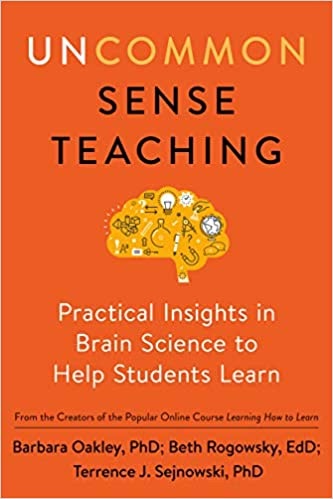
Uncommon Sense Teaching: Practical Insights in Brain Science to Help Students Learn by Barbara Oakley, Beth Rogowsky, and Terrence Sejnowsk
t explains how the brain works when it learns. It also offers lots of practical real world advice for teachers and learners of all ages. No school professional development library should be without it.

1. Building Memory: How Students Fool Themselves into Thinking They’re Learning

  • Information in working memory generally goes away when we stop thinking about it. This can fool students into thinking they really know something. What they need to do is right after they have encountered new information, they should see if they can retrieve it from long-term memory. Retrieval practice is one of the best techniques for strengthening new information in long-term memory. The more times you retrieve something the stronger your memory of it will be. Students should jot notes about what they just learned and compare their notes with other students. Retrieving information from previous days or weeks is called spaced repetition, which further strengthens long-term memory.

2. Teaching Inclusively: The Importance of Working Memory

  • Not all students have the same amount of working memory. For those with less, it’s vital to build their long-term memory, which will make the short-term memory they have more efficient. Working memory increases over time until children reach the age of about 14. Engaging students’ interests makes learning more effective while stress gets in the way.
  • Slower learners can benefit from reteaching, giving them more time to practice, giving them outlines to take notes on, and breaking things down into simpler steps. For faster learners go beyond factual questions, have them work together, increase the complexity of assignments, have extra activities for them to do, and let them devise their own activities. This helps you differentiate your teaching. In all cases, active practice should break up teacher talk.

3. Active Learning: The Declarative Pathway

  • Research shows that active learning is much more effective than simply listening to an expert. Note that not all hands-on activities are considered to be active learning. Active Learning engages students in the process of learning through activities and/or discussions in class. It emphasizes higher-order thinking and often involves group work. The foundation for conceptual understanding and creative thinking is the storage of basic facts and procedures in long-term memory. Note-taking and retrieval practice facilitate this process.
  • Long-term memories are stored in the neocortex, which is the big front and top of your brain. The process is facilitated by the hippocampus, which is composed of two small bean-shaped pieces at the base. It acts as an index while the connections of neurons that store memories are being made. Retrieving recently stored memories serves to help consolidate the information. Much of this consolidation occurs while we are sleeping. Brief breaks of even less than a minute can help students make sense of new material. Index links from the hippocampus dissolve after a while, which is why cramming the night before doesn’t work as there is no time for consolidation.
  • Frequent formative assessments, low-stakes tests, homework, and exercises can all help with retrieval. Daily physical exercise of an hour or more helps with the formation of neuron connections. Be sure to tap into prior knowledge. Use the think-pair-share method when teaching. Students will find that working in pairs or groups of three or four is more effective than larger-sized groups. If possible, pick a shy person from a group with the right answer (or a good answer) to present to the class.
Share this:
Share this page via Email Share this page via Stumble Upon Share this page via Digg this Share this page via Facebook Share this page via Twitter Share this page via Google Plus

Unlocking New Horizons: How Women Can Expand Their Careers and Personal Growth by Emily Graham

Friday, December 12th, 2025

Women

Unlocking New Horizons: How Women Can Expand Their Careers and Personal Growth

Across industries, women continue to redefine leadership, creativity, and impact. Yet many still face systemic and situational barriers—limited mentorship, career plateaus, and the constant balancing act between personal and professional ambitions. True progress requires intentional strategies: identifying new opportunities, building supportive networks, and pursuing education that empowers change.

What You’ll Find Here

  • Key mindsets that transform career plateaus into growth cycles
  • Actionable strategies to identify and seize new opportunities
  • A practical how-to checklist for advancement and self-development
  • A data-informed comparison of leadership pathways and outcomes
  • Guidance on continuing education
  • Shifting From Aspiration to Agency

    Career advancement starts with shifting from hoping for growth to designing it. Women often wait for recognition that never comes—or downplay their readiness for leadership roles. Instead, clarity and visibility are critical: articulate what you bring to the table, seek sponsorship rather than passive mentorship, and connect your career story to measurable outcomes.
    When a woman claims her narrative and aligns it with her organization’s priorities, she transitions from being seen as a contributor to being understood as a catalyst for progress. That shift changes everything: it moves conversations from “What role can I have?” to “What impact can I make?”

    Education as a Force Multiplier

    Pursuing advanced degrees or credentials remains one of the most powerful catalysts for reinvention. For women balancing career, family, and growth, flexible learning models open new possibilities.
    Enrolling in an accelerated online EdD in leadership program allows ambitious professionals to develop advanced strategic, organizational, and research skills—without pausing their current careers. These programs are designed for real-world impact: graduates lead school systems, nonprofits, or corporate learning initiatives that shape the next generation of leadership.

    The Network Effect

    Collaboration is the real engine of advancement. Networks—formal or informal—magnify opportunities, visibility, and resilience. Women who connect across industries often discover lateral moves that unlock unexpected doors.
    Before the next opportunity arises, ask yourself:

  • Who consistently challenges and supports my growth?
  • Which relationships bring visibility to my work when I’m not in the room?
  • How am I reciprocating, advocating, and amplifying others?
  • A network built on mutual growth doesn’t just offer professional connections—it creates psychological safety and belonging, both essential for sustained success.

    Common Barriers—and How to Navigate Them

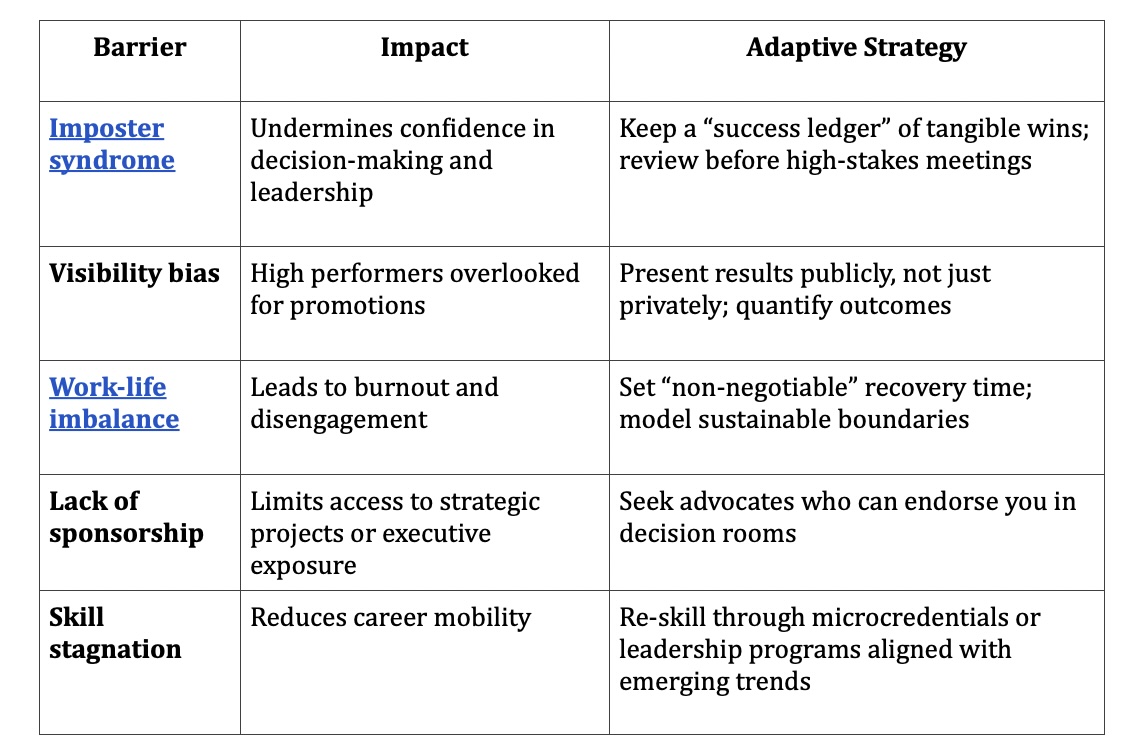
    Women still encounter structural obstacles and cultural expectations that slow career progress. Yet proactive navigation strategies can mitigate many of them.
    Graham
    Imposter Syndrome
    Work-Life Balance

    How to Identify and Seize New Opportunities

    Sometimes, opportunity doesn’t arrive neatly packaged. It’s discovered, created, or reframed.
    Try this short checklist for proactive career expansion:
    Scan your environment: Where are unmet needs, untapped audiences, or inefficiencies you can solve?

    Prototype action: Test a small-scale initiative that demonstrates capability beyond your current scope.

    Ask for feedback, not permission: Share results and insights to build momentum.

    Quantify the win: Convert impact into measurable metrics (time saved, revenue gained, satisfaction improved).

    Document the story: Turn outcomes into case studies or internal presentations to position yourself for future roles.
    The most successful leaders don’t just fill roles—they create new ones through demonstrated value.

    Key Habits That Sustain Long-Term Growth

    A few behavioral anchors separate those who progress consistently from those who stall.
    Continuous reflection: Schedule quarterly self-reviews as you would a business audit.

    Skill stacking: Pair technical expertise with communication, strategy, or design thinking.

    Visibility hygiene: Keep your professional profiles, publications, and bios updated.

    Mentorship loop: Mentor others; it reinforces your authority and expands your network.

    Boundary literacy: Sustainable success depends on saying “no” as decisively as “yes.”

    Frequently Asked Questions

    Here are a few of the questions that often arise when women explore new career and growth pathways:

  • Q: How do I balance career advancement with family or caregiving responsibilities?
A: Leverage flexible education models and remote collaboration tools. Focus on progress over perfection—growth can happen in increments.
  • Q: What if I’ve been out of the workforce for a while?
A: Reentry programs, certifications, and online graduate degrees are designed for this. Highlight transferable skills and recent learning to show readiness.
  • Q: Is leadership training really necessary for influence?
A: Influence without training can happen, but structured leadership education accelerates it—especially in environments where credentials still shape credibility.
  • Q: How do I know which opportunities align with my purpose?
A: Evaluate each one by asking: “Will this expand my impact, align with my values, or improve my learning curve?” If at least two are true, it’s worth pursuing.
  • Conclusion

    Growth doesn’t happen by waiting—it happens by positioning yourself where opportunity meets preparation. For women ready to lead, reinvent, or influence change, the path forward is both personal and systemic: cultivate clarity, pursue education that fits your life, and surround yourself with allies who amplify your ambition.
    Every time a woman claims her leadership narrative, she reshapes what’s possible—not just for herself, but for every woman who follows.

    Emily Graham

    Emily is the creator of MightyMoms.net. She believes being a mom is one of the hardest jobs around and wanted to create a support system for moms from all walks of life. On her site, she offers a wide range of info tailored for busy moms — from how to reduce stress to creative ways to spend time together as a family. You can email her at emilygraham@mightymoms.net. She lives in Arizona.

    Share this:
    Share this page via Email Share this page via Stumble Upon Share this page via Digg this Share this page via Facebook Share this page via Twitter Share this page via Google Plus

    What Is Covered in a Human Trafficking Course? by Kathleen Zara

    Sunday, July 17th, 2022

    Free Resources for Busy Parents and Educators Who Don’t Have as Much Time to Read and Surf as I Do

    TrafickingWhat Is Covered in a Human Trafficking Course? by Kathleen Zara explains why at least one person in every school district should take such a course. Be sure to share it with leadership in your school district.



    Human trafficking has become an international issue that is gaining more attention yearly. On the international level, South and Central Asia was the region with the second-most trafficking victims in 2019. Businesses need to be aware of what it is and how to identify it. This article will discuss the different things covered in a human trafficking course.

    1. The Definition
    It is the recruitment, transportation, transfer, harboring, or receipt of persons using threat or use of force or other methods of coercion, abduction, fraud, deception, abuse of power or position of vulnerability, or giving payments or benefits to get the consent of a person having control over another person for exploitation.
    Exploitation is prostitution or any other forms of sexual exploitation, forced labor or services, slavery or similar practices, and the removal of organs.

    2. How to Identify Victims
    The course will cover identifying potential victims of human trafficking and the signs that may indicate that someone is being trafficked. It includes looking for patterns of control, exploitation, and victimization.
    It is essential to identify victims because they are often hidden in plain sight. They may be working in massage parlors, nail salons, or factories. They may be living in homes with many other people and not have any personal belongings. They may also be moved around frequently and have few close friends or family members.
    If you see someone you think may be a victim of it, the best thing to do is reach out to organizations that can help, such as the National Human Trafficking Hotline. (888 373-7888) They can support victims and connect them with resources in their area.

    3. The Different Forms That Human Trafficking Can Take
    It is crucial to know the different forms that human trafficking can take to identify it. It can include sex trafficking, forced labor, organ trafficking, or domestic servitude. Sex trafficking happens when someone is forced or coerced into sexual activity. It can happen through force, fraud, or coercion. Victims of sex trafficking can be children or adults of either gender.
    Forced labor is when someone is made to work against their will through force, fraud, or coercion. It can happen in many industries, such as agriculture, manufacturing, construction, and domestic work. Organ trafficking is when organs are removed from a person for transplantation.

    4. What Businesses Can Do to Help Prevent and Report Instances
    You can learn how to prevent it in your business and what to do if you witness or suspect it. This knowledge is critical for business owners, employees, and managers. You’ll also learn about the signs of trafficking and how to report it.

    5. Due Diligence, Victims, and Perpetrators
    The human trafficking course covers a variety of topics related to crime. These can include due diligence measures businesses can take to ensure they are not complicit in trafficking, how to identify victims of trafficking, and profiles of typical perpetrators. The goal of these courses is to help participants better understand the issue and try to prevent them.

    Conclusion
    Whether you are searching to start a career or want to learn more about human trafficking, taking a certified course is a great way to gain knowledge and skills. A comprehensive online course will identify victims, understand legal issues, and develop victim-centered responses.

    Kathleen Zara
    Kathleen works as a freelancer and entrepreneur working from a start-up learning along the way about marketing, social and networking, creating Web sites, and web content. @ACAMS_AML

    Share this:
    Share this page via Email Share this page via Stumble Upon Share this page via Digg this Share this page via Facebook Share this page via Twitter Share this page via Google Plus

    What Schools Should Be Teaching About Nutrition by Craig Middleton

    Friday, January 24th, 2020

    Apple Pic
    What Schools Should Be Teaching About Nutrition by Craig Middleton covers some of the basics of nutrition that schools should consider adding to their formal curricula. While there is a lot more to know, this is a good place for you and your kids to start.

    Introduction

    • For a long time, many educators have pleaded that schools should teach more about problems that children will run into when they become adults. Adult challenges that some schools have started preparing students for include finances and general computer classes like teaching office software for example. Often disregarded is nutrition even though physical education is still typically required. Whether a school decides to integrate nutrition into their physical education or health classes or create a separate class, it should be part of every school’s formal curriculum.

    The Truth About Sugar

    • Added sugar has been increasingly seen in more foods than ever in the United States and around the world thanks to initiatives like the U.S. Sugar Program. Making sure you don’t consume too much sugar is important as it can cause many different issues such as cavities, weight gain, and even diabetes. Teach kids how to read labels on food products so they can limit how much sugar they consume on a daily basis. Additionally, have them avoid or very sparingly consume high sugar products like soda and instead consume better alternatives like green tea or just water. Cutting down on sugar is one of the best ways you can live a nutritious lifestyle.

    The Truth About Protein

    • Protein is a very important factor when building a diet for yourself. While protein is in so many foods, make sure to know which types of foods have the most like eggs, milk, beef, pork, fish, or chicken so you are able to build a well-balanced diet. Without protein, you can have deficiency issues that can stunt growth and make you more susceptible to infections. Additionally, you’ll want to eat more protein anytime you get into weightlifting as protein is what will help you build muscles. Make sure you fully understand protein when you want to know about proper nutrition.

    The Truth About Dairy

    • Dairy is the group of products made out of the milk of mammals such as cows, goats, sheep, and more. These products all include cheese, milk, butter, ice cream, and more, and you probably have at least one of these on a daily basis. If you’ve ever had stomach problems, for example, make sure you don’t have lactose intolerance. Lactose is a sugar found in dairy products and the enzyme lactase is needed by people consuming dairy products to digest them without problems. Make sure you don’t have lactose intolerance when consuming dairy products and if you do, consider ways you can still have dairy products such as taking lactase supplements or going for lactose-free products. Understanding dairy products is important when living a nutritious lifestyle.

    The Truth About Cell Health

    • Cell health is important as the more healthy your cells are the more energy you will have and the easier time you will have maintaining your target weight. Following proper cellular nutrition is important in gaining positive cell health. To do this, you’ll want to go for plant-based nutrients (fruits and vegetables) that will trigger your cells to become more healthy. Once you’ve started incorporating plant-based nutrients into your diet, you’ll see results down the line. Ensure that your cell health is good when you want to live a healthy nutritious lifestyle.

    Conclusion

    • No matter what age the children you’re responsible for teaching are, it’s always a good time to start teaching about nutrition. While many kids won’t be able to plan their own diet until they become young adults, some will be able to pass on what they learn to their parents so they might cook better for them. Teaching nutrition at a younger age can also get them to be dead set on following a stricter diet once they are cooking on their own. Building knowledgeable kids for the future will make them happier and healthier adults.

    Craig Middleton

    • Craig is a New York City-based retired business consultant, who is an expert in education and cultural trends. He has a Masters of Business Administration and a Masters in Education from St. Johns and loves sharing his knowledge on the side through his writing. If you have any questions or comments you can direct them to Craig at craigmiddleton18@gmail.com.
    Share this:
    Share this page via Email Share this page via Stumble Upon Share this page via Digg this Share this page via Facebook Share this page via Twitter Share this page via Google Plus

    Writing for Busy Readers: Communicate More Effectively in the Real World by Todd Rogers and Jessica Lasky-Fink

    Tuesday, November 11th, 2025

    Writing
    Writing for Busy Readers: Communicate More Effectively in the Real World by Todd Rogers and Jessica Lasky-Fink spells out the six principles you can follow to increase the probability that people will read, understand, and respond to what you write. Be sure to add it to your professional development library.

    Introduction

    • This book sets out the six fundamental principles of effective writing. It should have a well-defined purpose, help the writer and the reader, not be beautiful writing, have a rigorous science underlying its rules, and have a real context. Busy people tend to skim, postpone, or ignore complex messages. The average professional spends nearly one-third of their time reading and responding to email. If messages are ineffective they impose a tax on the readers’ time. Voters, for example are likely to skip ballot questions that use complex language.
    • Much of what we learned in school is irrelevant or counterproductive in the real-world. The principles in this book are derived from the sciences of cognitive psychology, social psychology, behavioral economics, neuroscience, marketing, and time management. The authors draw on randomized studies and have worked hard to make this book easy to navigate. (Doug: I think they have.)

    Part I: Engaging the Reader – 1. Get Inside Your Reader’s Head

    • Our brains have a limited ability to attend to and focus on multiple things, which also limits our ability to act. Unfortunately, we all tend to multitask, which is really task switching. When we switch from one task to another we are less efficient at both tasks and are more likely to commit errors. Even if we focus on a single task, we tire over time. Our writing, therefore, has to respect this landscape of stress and distraction.

    2. Think Like a Busy REader

    • Readers first have to decide to engage. This usually depends on the envelop, which is the subject line for an email or the importance of the sender. They also need to decide when to engage. Most readers tackle things first that appear to be easier. They need to decide how much time to engage where the decision to skim or scan comes in. Scanning involves reading things like headings and the first sentences of paragraphs. Finally, they have to decide whether to respond. To increase the probability the request has to be clear so the reader knows the task and how to do it. Make it as easy as possible. Above all, know your goals.

    3. Know Your Goals

    • Effective writing is about transferring key information from writer to reader. What is the most important information you want your reader to know? You cannot achieve your goals as a writer if you are unclear on what those goals are.
    Share this:
    Share this page via Email Share this page via Stumble Upon Share this page via Digg this Share this page via Facebook Share this page via Twitter Share this page via Google Plus

    Bard Does a Lesson Plan – If You Are Still Teaching, You Should Use This.

    Thursday, November 16th, 2023

    Bard
    I asked Google’s Bard to “Prepare a lesson plan to teach the quadratic equations at the high school level.” Below is what I got back. My conclusion is that if I were still teaching, I would always ask for Bard’s plan before I made my own. I might not use Bard’s plan, but I would look to it for ideas. I would certainly share the Additional Resources links with my students. If you are still teaching, why aren’t you doing this? This is probably more detailed than your real lesson plans and will impress your principal.

    Lesson Plan: Quadratic Equations

    Grade Level: High School

    Subject: Algebra II

    Time: 50 minutes

    Learning Objectives

    Students will be able to identify and define quadratic equations.
    Students will be able to graph quadratic equations.
    Students will be able to solve quadratic equations using factoring, completing the square, and the quadratic formula.
    Students will be able to apply quadratic equations to real-world problems.

    Materials

    Whiteboard or projector
    Markers or pens
    Graph paper
    Calculators (optional)
    Worksheets (optional)

    Procedure:

    Introduction (5 minutes)

    Begin by asking students what they know about quadratic equations.
    Elicit responses from students and provide a brief overview of the topic.
    Explain that quadratic equations are polynomial equations of the second degree, meaning they have a highest power of 2.

    Identifying Quadratic Equations (10 minutes)

    Display a variety of equations, some quadratic and some not.
    Ask students to identify which equations are quadratic and explain their reasoning.
    Provide examples of quadratic equations in various forms, including standard form, factored form, and vertex form.

    Graphing Quadratic Equations (10 minutes)

    Review the concept of graphing equations in general.
    Introduce the concept of the axis of symmetry for quadratic equations.
    Demonstrate how to graph quadratic equations using vertex form.
    Allow students to practice graphing quadratic equations on their own or in pairs.

    Solving Quadratic Equations (20 minutes)

    Introduce three methods for solving quadratic equations: factoring, completing the square, and the quadratic formula.
    Explain each method step by step, using examples to illustrate the process.
    Provide students with practice problems to solve using each method.

    Real-World Applications (5 minutes)

    Discuss real-world situations where quadratic equations can be used to model problems.
    Provide examples of such problems, such as calculating the height of an object launched into the air or determining the profit or loss of a business venture.
    Encourage students to think of their own examples of real-world applications of quadratic equations.

    Closure (5 minutes)

    Summarize the key points of the lesson.
    Review the different methods for solving quadratic equations.
    Encourage students to ask any remaining questions.

    Assessment

    Observe students’ participation in class discussions and activities.
    Collect and review worksheets or homework assignments.
    Administer a quiz or test to assess students’ understanding of the material.

    Differentiation

    For students who need more support, provide additional practice problems with worked-out solutions.
    For students who are ready for more challenging material, introduce the concept of complex numbers and solving quadratic equations with complex roots.

    Additional Resources

    Quadratic Equations
    Solving Quadratic Equations
    Real-World Applications of Quadratic Equations

    Share this:
    Share this page via Email Share this page via Stumble Upon Share this page via Digg this Share this page via Facebook Share this page via Twitter Share this page via Google Plus

    Dr. Doug Green’s Advice to Prospective Parents

    Monday, June 27th, 2022
    Parenting

    Dr. Doug Green’s Advice to Prospective Parents

    Twitter: @DrDougGreen

    Introduction

    • I was recently invited to a baby shower for my massage therapist. In addition to a card and some money, I included the following advice. It was very well received and appreciated so I thought I would share it with the readers of this blog who can pass it along to any expectant parents and parents of young children they know.

    Congratulations

    • Congratulations on almost being parents. While I’ve only raised one child my wife and I must have done something right given her success in the New York City art scene. I think the big idea is to always encourage, and never discourage.

    Don’t Stifle Artistic Interests

    • When my daughter told us she wanted to “make cartoons” when she was five it would have been easy to pooh pooh the idea and not support it as neither of us were artistic and we both had other ideas about our child’s career options. Our vision, however, was to do just the opposite.
    • We made sure that she always had lots of art supplies, took her to every museum possible, paid for some private art lessons, and sent her to a summer program at the Ringling School of Art and Design prior to her senior year in high school.
    • We then helped her with her application to Pratt Institute in Brooklyn, NY and dug deep to pay for it. After graduating with high honors she has been working nonstop since 2006 in a field she loves.
    • Like most non-starving artists she is working for a company and doing what the boss wants. (The Tampon Hall Show on ABC) While she likes her work, it isn’t exactly the work she would do if left to her own passion. This is what she does in her free time, which seems to be typical in the art community.

    What Else Did We Do?

    • Here are some other things we did. There was no TV in her bedroom. If she wanted to watch TV at least one of us was nearby. We made sure that she engaged in exercise including dance lessons.
    • When we went somewhere she almost always went with us and we never took a vacation without her. We engaged her in lots of conversations and asked a lot of questions. I read to her every night at bedtime until she could read just about anything herself.
    • We had high expectations of her performance in school and helped with homework when she asked for help. When necessary, we intervened with her teachers.
    • In one case when she earned a bad grade (35%) on her first algebra test we meet with the teacher who suggested that she drop out of advanced math. We politely told the teacher that was not a option and that we would help with her homework.
    • Nearly every day before dinner I sat with her and helped with her homework. I realize that many parents might not be able to do this, but do what you can and find help somewhere. At the end the year we were rewarded with a 100% on the New York State algebra regents.

    You Are Not too Young to Spill Paint or Break Eggs

    • I let her paint the basement floor when she was three. This made sense as there was no downside to spilling the paint. I let her crack eggs in the kitchen when she was five. It’s hard to miss when the goal is to break an egg and any five-year-old can fish pieces of shell out of cookie dough.
    • I let her mow our lawn with our gas-powered lawn mower when she was nine. It automatically shut off if you took your hands off of the handle so it seemed safe. Unfortunately for me, this chore only seemed like fun a few times so it wasn’t long before I had that job back.
    • She painted all of our woodwork when she was twelve. By then she could paint a strait line as least as well as I could so I just got out of the way. Unlike the lawn mower she stuck with this chore.
    • Prior to leaving for college she executed her own redesign of one of our bathrooms. This involved designing and making templates for patterns that were applied around the ceiling and on the walls. She also got a job painting her own designs on local clothing donation bins.

    You Don’t Learn Much Doing Unskilled Labor

    • We did not even mention the idea of getting an unskilled part-time job and she never mentioned it as it would take time away from her artistic endeavors.
    • As a result of the skills she had honed with our support, she earned a total of $36,000 in merit-based scholarship money from Pratt. This was far more than any unskilled part-time job would have brought in.

    Know Their Friends

    • We always knew who her friends were and got to know the friend’s parents. When she was invited to parties in high school I always took her and went inside to say high to the parents. If I didn’t like the atmosphere we both left.
    • In short, she was more of a friend than a child, but she knew who her parents were and that we were in charge.
    • I believe you will be great parents and I’m so glad that people like you are having children. Please consider using this money to start a savings account for your baby. Someone did that for my parents when I was born and it had a lot to do with making me a saver. Not having to worry about money is a real blessing.

    Good luck and God bless: Dr. Doug Green.

    Share this:
    Share this page via Email Share this page via Stumble Upon Share this page via Digg this Share this page via Facebook Share this page via Twitter Share this page via Google Plus