Author Archive
Free Thinkers by Joshua Davis – Inspirational Case Study
Monday, November 25th, 2013
Free Thinkers by Joshua Davis from the Nov. 2013 issue of Wired Magazine tells how a teacher in a Mexican border town converted his classroom from the factory model of the 1800’s to one drawing on modern research with amazing results. It’s an inspirational case study featuring a special teacher and student that all school leaders need to pay attention to. The author (@JoshusDavisNow) is a contributing editor for Wired and has written 30 feature articles for the magazine.
The Setting
- José Urbina López Primary School sits next to a dump in Matamoros, Mexico. It’s a city of almost half a million, and a flash point in the drug war. Shoot-outs are common as are bodies in the street. The school was known as a place of punishment. Students sat in rows and listened as teachers doled out knowledge that they were expected to parrot back. Sergio Juárez Correa taught such classes for five years when he realized that they were a wast of time.
- In 2011 he started to experiment. He was inspired by the work of Sugata MItra who gave children in India access to computers without instruction. What he found is that they were able to teach themselves a surprising variety of things. Even though Sergio had no computers, he was still able to give his student much more control of their learning.
Problems With Our System
- The current system in the US generates hundreds of thousands of dropouts, and one third of those who do graduate from high school are not prepared for college. The dominant model of public education is rooted in the industrial revolution that spawned it. Conversely, children are motivated by curiosity and playfulness and teach themselves a tremendous amount when left to their own means. In sort, human cognitive machinery is incompatible with conventional schooling. Children soon learn that their questions don’t matter, which is not the way natural selection designed us to learn. If you don’t control your learning, you simply won’t learn as well.
- Since schools were invented, the top three skills have been reading, writing, and arithmetic. Today in the real world, they are teamwork, problem-solving, and interpersonal skills. In response, a new breed of educators are inventing new ways for children to learn, grow and thrive. Knowledge is no longer a commodity that is delivered, but something that emerges from exploration. The idea is to create ways for children to discover their passion.
Posted in News that matters | Comments Off on Free Thinkers by Joshua Davis – Inspirational Case Study
Saturday, November 16th, 2013
Little Bets: How Breakthrough Ideas Emerge From Small Discoveries by Peter Sims explains the qualities that set innovative people apart from the pack. He summarizes a great deal of research that makes his points convincing. While this is an ideal book for high school and college students, it’s never too late for adults to take advantage of these valuable lessons. Click at the bottom of any page to purchase copies for yourself and people you work and live with.
Peter Sims
- Peter is the founder of BLK SHP Enterprises, which works with Fortune 250 organizations. He is a former teacher at Stanford Business School where he established a popular program in collaboration with the School of Design. He is also a former venture capital investor with Summit Partners in the US and UK. With Bill George his is the author of True North: Discover Your Authentic Leadership. He worked with General Electric, Innosight, and his own Fuse Corps to grow entrepreneurial leaders and promote their service to grassroots projects.
Introduction
- Anyone can spend a portion of their time and energies using little bets to discover, test, and improve new ideas. This is at the heart of this book. From comedians to big companies, success is preceded by many survivable small failures. While some prodigies can create something that works, the rest of us can use little bets to unlock creative ideas. Most successful entrepreneurs don’t begin with brilliant ideas, they discover them along the way. As examples Peter points to companies like Google and Amazon. In both cases, their exploratory mentality spawned continual breakthroughs. These people are less likely to try to avoid errors or surprises and more likely to be poised to learn from them. As far as Peter can see, the essential concepts spelled out in this book generalize to just about any field.
Posted in Book Summaries, Business Books, Education Books, Leadership Books | Comments Off on Little Bets: How Breakthrough Ideas Emerge From Small Discoveries by Peter Sims
Sunday, November 3rd, 2013
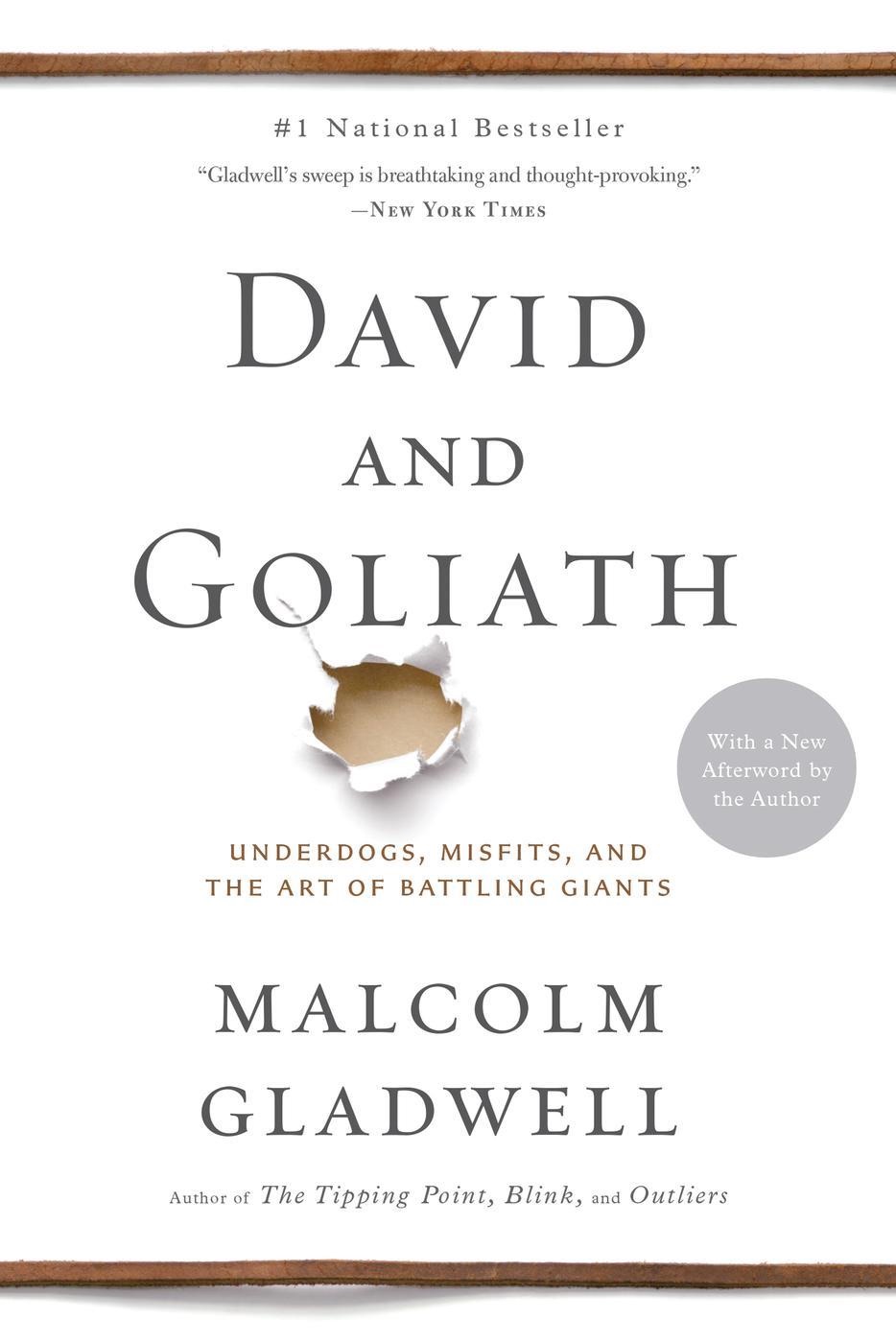
David and Goliath: Underdogs, Misfits, and the Art of Battling Giants is Malcolm Gladwell’s fourth best-selling book to be summarized here. I’ve been a big fan ever since I summarized The Tipping Point. If you like to give books as gifts, please click below and get copies for yourself and your favorite bookworms.
Why Goliath was the Underdog
- In the story of David and Goliath, it turned out that it was Goliath’s size that made him a better target for David’s sling. Warfare of the time featured cavalry, infantry, and a third group that fired projectiles like arrows and rocks. The infantry represented sitting ducks as they were relatively stationary compared to the cavalry. The humble infantryman, however, had better odds taking on a charging horse with a spear to the belly. Calvary could take on the projectile boys as they were moving targets that were much harder to hit. This is like a game of rock, paper, scissors were the odds depend on the matchup. For Goliath, facing a slinger like David was like facing a modern rival with a handgun.
Use Your Assets, Hide Your Weaknesses
- Gladwell uses the David and Goliath story as a metaphor for how we should not always assume that the people who seem to have the upper hand really do. He tells a number of stories of how people who didn’t seem to have a chance won the day. One features a man from India who decided to coach his daughter’s basketball team. His girls were not especially tall or skilled, but he changed the odds by changing how the game was played. He realized that the other teams didn’t defend over half the court. When he put in a full-court press that lasted the entire game, he found that there were enough turnovers which lead to easy baskets to allow his team to triumph over superior talent.
- There is also the story of Lawrence of Arabia whose troops were successful because they took advantage of their main asset, which was speed. This showed that material resources are not always an advantage. Rather than trying to improve on your weaknesses, sometimes it is better just to hide them.
- Even wealth can be a disadvantage when it comes to raising kids. Malcolm tells the story of a successful businessman who worked in his father’s scrap metal yard. It was hard, dirty work and it made him realize that he needed to work hard to make sure he would enjoy a better future. It was his family’s very lack of wealth that gave him the qualities that allowed him to be wealthy today. Ironically, he now has a problem as his kids want for nothing. He fears they won’t develop the qualities that made him successful. While poverty can be stressful and debilitating, it seems that just enough wealth can make you relatively happy while still letting you develop desirable qualities. The same also seems to work for class size as classes that are too big or too small have their own downsides.
Posted in Book Summaries, Business Books, Education Books, Leadership Books | Comments Off on David and Goliath: Underdogs, Misfits, and the Art of Battling Giants by Malcolm Gladwell
Saturday, October 26th, 2013
Five Effective Habits to Increase Your Motivation to Study by Edmond Garrett offers students of all ages key tips for organizing and getting the most out of study time. Be sure to share this sound advice with any students you know.
The amount of effort you put into studying directly reflects the grades you receive from your classes, whether you’re in high school or college. Unfortunately, motivation to study is often lacking when compared to the desire to engage in other activities, like spending time with friends or enjoying other leisure pursuits. However, if you build the right five habits now, you can increase your motivation to study, while still leaving time to enjoy life’s other joys.
Early Review
- Make a habit of waking ten minutes early each morning during the week. Spend this time reviewing class materials you’ve already covered. This isn’t a time to catch up on reading assigned chapters or finishing homework you should have done the night before. This time is specifically for quick review of already read materials, such as reading summaries at the end of textbook chapters or reviewing key concepts and definitions.
Scheduled Study Times
- Create a weekly calendar on Sunday laying out your week. Look at the syllabus or class schedule for each of your courses to determine the tests and assignments scheduled for the week. Set aside specific times devoted to studying for each class. Your set aside times are flexible if something comes up during the week, but making a habit of setting this time aside will give you a better chance of following through on your studies.
Posted in Guest Posts | Comments Off on Five Effective Habits to Increase Your Motivation to Study by Edmond Garrett
Wednesday, October 23rd, 2013
The Importance of Recess and Play by Ken Myers takes on schools that have cut back on recess thinking it will help their test scores. Based on what we know, this makes no sense and Ken does a great job spelling out the reasons why.
- According to CBS News, a Long Island school is banning dangerous recess activities in favor of safer alternatives. No, the children aren’t playing with brass knuckles and mace. Instead, soccer balls, cartwheels and games of tag are no longer allowed unless supervised by a coach. You read that right. Children will be playing with Nerf balls for their own safety.
- The decrease in funding and time allotment for gym and recess is a disturbing trend that is developing across the country. Play is a pivotal part of a child’s development. The human body was not meant for constant rest, especially in children. While classroom topics are important to a child’s breadth of knowledge, exercise is equally important for growing children. The benefits of recess and play go beyond basic physical benefits. Unstructured time allows children to develop social skills, retain new information and create healthy habits that last a lifetime
Posted in Guest Posts | Comments Off on The Importance of Recess and Play by Ken Myers