Archive for the ‘Book Summaries’ Category
Wednesday, August 22nd, 2018
The Gritty Truth of School Transformation: Eight Phases of Growth to Instructional Rigor by Amy M. Dujon tells the story of how, as principal, she lead her school from one that was teacher-centered to one that is now student-centered with rigor. This is a book that every principal and teacher leader should read. It can also help parents become better teachers at home. Make sure that your school has a copy.
Why This Book?
- The goal is to tease out what school leaders, in partnership with district leaders and teachers, can do to transform the instructional culture of their schools and to promote more rigorous learning. One discovery is that transformation needs to be sustained and not static and their vision is focused on the future. There is a concern about the defenders of the status quo and a recognition that traditional pedagogies are not likely to prepare students for the world they will enter.
- The concept of productive struggle is at the heart of this work. This means engaging in an effort, thinking, and learning that is just beyond one’s current ability. It is akin to the idea of deliberate practice (K. A. Ericsson, 2003). The goal is to stretch each aspect of learning capacity without having it be eclipsed by a focus on acquiring knowledge and completing tasks. Several chapters contain QR codes that take you to additional resources.
Part I The Productive Struggle – Phase 1. Setting the Vision
- The story here revolves around the school where Amy became principal in 2013. The demographics had changed and results declined. Traditional teaching that had been good enough needed to change. What was needed was second-order change rather than first-order change where teachers essentially went through the motions. Second-order change requires deep reflection, a substantive rethinking of philosophy and practice, and significant changes to school culture. The first key is to understand the importance of shared vision, mission, and core values. If you want to get at a root cause, try the Five Whys Protocol.
- The goal is to shift from instruction where the teacher does most of the talking and tells students what they need to know to one where the students talk to each other more as they make connections and draw conclusions. The idea of student autonomy is central here. To make this type of second-order change happen a leader needs to find and support first followers. These first followers will show others that the leader is not there to judge but to help them grow. This will attract new followers.
Phase 2. The Deconstruction
- One step in moving from teacher-centered instruction is to tell students only to raise hands to ask questions. You still need to know what they are thinking, but having one student give an answer doesn’t tell you much. As a leader, you will have to change too. Doing observations where you compliment a teacher on something and then give them something to work one should stop. Focus on what students are doing and if they are thinking. Try to be nonjudgemental. Focus public praise on changes in student behaviors and outcomes. Treat teachers and staff as equals or thought partners.
Posted in Book Summaries, Education Books, Leadership Books | Comments Off on The Gritty Truth of School Transformation: Eight Phases of Growth to Instructional Rigor by Amy M. Dujon
Monday, July 15th, 2019
The Happy Mind: A Simple Guide to Living a Happier Life Starting Today by Kevin Horsley and Louis Fourie offers a common-sense approach to living a happy life. As a very happy person, I find their advice right on the money. Please share this with people you know who aren’t happy enough. Also, share with young people so they can learn how to be happy for the rest of their lives. Here is
the link to the book and
the link to their website.
1. The Search For Happiness
- Start by taking some time to write down your definition of happiness. This is something you will come back to later in the book to adjust as you gain perspective. Since happiness is so subjective there is no one definition that applies to everyone. None the less, everyone agrees that it is important to be happy.
- Next we look at different ways that people approach happiness. For some wealth is the driving factor even though it doesn’t guarantee happiness. These folks usually also seek status to make them happy. Some people think they will be happy only if they can change their location. Many seek happiness as they strive to improve their physical appearance. This may seem vain, but there is nothing wrong with caring for yourself. Many people see happiness sometime in the future or even the afterlife while others fondly recall the good old days. Happiness can also result from social activity and may rely to a great extent on a life partner. Social dynamics in the workplace bring happiness to some. All of these happiness influencers are external.
2. Happiness Is
- 1. Thinking In a Different Way — Happiness exists in your mind so it is important how you think. If your thoughts aren’t making you happy you need to think differently.
- 2. Assuming Full Accountability for Your Circumstances — You have to own your life and be responsible for what happens. That means you have to manage circumstances and not just let them happen to you. Your attitude is a choice and it can support or obstruct you.
- 3. Enjoying Simple Things More — Small joys are endless as long as you look for them. Nature’s beauty can make you happier if you take the time to enjoy it. You also need to have gratitude for all the little things that make you happy as you push anger, arrogance, desire, indifference, regret, resentment, and guilt away.
- 4. Owning Your Own Future — You need to own the situations you are in and don’t settle for helplessness. Adjust to new conditions and change the things you can change. Planning must be a priority if you want to accomplish your goals.
- 5. Being Engaged In What You Do for a Living
— A job you love or at least enjoy most of is vital to a happy life. You should also look to make changes so that you like it even more.
- 6. Invest in Your Overall Wellness — Taking care of yourself involves a healthy diet and exercise. Surround yourself with constructive people and reflect on good things. Stay curious and learn something new each day. Pay attention to your finances and spend less than you make. Be sure not to make any enemies.
- 7. Having Constructive Relationships — Happy people get along with others. They also enjoy their own company as being alone isn’t being lonely. Carefully select the people you develop relationships with.
- 8. Having an Optimistic World View — Optimistic people are happier. Leave the past behind and be quick to forgive others. Carrying grudges and being judgmental won’t make you happy. Try to see the funny side of life and be sure to laugh at yourself.
- 9. A Day-to-Day Effort — Happiness is work. It’s easier to be miserable. You need to be committed and make a constant effort. (Doug: After a while, it will become second nature.)
3. The Origin Of Unhappiness
- If you do the opposite of what is discussed in the previous chapter you are bound to be unhappy. Unhappy people freeze when they face challenging situations. They look for culprits rather than solutions. They don’t take responsibility for their fate and constantly blame others. They neglect their health and their finances and fail to build solid relationships. They focus on what they don’t have and haven’t done.
- At the heart of this is the failure to use the thinking brain also known as the neocortex. Instead, they are likely to rely on the primitive part of the brain that makes knee jerk decisions and reactions. For more on this see my summary of Thinking Fast and Slow: How the Brain Thinks by Daniel Kahneman.
4. Practical Guideline, Thoughts, Suggestions & Reminders in the Interest of Happiness
- Happiness is work, at least for a while until it becomes second nature. It should also be personal as you strive to find just what makes you happy. So make your plan and review and modify it from time to time. Learn to appreciate what you have along with the small things. Be sure to look for ways to spice up your plan and take advantage of situations that aren’t planned for. Keep it simple and travel light. A mindset of modest expectations fuels calmness.
- The only life you can direct is your own. You can try to change others, but don’t count on it. (Doug: Don’t marry someone thinking you can fix the characteristics you don’t like after you are married.) Make sure the information you take in is nutritious. Try to focus on one thing at a time as multitasking is inefficient and leads to more errors. Be serious about your job and proud of what you do. Above all keep looking until you find a job you enjoy. Forgive quickly as you do so for your own happiness, not the happiness of those you forgive, and don’t carry grudges. Judging others can result in endless mental effort.
- Sleep is when the brain repairs itself. Try to get seven or more hours and sleep the same hours every day. Be good to people in need. Performing an unexpected act of kindness and make you happier. Be cheerful and make time for laughter. The present is the only real tense. What you do and think now is what matters. It’s hard to be happy if your diet is bad for your body. Everyone wants to live in a neatly organized space so be responsible for yours. Craft loving relationships starting with your immediate circle. Take time enjoying being with just yourself. Try to make small daily shifts in the directions described in this book. Be frugal with your finances and decide that you are going to be happy.
5. A Few Last Words
- Learn from hurtful events and you will probably have fewer of them. Workaround your weaknesses and optimize your strengths. Enjoy your own company and look after your body. Keep your word and know when to say no. Never blame, even yourself. Live every day as if it’s your last as one day it will be. Laugh a lot more than you cry and remember, you don’t have to be happy for the rest of your life, only now.
Kevin Horsley and Louis Fourie
- Kevin is a lifelong student in the field of neuroscience. He is a World Memory Championship medalist and a two-time World Record holder for The Everest of Memory Tests. He is an international speaker, trainer, and consultant who helps organizations improve their thinking, creativity, motivation, and learning
- Louis started as an economist in the South African financial industry and was one of the first winners of South Africa’s Economist of the Year award. He founded a leading South African wealth management business and acted a chairman for twelve years. He then founded The Logic Filter a consultancy group that mentors young professionals and advises emerging business leaders.
Posted in Book Summaries, Business Books, Education Books, Leadership Books | Comments Off on The Happy Mind: A Simple Guide to Living a Happier Life Starting Today by Kevin Horsley and Louis Fourie
Tuesday, January 12th, 2021
The Hype Machine: How Social Media Disrupts Our Elections, Our Economy, and Our Health and How We Must Adapt by Sinan Aral takes an in-depth look at the impact that social media has had on our society. He covers the positive and negative aspects and offers advice for how scientists, industrial leaders, and policymakers can collaborate to clean up issues associated with things like fake news, election tampering, and free speech. This is a book that every consumer of modern media needs to read so click here to get your copy now.
Preface: Pandemics, Promise, and Peril
- Sinan’s Hype Machine is the real-time communications ecosystem created by social media. We start by seeing how COIVD pushed billions of more people to laptops and smartphones as many digital Luddites were forced on to various online platforms. Even routine users found themselves using it more and young people who were given limited screen time by parents prior to COVID started spending the entire school day online. People responded by organizing Zoom meetings to brainstorm problems old and new. As automated “bot” software along with cyborg and troll networks spread misinformation about things like COVID and elections, others got to work to fight these new digital enemies. As we have seen there is potential for great promise and peril. This book takes a look at both and offers suggestions for how we can make the most of the Hype Machine.
1. The New Social Age
- Humans have always been social animals. The Hype Machine has simply poured gas on our campfires. It is designed to inform, persuade, entertain, and manipulate us. It learns from our choices and location to improve its persuasive leverage. The motivation of course is money. It can rightly be considered the social media industrial complex
- We start with the story of how Russia used social media as a key part of their armed takeover of Crimea in 2014. Every time a pro-Ukrainian message was posted it was swarmed by messages from Russian bots and subsequently taken down. Most people were left with the idea that the people of Crimea wanted to be part of Russia.
- During his PhD work, Sinan realized that statistics required observations to be independent while modern networking made everything interdependent. His epiphany at the time was that digital social networking was going to turbocharge how information, behavior, economic opportunity, and political ideology flowed between people. His thesis was on how information flows through digital social networks and as he now evaluates hundreds of companies each year, he gets to see what is coming. He knows that we don’t know enough and advocating for more research is a theme of this book.
2. The End of Reality
- Fake news isn’t new, but the speed at which it can spread can cause real consequences. Rumors of gas shortages and a shooting at the White house caused long gas lines and a brief stock market crash. Some put out positive fake news about stocks they own and sell when the price goes up (pump and dump). We know that Russia made an effort to impact the 2016 election using the Hype Machine, but we don’t know the impact that effort had. Using social media in an effort to impact elections is a global problem.
- Another area where fake news distributed by social media has had an impact is the world of vaccines. Anti-vaxers have used it and caused some communities to decrease vaccination percents below the point where they offer heard immunity. This has caused an increase in cases of measles, a disease that the US declared conquered in 2000. Another problem is that several studies show that false news spreads faster than real news. Political false news travels faster than any other category.
- Social bots are software controlled social media profiles. They pounce on fake news and retweet it broadly. Real people then pick it up and do most of the spreading. They often mention influential humans who can give them a greater reach. Novelty attracts attention (the novelty hypotheses) and as a result, false news is more novel. Big repetition causes belief. (Doug: This is something that Hitler took advantage of.) People also believe what they already think (confirmation bias) so when you try to convince them that what they believe is false they tend to dig in even harder. Since fake news attracts more readers it makes more money by posting Google ads. This makes it a big business. Generative adversarial networks (GANs) pit two neural networks against each other. One learns from the other’s decisions and optimizes its efforts to fool the other. They can also be used for good. Deepfaked audio can allow one person to sound like another, which has been used to defraud companies.
3. The Hype Machine
- The Hype Machine is an information processor regulating and directing the flow of information in society. It is comprised of the network itself, the interaction between people and machine intelligence, and the input/output device, which is most commonly the smartphone. In addition to these three components, there are the four levers of Money, Code, Norms, and Law. Networks learn about us by looking at who we are connected to, what we read, and what we buy. People tend to cluster and similar people connect. This causes echo chambers that spread fake news. If one person has strong connections to two others, the others are likely to have at least a weak connection. The small-world phenomenon also shows up in social media as the average distance between any two people is about 4.7 degrees, not six.
- Sinan describes what he calls the Hype Loop. It starts with machine algorithms sensing who we are by what we say, what we consume, and what we do. It then offers suggestions for things like who to friend and what to buy. We then consume content based on the suggestions and finally, we take action such as making a purchase, sharing content with others, or voting.
- Connections via social media platforms are much more likely to happen via suggestions offered by algorithms than by people searching. This may also contribute to political polarization as similar people get connected faster. Algorithms also recommend the content we consume. Facebook is now the largest news outlet. Its goal is to attract more likes and more viewership. Some things are best done by the machine. Spam filters and newsfeed ranking are examples. More reflective people tend to want their news recommended for them. Since our smartphones are always with us the Hype Machine is constantly learning about us. Apps constantly share data with five to ten other apps. The next big thing is likely to be the brain-computer interface so we can control things with our thoughts. Think of using your “brain mouse” to click on something you see in an augmented reality space.
Posted in Book Summaries, Business Books, Education Books, Leadership Books | Comments Off on The Hype Machine: How Social Media Disrupts Our Elections, Our Economy, and Our Health and How We Must Adapt by Sinan Aral
Tuesday, August 9th, 2016
The Innovator’s Mindset: Empower Learning, Unleash Talent, and Lead a Culture of Creativity by George Couros gives great encouragement and advice to teachers seeking to improve continuously in the face of budget restrictions, policies that don’t make sense, and curricula that are way too static for a constantly changing world. This would be a great book to give to every teacher in your school.
Introduction
- George begins with praise for his father who was always learning and exposing his children to the latest technology from the VCR to Facebook. As an illiterate Greek immigrant, he started as a dish washer and ended up as a restaurant owner. While his father had to embrace countless changes, George regrets that many educators are more likely to resist change rather than embrace it. As a result, we have 21st-century schools with 20th-century learning. If teachers don’t understand that the world is changing and that they need to change with it, the world may decide that it doesn’t need them anymore. If it’s just about knowledge, students can find and digest that themselves.
- There is a need for innovation in education. Inspiration is also needed and it is one of today’s students’ chief needs. It can spark curiosity that will prompt students to learn on their own. Unfortunately, most students leave school less curious. Successful students leave school being good at school and the world isn’t school. One day they are raising their hand to go to the restroom and the next day they are on their own in a world that requires critical thinking and collaboration.
Part I: Innovation in Education – 1. What Innovation is and Isn’t
- George sites the failure of Blockbuster Video Rental as an example of how an organization can fail if they don’t change fast enough. If, according to the common saying, “We need to prepare kids for jobs that don’t exist,” innovation in education is essential. George even created a job title: Division Principal of Innovative Teaching and Learning. No teacher has ever had a former student return to say a standardized test changed his of her life for the better.
- George defines innovation as a way of thinking that creates something new and better. It can be something totally new (invention), or a change to something that already exists (iteration). It’s important to avoid thinking that any use of technology is innovative. Student essays done on a computer are probably not innovative, while a student blog may well be. Technology is a tool, not a learning outcome or a leadership outcome. As John Maxwell once said, “Change is inevitable, growth is optional.” It’s vital that education not become the new Blockbuster.
2. The Innovator’s Mindset
- We start with an inspiring story of how a student overcame a stutter by adopting the innovator’s mindset. He goes on to discuss the highlights of Carol Dewck’s book Mindset: The New Psychology of Success. See my summary here. George points out that the world only cares about and pays for what you can do with what you know, and it doesn’t care how you learned it. Every educator, therefore, needs to have an innovator’s mindset. To promote this, George made a budget line titled ‘innovation’ and it was up to teachers to apply for the money. This is like a school setting up its own grant system. He also lets teachers know about the popular mantra that says: failure is an important part of the process.
- Letting teachers know they have the freedom to fail will also promote resiliency and grit. The only way to innovate is to try things and see if they work or not. This must be done as you adjust to each learner. In order to innovate, you need to focus on asking questions. This will drive the process. Teachers also need to ask would they want to be a learner in their own classrooms? Lessons need to connect to students’ lives and they need to learn from each other. You also need to collect feedback continuously.
3. Characteristics of the Innovator’s Mindset.
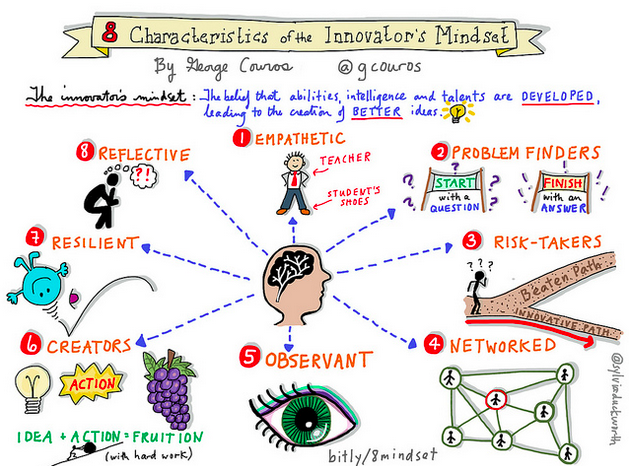
- Silvia Duckworth’s illustration at the top lays out the eight characteristics. They are: 1) Empathetic – This is all about thinking about the classroom environment and lessons from the students’ point of view. 2) Problem Finding: This is one step beyond simply giving students problems to solve. This will help students to become self-starters. 3) Risk Takers: There needs to be a balance between drawing on one’s experience and trying something new. 4) Networked: Every idea is a network of ideas. When students come to school we continually tell them to share. Educators need to take this advice. 5) Observant: Inspiration is everywhere and often in unexpected places. You just have to keep your eyes open. Educators also need to look beyond their field for ideas and inspiration. 6) Creators: Anyone can consume information. The move from teacher-centric instruction to learner-centric creation is vital. 7) Resilient: Expect pushback from students, colleagues, and supervisors as you try new things. This is a skill that all of us need to develop. 8) Reflective: What worked? What didn’t? What would I change? What do I do next? It’s important to question your efforts, progress, and processes.
Posted in Book Summaries, Education Books, Leadership Books | Comments Off on The Innovator’s Mindset: Empower Learning, Unleash Talent, and Lead a Culture of Creativity by George Couros
Tuesday, December 30th, 2014
The Innovators: How a Group of Hackers, Geniuses, and Geeks Created the Digital Revolution by Walter Isaacson tells the stories of the people most responsible for getting us to where we are in terms of technology. Each chapter focuses on a different innovation that made today’s world possible. It starts in the mid 1800’s when computers were just ideas and takes us to the present time. Click at the bottom of any page to get this very cool history book.
Walter Isaacson
- Walter is the CEO of the Aspen Institute, has been the chairman of CNN, and the managing editor of Time magazine. He is the author of Steve Jobs; Einstein: His Life and Universe; Benjamin Franklin: An American LIfe; and Kissinger: A Biography. He is also the coauthor of The Wise Men: Six Friends and the World They Made. He lives in Washington, DC.
Introduction
- The computer and the Internet are among the most important inventions of our era, but few people know who created them. These and other key inventions of the digital age were done collaboratively by many fascinating people who are featured in this book. The focus is on their characteristics and how they collaborated. When it comes to inventions, we tend to focus on individual genius rather than the teamwork that is almost always required. Walter also looks at the social and cultural forces that provided the atmosphere for key innovations. He notes happily that much creativity that gave us the digital age came from those who were able to connect the arts and sciences. It seems that the human-machine symbiosis that grew out of the connection between the personal computer and the Internet was largely given to us by people who stood at the intersection of the humanities and technology.
Posted in Book Summaries, Education Books | Comments Off on The Innovators: How a Group of Hackers, Geniuses, and Geeks Created the Digital Revolution by Walter Isaacson
Monday, April 13th, 2026

The Invincible Brain: The Clinically Proven Plan to Age-Proof Your Brain and Stay Sharp for Life by Majid Fotuhi offers a five-pillar plan that anyone can use to improve their brain and body. Following this plan will help you avoid cognitive problems and even help you get rid of any cognitive problems you have at any age. You only have one body, so make sure you follow this advice. This book is a must.
Introduction
- The brain is capable of miraculous feats of growth and rejuvenation. It often finds a way around any damage. Use it, and it gets smarter and better at anything. Your genes matter, but your family environment, education, work, social interactions, hobbies, and dedication to learning matter more. You need to feed it a proper diet, provide it with blood and oxygen via exercise, and sleep well to allow it to repair itself.
- Your lifestyle impacts brain function. When it comes to diseases like Alzheimers, most neurologists agree that prevention is possible. You have a lot of control over how your brain ages. Majid has developed and tested a 12-week brain fitness program that has improved brain functioning in over 80% of adults and children who tried it. This includes children with ADHD. The purpose of this book is to provide his program to the reader. It’s never too late.
Part One: A New Definition of Intelligence – 1. The Unlimited Potential of the Invincible Brain
- Recent brain imaging has greatly increased our knowledge of the brain, but there is a lot of mystery left. We do know that the hippocampus, a thumb-sized extension of our cortex is the most malleable part with the most growth potential. Your brain changes based on how you live and what you do. The parts you use grow while the parts you don’t use shrink. Your lifestyle and mindset determine how smart you get about anything.
- Studies with London cab drivers who study for four year to learn every street show that their hippocampus grows bigger during the process. The same is true for people engaged in intensive language learning. Growth is not limited to young people. Majid believes that our brain’s ability is 30% due to our genes and 70% due to our environment. IQ tests are popular because they produce a single number, but poor tools for assessing intelligence as there are many things you can’t measure like emotional intelligence, social skills, and sense of humor.
2. You Are Smarter Than You Think You Are
- Here Majid provides non comprehensive definitions for no less than 30 intelligences. He than asks the reader to subjectively rate themselves from 1 to 10 for each intelligence. Some that might not seem obvious are street-smarts, nature, cooking, and happiness. This will allow you to work on the parts of your brain that are most important to you where you would like to score higher.
3. The Invincible Brain Mindset
- There are psychological and measurable physical benefits to having a sense of purpose. People with a purpose have a reduction in cognitive impairments and dementia. Their risk of stroke is one half. They have fewer heart attacks and a lower risk of death from all causes. They are less likely to have sleep problems and less likely to be overweight. The are less likely to be depressed or lonely and more likely to be happy. They even enjoy sex more.
- There are seven questions here that can help you find your purpose like what do you like to do the most. The first step is to believe. This involves having a growth mindset. Intelligence can be developed if you believe that you can get good at anything. This will grow your brain. It’s important to see advice as helpful feedback rather than criticism. See mistakes as learning opportunities and seek quality practice over quantity.
Posted in Book Summaries, Education Books | Comments Off on The Invincible Brain: The Clinically Proven Plan to Age-Proof Your Brain and Stay Sharp for Life by Majid Fotuhi
Monday, April 13th, 2020
The Knowledge GAP: The Hidden Cause of America’s Broken Education System and How to Fix It by Natalie Wexler confronts the difference between content-rich and skills-based ELA curricula and makes a strong case for the former. She argues that students need a strong knowledge base in their long-term memories in order to comprehend complex text and to think critically. They also need systematic phonics instruction to learn how to decode words as they gain knowledge beyond their personal sphere. She sees a shift away from a focus on skills and leveled readers slowly taking place.
Part One – The Way We Teach Now: All You Need Is Skills – 1. The Water They’ve Been Swimming In
- The main point here is that all over the country, the focus in elementary schools is on teaching reading skills using texts that shun any meaningful history or science content. Math is also given a lot of attention as it is the other subject that shows up on federally mandated tests and test prep takes up a significant amount of time in most schools. Meanwhile, the achievement gap, which is really a test-gap, has not budged in twenty-five years. History and science are shunned in the early grades as they are widely considered to be not developmentally appropriate.
2. A Problem Hiding in Plain Sight
- An experiment from 1987 demonstrates the importance of prior knowledge when it comes to comprehension. It involved presenting students with texts that involved the play by play of a baseball game. It showed that bad readers who knew a lot about baseball outperformed good readers who didn’t. The idea is that real knowledge from social studies and science should be embedded in all reading lessons. This implies that the gaps we see on tests are more likely to be knowledge gaps than skills gaps.
- History is a series of stories and kids love stories. The same is true for science topics. It’s ironic that abstract concepts like captions and symbols are considered appropriate for six-year-olds while information from history, science, and the arts are not. Teaching disconnected comprehension skills boosts neither comprehension nor reading scores. They are analogous to empty calories.
Next Natalie explains why poor kids don’t generally do as well in school. At home, they are exposed to less conversation and less complex vocabulary. They also engage in less turn-taking conversation and debate with parents. Parents read more to them and introduce them to more knowledge about the real world. This knowledge gap only widens over time as students who start out with more learn more. By using texts light in knowledge to teach skills, schools are the problem handing in plain sight. You can’t think critically if you don’t have a knowledge base to think with. Students also need to write about what they are learning.
3. Everything Was Surprising and Novel
- The focus here is on the work of Daniel Willingham. The two basic components of reading are decoding and comprehension. They are treated as one subject, but factors leading to success in each are fundamentally different. Instruction in phonics can teach decoding. As for comprehension, it depends on how much vocabulary and background knowledge the student has. It can be achieved naturally if you have enough information. Relying on teaching strategies to teach comprehension can explain the disastrous results we have seen. Teaching content is teaching reading. Reading tests are really knowledge tests in disguise as they draw on it to assess comprehension.
- Much of the problem can be laid at the feet of the schools of education. They spend little or no time on practicalities like classroom management. They seem to think that the more removed they are from ordinary concerns the more prestige they will garner. They aren’t big on exposing students to the findings of science. Most are also responsible for teaching that you should use strategies and skills for teaching comprehension and not using them much to teach decoding.
- Another reason some avoid testing content is that anything can be easily looked up on the Internet. What they miss is if you have to spend an inordinate amount of time looking things up, you will interrupt the flow of understanding that comprehension depends on. Retrieving information from long-term memory serves to reinforce it. You also might look up the wrong meaning of a word with multiple definitions.
4. The Reading Wars
- Here we get some history regarding Rudolph Flesch’s 1950’s studies and his conclusion that the systematic teaching of phonics was necessary to help students learn how to decode text. His book Why Johnny Can’t Read was a big sensation. This was the beginning of the Reading Wars. On the other side was the “whole language” movement. This turned somewhat political as teaching whole words was considered progressive and was largely adopted by the left who didn’t trust academics has they had never taught in an elementary classroom. Unfortunately, the Reading Wars aren’t over, they have only gone underground.
- What Flesch and his opponents missed was that unless you build knowledge and vocabulary, the ability to decode or recognize whole words wouldn’t count for much. Large adoptions of whole language programs largely failed. A phonics-based program called Reading First showed promise, but congress defunded it in 2008. It also treated reading as a self-contained subject, which leads to a decrease in subjects that could build knowledge and vocabulary. It’s also hard to change the beliefs of teachers when you don’t explain the underlying ideas.
Posted in Book Summaries, Education Books, Leadership Books | Comments Off on The Knowledge GAP: The Hidden Cause of America’s Broken Education System and How to Fix It by Natalie Wexler
Monday, April 8th, 2019
The Leadership Mind Switch: Rethinking How We Lead In the New World of Work by D. A. Benton and Kylie Wright-Ford makes an excellent textbook for any modern course on leadership, including educational leadership. It deals with how our modern culture impacts how leaders need to think and operate and it also deals with leadership qualities that never change. Get a copy for any aspiring leader you know.
Introduction
- The leadership game has changed over time and continues to do so. The book’s premise is that a mind switch is needed now to be ready for the future that will be vastly different. This book offers tools and information that you will likely need to lead in the future. You will need skills to understand and relate to people of all kinds. The more human aspect of leading is emphasized here. Leadership is everything in business and schools and since someone is going to lead it might as well be you.
Part One: Leading Today and Tomorrow 1. The Changing World of Leadership
- We know that information is rapidly expanding and that there will be welcome and unwelcome consequences. Technology is ever expanding and robots may soon join your staff. Telecommuting is on the increase so you need to be able to communicate with others from almost anywhere in the world. Office spaces and hours are changing and some people, even leaders, don’t have desks. Leadership today is about character and communication. They will have more daily contact with everyone and must be able to connect with all types of people.
- Leaders will have to understand and use technology and decide how it will be used. Leaders must decide the rolls that things like virtual reality, augmented reality, artificial intelligence, and the Internet of things will have. Worker turnover has increased so it’s up to leaders to be the kind of people who can persuade workers to stay. The workplace will be more diverse so the leader needs to be able to relate to everyone. They must understand who they are speaking to, tell stories, and know that feelings count. They also must avoid generation gap issues. A description of the generations is included here.
2. Rethinking Our Leadership Qualities
- Leadership is ever evolving. After setting a course (vision) a leader needs to develop a team that collaborates, cooperates, and enjoys each other. They need to be informed, curious, stable, positive, and accountable. They need to be able to relate to all generations and with people from all cultures. The one thing all followers want is trust and loyalty. Without them, nothing else matters. You must be accessible and not play loose with the facts. Speak frankly but be discreet.
- Keep in mind that older workers are more likely to be cynical. Clear the air when you slip up with something you said, done, or implied. Do it privately on the phone or in person, not via email or text. Project confidence, which is a combination of courage and curiosity. Show that you are continuously learning and willing to try new things. Know your limitations and ask for help.
- Know when it’s time to change course rather than being stubborn. When it comes to technology lean towards early adoption. As a leader, you need to have a wide range of interests. This is where being curious helps. Be open-minded and nonjudgemental. Learn to ask good questions and listen well to the answers. The concept of grit is covered here. See my summary of Angela Duckworth’s book Grit: The Power of Passion and Perseverance.
3. Developing Our Leadership Behaviors
- You need to be consistent and set an example every day. Don’t be moody. Everything you say and do communicates a message. In addition to words, things like posture, clothes, tone of voice, body language, facial expression (smile), and energy level communicate. When you do talk, don’t talk too fast. With younger people, you may find yourself texting more. Tell staff to only send emails that they would put on the wall for everyone to see and not to read between the lines. Some people are comfortable with physical contact, but not everyone.
- Stories are important and powerful. You need to set the scene, explain what happened, and wrap it up with a moral or key takeaway. Keep current and interesting, which will make you dynamic. Dynamic leaders introduce new ideas, are creative, bring energy and focus, change with the times, consider all situations, and model confident behavior. They enable change they don’t just manage it. They adapt to new technology, make course corrections when needed, and model the right attitude. They make work fun, interject humor, and accept and embrace all team members. They constantly recognize the actions they want to see.
Posted in Book Summaries, Business Books, Leadership Books | Comments Off on The Leadership Mind Switch: Rethinking How We Lead In the New World of Work by D. A. Benton and Kylie Wright-Ford
Sunday, March 10th, 2013
The Little Book of Talent: 52 Tips for Improving Your Skills by Daniel Coyle (© 2012, Bantam Books: New York, NY) is a bit over 100 pages and offers specific tips for developing talent. Daniel relies on abundant research to help you copy the techniques used by the top performers in many fields. In addition to growing your own talents, this book will help parents, educators, and coaches increase the success rate of their students. Every home should have a copy, so click the icon at the bottom of any page to get yours.
Posted in Book Summaries, Business Books, Education Books, Leadership Books | Comments Off on The Little Book of Talent by Daniel Coyle
Monday, May 2nd, 2022
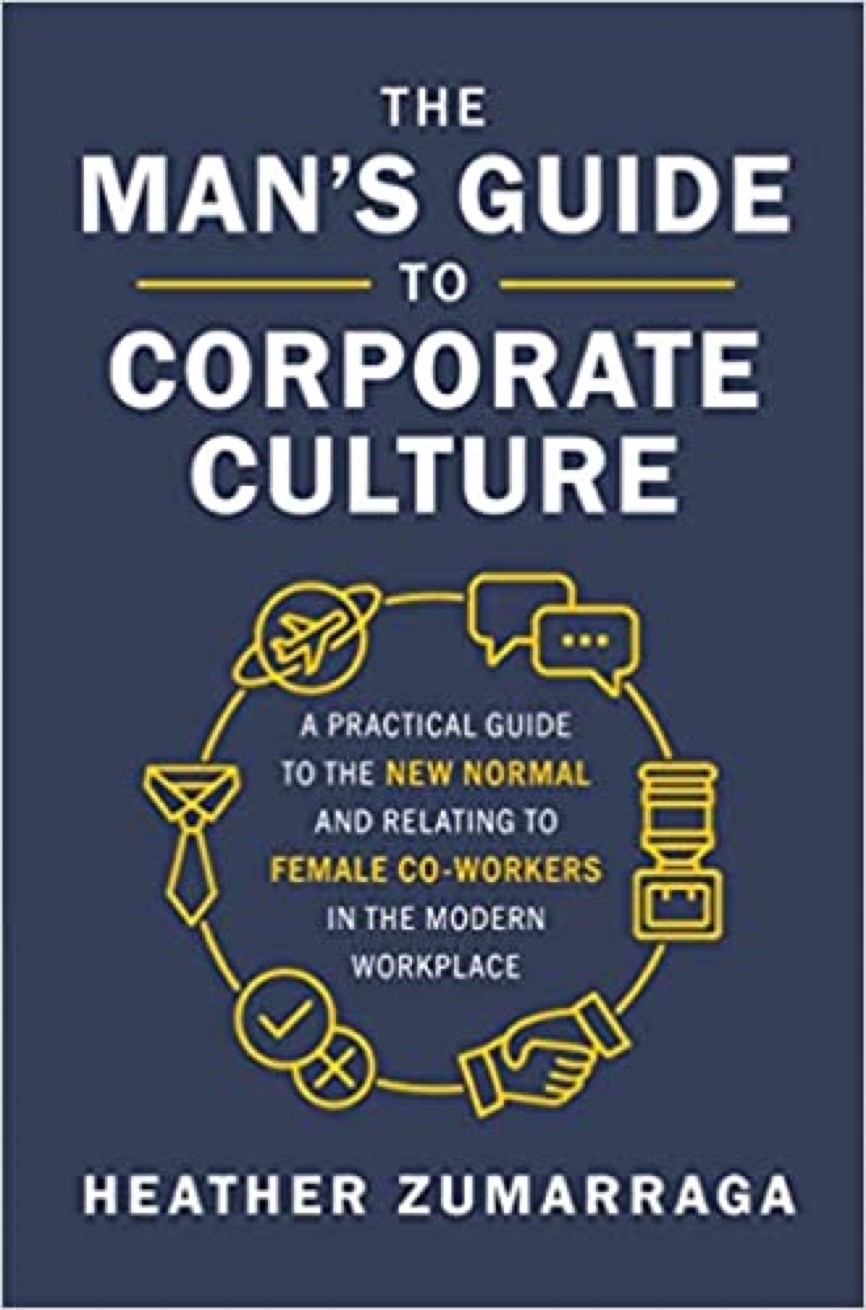
The Man’s Guide to Corporate Culture: A Practical Guide to the New Normal and Relating to Female Co-Workers in the Modern Workplace by Heather Zumarraga explains how the modern workplace has evolved over time and how men (and women) can navigate it while staying out of trouble. Things like accusations of sexual harassment or worse can be real career enders so take Heather’s advice if you want to stay afloat in what can seem at times like a tsunami.
Who is This Book for and How to Read This Book/Introduction
- This book is for men who work with women, corporations, small business employers, human resources departments, college students, and men and women couples. Here we find the chapters intended for men, corporations, and both men and women so you can skip around if you choose.
- Sionce the national discussion of sexual harassment in the workplace has gone to a whole new level, many men have become fearful of the perceived power that women have. The big change is that women are no longer afraid to speak up and are often encouraged to do so. This book is designed to help men learn to collaborate and find synergies with female colleagues so that they can take advantage of the skills and qualities that women offer. You can only do your best if you feel comfortable and this book should help. It’s based on the author’s experience along with hundreds of interviews.
1. It’s a Woman’s World and You Are Just Working In It.
- Women hold more jobs in the US than men and earn more college degrees at every level, which strongly correlates with higher incomes. Heather sites a number of successful female CEOs of some of the country’s largest companies. Yet 60% of male managers are not comfortable participating in normal workplace activities with women, such as mentoring and socializing. This serves to deprive their company of the talent of half of the population. The modern trend is for organizations to forbid romantic relationships in the workplace and even with customers and suppliers employees. Relationships that result in ex-lovers working together can create a hostile working environment. Many top-level executives have lost their jobs for inappropriate behavior and this list includes some women. The trend is finally toward a more ethical corporate governance.
2. How Did We Get Here?
- In 1986 the Supreme Court ruled unanimously that sexual harassment that was sufficiently severe or pervasive created a hostile or abusive working environment. Prior to that women were limited to lawsuits when the harassment was part of a quid pro quo for promotion. Now the simple act of pervasive harassment is enough to sue in federal court. Derogatory remarks about physical appearances, unwanted flirtation, and touching are possible allegations. Courts use the reasonable person standard when deciding if the behavior amounts to sexual harassment. The genders of the people involved are not relevant.
3. The Pendulum Has Swung Too Far
- As a result of this situation, many men worry about giving negative feedback to women. The media has created a world where some women are comfortable believing men are the enemy. The negative bias against men results from the movement going overboard. There are so many accusations it’s hard to know what to believe. A critical mass of accusations, however, makes it obvious that there is some truth to it as some recent high-profile cases have shown. False accusations or even misplaced suspicions, now have absurdly powerful repercussions. If you ever have to be deposed as part of a legal process, bring an attorney. Unfortunately, almost any behavior such as a shoulder pat can now be stretched into harassment. As a result, many men are reluctant to hire attractive women or hire women for jobs involving close interpersonal interactions. Also, the incarceration rate (90%+), the homicide rate (67%), and the homeless rate (70%) imply that men have a major crisis.
4. Let Mars Be Mars and Venus Be Venus.
- There is an agreement in the literature that men and women are different. Women tend to have better verbal abilities like reading comprehension and writing. They are also better at retrieving information from long-term memory. Men are better at juggling things in working memory and have better visuospatial skills. Men are more visually oriented and have stronger responses to sexual stimuli. The advice here is that you have a frontal lobe so use it to self-regulate. Think of it as the brakes for your brain.
- Women demonstrate more facial expressions than men and are better at reading them. Men will be distracted by bare skin, short dresses, and high heels. The lesson here is look at her face. You can compliment apparel but not physical appearance. Pay attention when women are talking and consider turning off your phone. Maintain eye contact, don’t interrupt, and paraphrase what is said. You really don’t have the luxury of not liking women or other men at work. If you do you will give it away somehow. Demonstrate you care by showing an interest in their personal life.
Posted in Book Summaries, Business Books, Leadership Books | Comments Off on The Man’s Guide to Corporate Culture: A Practical Guide to the New Normal and Relating to Female Co-Workers in the Modern Workplace by Heather Zumarraga