
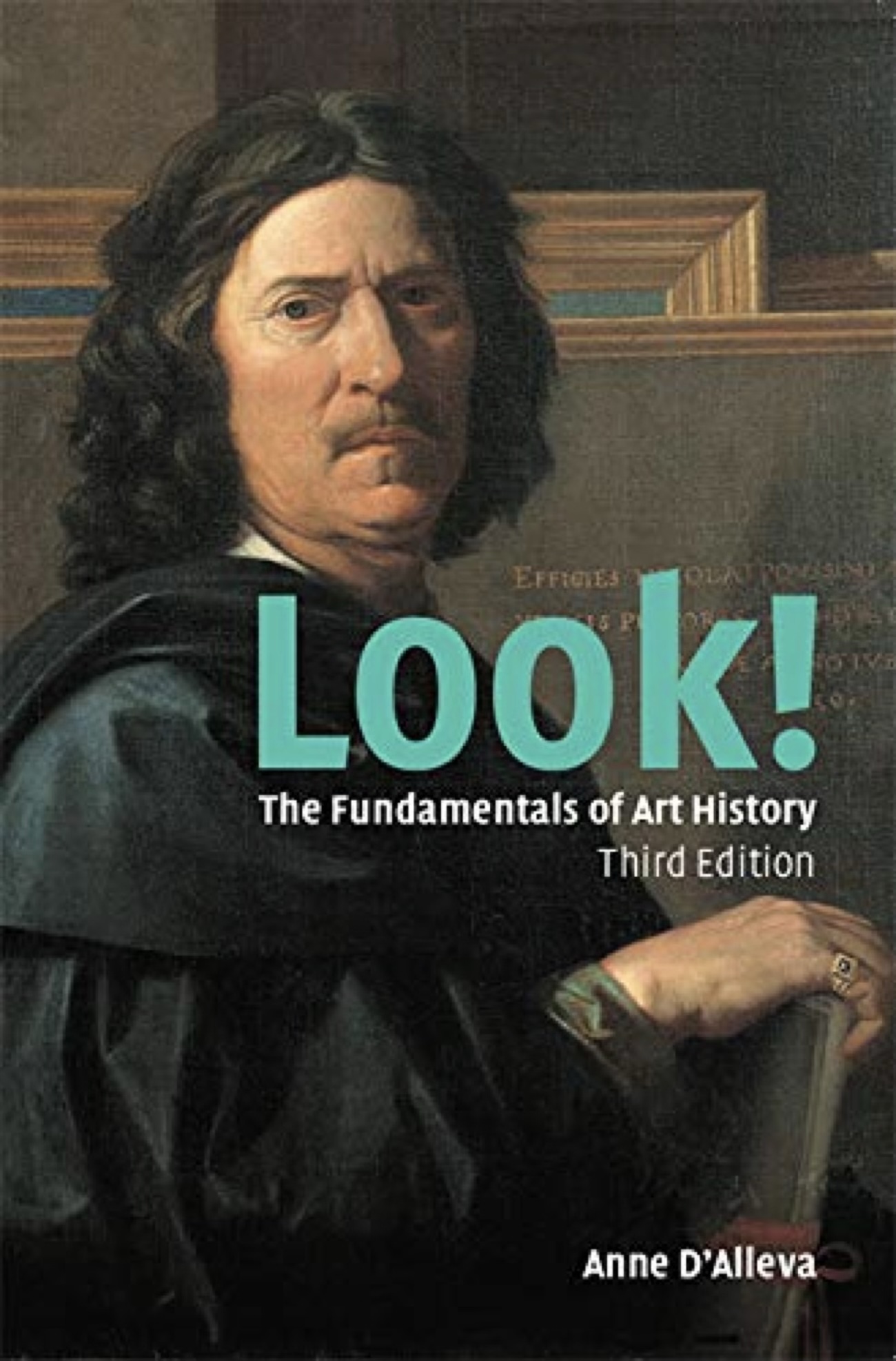
Look: The Fundamentals of Art History 3rd Edition by Anne D’Alleva takes the mystery out of having a successful experience with art history. An art history course should be a joyful experience, not drudgery. This book will give you the strategies to make your experience more joyful, and you will probably get a better grade. If you know anyone getting ready to take art history next semester, send them this summary and a copy of this excellent book.
1. Introducing Art History
- Art historians try to understand what artists are expressing in their work, and what viewers perceive in it. They try to understand why it was made and what it reflects about the world in which it was made. Anne prefers a broad definition of art as all the different kinds of things people make and do creatively. She sees it as any material or visual thing that is made by a person(s) that is invested with social, political, spiritual, and/or aesthetic value by anyone. This includes films and performances.
- History, from the Latin word for inquiry, is simply a tale or a story grounded in events that happened. Art historians also write about the art of the present as it will be history in time. This discipline teaches one to think differently and ask interesting questions. One must look beyond surfaces and see the nuances in things. It helps one develop skills in visual analysis, critical reading, argument building, and the expression of ideas. These skills are valuable in a wide range of professions.
- Art that endures gives us a sense of what past lives were like. It lets you engage in detective work as you enjoy it for its own sake. It’s a key element to telling human history. Many other academic disciplines draw from it, such as art criticism. Sociology, anthropology, aesthetics, cultural studies, and connoisseurship.
2. Formal Analysis
- Formal analysis involves looking at a work of art and trying to understand what the artist is trying to convey, but it’s never divorced from context (Chapter 3). The formal elements of a work include color, line, space, mass, scale, and composition. Colors can have values that vary from light to dark. Lines can be strong, continuous, or broken. The artist may try to add a three-dimensional look or keep it flat. Note the size relative to yourself. What attracts your attention? Does it cause an emotional response, and is it figurative or abstract? Below are some questions to consider for seven different types of art. For each, Anne also gives an example of how to formally analyze a sample work.
- Two-dimensional art: Painting, Graphic Arts, Photography – Are colors saturated and where are the bright colors. Is there a wide or narrow range of colors? Do they blend together or is there contrast? Is there an illusion of depth? Does the surface feature texture or is it smooth?/li>
- Sculpture – Is it free standing or part of a surface? Is it built up, created by subtracting material, or is it cast? It is meant to be viewed from different angles? What materials were used, and do they allow for open spaces? How do light and shadows affect your impression? How does color affect the viewer’s perception?
- Architecture – What is the physical and visual experience of the building? What is the scale? What is emphasized? Is it linear or more curvy? What is the impact of light and shadow? Does it blend in or stand out from its environment? How does the layout of the rooms impact the work?
- Installation Art – The issues are similar to those confronted in sculpture and architecture. How does it work with its environment? What effect does it have on you? What is the role of light, color, and texture? Does it allow for participation?
- Performing and video art – Here, the artist’s movement, gestures, and sounds become the artwork. Is it rehearsed or improvised? Is there interaction with the audience? How are words, music, and gestures used? What is the impact of clothing and props?
- Digital Art – This is computer technology. What effects does it make possible? Do the effects heighten the sense of reality? What role does the technology play in the creation of the work?
- Textile and Decorative Arts – Does it have a function? How are the materials used? Is there an emphasis on texture? Do you see simplicity or complexity? What is the role of color and line?
3. Contextual Analysis
- With contextual analysis, you are trying to understand a work of art in a particular cultural moment. Works of art are shaped by historical processes, which are in turn shaped by works of art. Some questions to ask are: 1. Who was the patron, the artist, and the viewers? 2. What sort of records did the artist leave? 3. Were other artists or assistants involved? 4. What were the patron’s motives, and did he participate? 5. Was he acting on behalf of an institution? 6. Who was able to see the work and what was the response? 7. When and where was it made? 8. Was it innovative in some way? 9. Did it address larger social issues? 10. What was the political, religious, or social context?
- Most art is found in a museum, which usually alters its context. Museums have their own agendas. There is a brief history of museums here as they have evolved since the days of the ancient Greeks. Anne tells a story of the difference she felt between seeing many altarpieces in the Uffizi Gallery in Florence, Italy, followed shortly by seeing just one in a church with people praying near it (its original context). (Doug: I had this same experience in Florence.)
- You need to be aware of the assumptions you make and your own biases as you analyze. You need to test and rethink what you think you know. Studying a work from the past is like visiting a foreign country. It’s like learning a new language. The meaning of some words changes over time. Artificial, for example, means “fake” today. In the sixteenth century it meant “full of deep skill and artistry.” Like the last chapter, there are examples of analysis here.
Share this:


DrDougGreen.com If you like the summary, buy the book
Pages: 1 2