
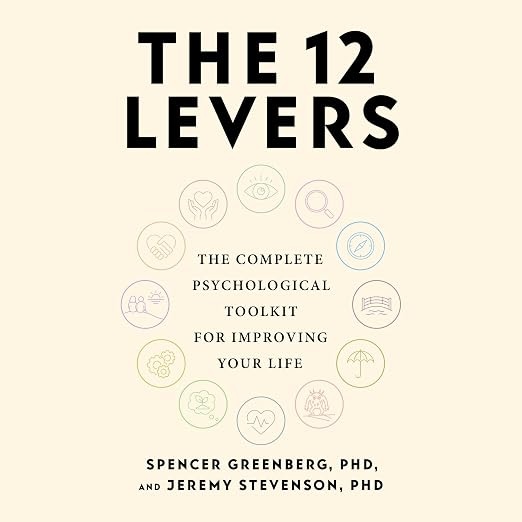
The 12 Levers: The Complete Psychological Toolkit for Improving Your Life by Spencer Greenberg and Jeremy Stevenson goes beyond things like diet, exercise, and sleep to deal with the psychology of self-help and improvement. If you suffer from negative thoughts that lead to anxiety and depression, this book is for you. Have a copy on hand for yourself, or to give to people you work and live with who might need it.
Introduction
- There is an overwhelming amount of self-help literature. While researching this book, the authors analyzed the content from 106 books, 23 therapies, along with numerous journal articles, videos, manuals, and other materials. They found that 495 techniques fell into 12 categories that they call Levers. These levers cover all psychological approaches that can improve your life. Don’t hesitate to try a technique as you read about it. The goal is to make you happy, as plenty of suffering is unnecessary.
1. Unravel the Causes
- If you want to make a problem better, you need to start by working to better understand what causes it. The technique here is called ABC. A is for identifying the activating event. B is for your beliefs that allowed the activating event to cause the problem. C is for the consequences, both emotional and behavioral. You also need to ask if there are any background events in your recent or distant past that cause the activating event to have its negative impact.
- Be sure to look for things that are part of the problem that you can control, and work to control them. One thing you can control is your attitude. Ideally, you can identify the issue as it occurs and get right to work on it. Try bright spot analysis. This is where you talk about what is working and focus on that. Ask what was different when the same activating event was less hurtful.
2. Uncover Your Guiding Foundations
- Intrinsic values are those fundamental values that you value for their own sake. Learning, loyalty, and happiness are examples. To find yours, try asking what you dreamt about as a child, who you admire, and what triggers strong emotion. Try taking the intrinsic values test at ClearerThinking.org. When you have five to ten, write them down and review them daily.
3. Actualize Your Guiding Foundation
- Once you know your values, it makes sense to take action in line with those values. Make sure you have goals in line with those values that are achievable. The authors recommend no more than four with one overarching goal. You should have a timeframe for your goals and break them into smaller steps.
- One key to reaching your goals is to form habits, which are powerful because they let you keep doing something consistently with minimal effort or conscious thought. Healthy habits are the compound interest of self-improvement. One way to make sure you follow through on a new habit is to connect it with one you already have and perform in a reliable manner. Start small, make sure your environment promotes the habit, remind yourself of its benefit, and reward yourself if you follow through.
4. Prepare for the Storm
- If you have recurring mental issues, you need one or more plans regarding how to deal with them when they show up. It’s much like having a plan for a storm. You need to identify the risk factors so you can spot problem situations and early warning signs. Then develop a plan that lets you cope with or sidestep the problem. You may want to take the opposite of the action you have taken in the past that has made things worse./li>
- You might have more than one plan for a specific problem depending on the intensity of the problem. One idea is to stop, take a step back, observe, and proceed effectively. When you have the plan(s), write them down and review them often. Put them where you will see them. Try the “Program Yourself to Improve Your Life Plan” at ClearerThinking.org.
5. Approach the Monster
- Fear can be learned and unlearned. To unlearn a fear, you need to confront it. Start gradually and slowly bring it closer or more intense. Once you have conquered a fear, you may need to confront it from time to time to keep it at bay. If you are afraid of something that is actually dangerous, a better plan might be to avoid it altogether. Watch out for “safety behaviors” that can temporarily allay a fear but prevent you from actually learning to deal with the fear.
Share this:


DrDougGreen.com If you like the summary, buy the book