Author Archive
Tuesday, January 7th, 2020

Managing Stress as a Student by Marie Miguel offers sound advice for students of all ages about how to better manage and avoid stress. In addition to tips that anyone can follow on their own, she also lets you know that seeking professional help can be the right thing to do. There are links here where you can find some first-rate counseling near where you live.
Students Are Stressed Out Sometimes
- It’s natural to experience stress when you’re in an academic setting, whether that’s high school, college, or graduate school. Some of the stressors you may experience are having short deadlines or deadlines in general, challenges in organization, and balancing your social life with studying. You may procrastinate and wait until the last minute to finish a paper and then feel the stress of having to complete things quickly. Here are some tips to help you manage your stress levels and complete your coursework.
Combat Procrastination
- People might tell you, “stop procrastinating,” but that’s not a helpful statement for those who engage in procrastination. You need to figure out the source of why you’re procrastinating and fight against it. Some people procrastinate because they’re scared that the end product won’t be perfect. If you’re delaying your work due to perfectionism, remember that not every paper or project needs to be the best thing ever. It would help if you started, and all you can do is your best. If you’re in college or graduate school, you got into this school for a reason, and you can complete this goal. Remember that all you need to do is start, and once you start, things will be easier to achieve than you think. One of the hardest parts of beating procrastination is opening your laptop or computer and getting things going. Once you’ve done that, it can become a whole lot easier.
Managing Time
- One of the things that stress people out in school is time management. Something that you can do to help yourself is to figure out how much time something takes to complete. You may have an inaccurate perception of people; people with ADHD, for example, sometimes can’t gauge how long something will take. Setting a timer when completing homework can be an incredibly useful action for you. Once you know that it takes you three hours to write a paper, for example, you can set aside that block of time to start writing. It’s important to remember that almost any task can be broken up into smaller tasks. Knowing this makes things much less overwhelming for a lot of people, so next time you get an assignment, manage your time by deciding what piece of an assignment you’ll do at what date and time. Maybe, you’ll write the outline of a paper the night that you get the assignment, and the next day, you’ll start a draft. Make sure that you’ll have a realistic sense of how long something will take so that you don’t put the unnecessary pressure on yourself to complete things in a time crunch.
Student Loans
- The idea that we have to pay back a massive amount of student debt stresses a lot of people out. Some people pay loans back while they’re in school, and others wait until they graduate. If you’re paying off loans, remember that having a budget can help. Organization is a big part of this. If you need help creating a budget that’s okay. Maybe you aren’t the kind of person that manages finances efficiently; it’s okay to ask for help. You can find it from someone on campus or an individual in your life that understands the process of paying back loans and can give you advice on how to manage money as you pay back your loans. Having the ability to manage finances is a vital life skill that’ll help you pay off your student debt, whether you choose to do it during or after school.
Leaving Work Until the Last Minute
- Leaving things for the last minute goes along with procrastination, but sometimes, people wait until there’s not a lot of time left for a particular reason. Some students say that they thrive off of the adrenaline of leaving an assignment until right before it’s due, but remember that this kind of behavior is a pattern and that it fuels itself. Eventually, you’ll get burnt out from leaving things until the last minute. Learn to get your adrenaline elsewhere, like through sports or engaging in social activities like playing games with friends. Planning is crucial when it comes to academics.
Managing Stress is Possible in Therapy
- If you’re feeling stressed out, one place that you can talk about it is in therapy. You might see a counselor on campus, or you might search “counseling near me” online to find someone in your local area. Whether you see someone online or in person, a mental health professional will be able to help you manage life stressors both inside and outside of school. If you’re struggling to cope with stress and feel like you’re breaking underneath it, it’s essential to ask for help. There are solutions to this issue, and managing stress as a student is possible. It may take some time, but seeing a therapist or counselor can help you combat stress and develop coping strategies to use when you feel overwhelmed.

Marie Miguel
- Marie has been a writing and research expert for nearly a decade, covering a variety of health-related topics. Currently, she is contributing to the expansion and growth of a free online mental health resource with BetterHelp.com. With an interest and dedication to addressing stigmas associated with mental health, she continues to specifically target subjects related to anxiety and depression.
Posted in Guest Posts | Comments Off on Managing Stress as a Student by Marie Miguel
Monday, January 6th, 2020
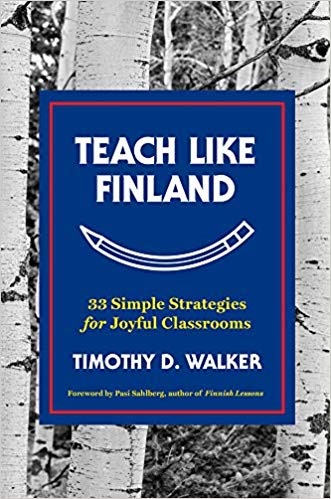
Teach Like Finland: 33 Simple Strategies for Joyful Classrooms by Timothy D. Walker tells the story of an American teacher who moved to Finland with his Finnish wife and got a job teaching in a Finnish school. Although he realizes that there are many constraints that prevent American schools from being like Finnish schools, he does think that we can borrow a great deal from the way Finnish teachers operate. All school leaders should get a copy and consider making copies available to their teaching staff.
Forward by Pasi Sahlberg
- You can read my summary of Pasi’s Finnish Lessons here.
- When the first PISA scores were released in 2001, to everyone’s surprise, Finland came in first. There was also less variation between schools and less influence from family backgrounds. Spending was modest. Students start at age seven, schools address all subjects evenly, there are no private schools, students aren’t segregated by their ability, and they believe anyone can learn most of the expected things with sufficient support. Teachers must have a research-based masters and a full-year internship, and about half of all students get some special education support as soon as they need it.
- Principals are certified teachers and do some teaching. After school, there are many associations and clubs that allow almost all students to engage in sports, arts, and/or cultural activities. While it is impossible to transfer education systems from one place to the other, Tim shows how you can use principles found in Finnish schools to improve the quality of education in your school.
Introduction
- As a first-year teacher in Massachusettes, Tim was so burned out that he took a month-long leave in February. After three years of teaching, he moved to Helsinki with his Finnish wife and landed a job teaching in an English speaking fifth grade. In addition to teaching there for two years, he also visited other schools and interviewed many other teachers. He believes that American teachers can and should put Joy first in their classrooms. To organize this book he starts with Raj Raghunathan’s four ingredients of happiness, which are belonging, autonomy, mastery, and mindset. To these, he adds well-being.
1. Well-Being
- Schedule Brain Breaks: When Tim started teaching in Finland he shunned the 15-minute breaks every forty fine minutes employed by other teachers. He soon noticed that his students became zombie-like after a while. When he did start with breaks he noticed that students were much more focused. Refreshing one’s brain leads to greater productivity and creativity. Students should have a choice of what to do during breaks. Look for enjoyment, novelty, and independence. Classrooms also should have “calm spots.”
- Learn On the Move: Until recently, Finland, like the US, got a D for physical activity levels. This prompted the introduction of a program called “Finland on the Move.” They realized that students weren’t getting enough exercise so they added more movement during breaks and during class time. Older students act as exercise facilitators for younger students. Playground gear is checked out to each student. Calisthenics breaks happen during class. Standing desks and exercise balls as seats are being added to classrooms. Students post work in class or hallways and then walk around leaving questions and praise on other students’ work with sticky notes.
- Recharge After School: Finish teachers know the importance of recharging after work. They engage in activities that are not related to their school work. It helps that their teaching load of about 18 hours a week is much less than the 26.8 US schools average. Unlike many US teachers, they don’t equate success with how many hours they work. Rather than encourage teachers to stay late like some US schools, principals will say things like “shouldn’t you be home by now.” This greatly lessens stress and anxiety. Finnish teachers do give homework, but it consists of simple tasks which can be completed over several days without parental help.
- Simplify the Space: Unlike many US classrooms that feature walls cluttered with teacher displays and student work, classrooms in Finland are relatively simple. Studies show that cluttered walls distract student attention and interfere with learning. By putting only a few things on the walls they will get more attention. Posting quality student work is fine, but it need not stay up too long. Not having to constantly decorate also gives teachers more time for other uses.
- Breathe Fresh Air: Classrooms full of students can also have increased levels of carbon dioxide, which can negatively impact learning. For this reason, opening windows from time to time is part of the Finnish philosophy. They also get students outdoors even when it’s raining and at temperatures as low as 5 degrees F (-15 C). Classroom temperatures should be between 68 and 74 F and they should feature as much natural lighting as possible.
- Get Into the Wild: Howard Gardner the creator of multiple intelligence theory has added an eighth intelligence he calls naturalist intelligence. Finnish teachers get their students into nature as much as possible be it on the school grounds or via a field trip. On the school grounds, you can observe and record nature. You can also grow things and add bird feeders. Be sure to bring nature into your classroom where you can also grow plants and some small animals like frogs.
- Keep the Peace: Peaceful classrooms make for better learning. At times the room will be quiet as students work independently. At other times students will collaborate. Sometimes both may be happening with the collaborators off in a corner. Students work to make class rules with a focus on respect and three rules is a good number. Then they make anchor sheets, which show the kind of behaviors that promote the rules. Students take charge of a “noise detector” so they feel responsible for keeping the peace. Meditative-like mindfulness activities help settle students down after periods of physical activity.
Posted in Book Summaries, Education Books, Leadership Books | Comments Off on Teach Like Finland: 33 Simple Strategies for Joyful Classrooms by Timothy D. Walker
Monday, November 11th, 2019
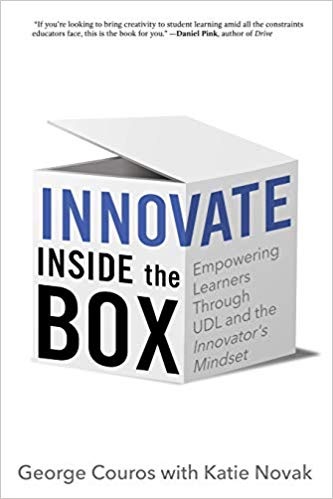
Innovate Inside the Box: Empowering Learners Through UDL and the Innovator’s Mindset by George Couros with Katie Novak builds on his previous book The Innovator’s Midset. The goal of this book is to help teachers grow so they are more likely to make a difference in their students’ lives. Constraints like red tape, limitations, and lack of funds comprise “The Box” in the title. Innovating in spite of those constraints involves finding another way around problems that limit the impact teachers have on their students.
Introduction: Because a Teacher
- Most of us can remember one or more teachers who made a significant positive difference in our lives. Perhaps other adults have done the same. A goal of this book is to help teachers grow so they are more likely to be that kind of difference-maker. Constraints like red tape, limitations, and lack of funds comprise “The Box” in the title. Innovating in spite of those constraints involves finding another way around problems that limit the impact teachers have on their students.
Part One – The Core of Innovative Teaching and Learning
- 1. Relationships: Research shows that students perform better when teachers prioritize relationship building. Increased social capital leads to higher test scores. Since collaboration builds social capital it also raises scores. This means that relationships between adults are important too. It seems we learn more from someone with whom we have a positive connection.
- Tips for relationship building include: Greeting kids at the door, playing music as they enter, making first interactions positive, calling parents early, flexible planning, allowing students to design the classroom, tapping into to each student’s passion, encouraging students to ask questions to keep them curious, and loving them. Studies with dropouts show that they usually weren’t connected with anyone at school. If a student arrives late just say “I’m glad you are here.”
- 2. Learner-Driven, Evidence-Informed: Learner-driven means that students have a voice in setting learning goals. Evidence-informed means that teachers go beyond grades when they give students feedback. You should be driven by students, not data. Students get lost in the process when teachers are driven by test scores. Beyond grades, evidence can include portfolios, self-assessments, performances, and anything that highlights learning and growth.
- Most of what employers look for cannot be graded. That includes creativity, initiative, critical thinking, and complex problem-solving. Grades can even deter learning. George suggests that you give students feedback without grades. When students are invested in their own goals, they will go beyond the goals the teacher sets for them. Focus on students’ strengths first. If they see weakness as they use their strengths they will be more motivated to work on it.
- 3. Creating Empowered Learning Experiences: Empowerment is about helping students figure out what they can do for themselves. Rather than listening, reading, observing, and consuming they should spend more time speaking, writing, interacting, and creating. Student choice is big here. If students have a voice in what they learn and how they demonstrate that they have learned they will be more motivated. They should be doing writing blogs, video scripts, and podcasts.
- The next big idea is to have students generate questions rather than just give the right answers. The best questions might be those that the teacher can’t answer. We also note that curiosity improves intelligence as it drives the acquisition of knowledge. In essence, our goal is to create self-directed learners. George tells of how he created a student IT department at his school and how another teacher had students be responsible for all aspects of running the school store. In essence, students are the most underused resource in our schools.
- 4. Master Learner, Master Educator: In addition to continuously learning, teachers need to make sure that students know they are learning. For example, if you want students to curate digital portfolios, you should first make one yourself and let them see it. This is learning for your students. Learning about your students should, however, be your first priority. Start with the student who gives you the most trouble and spend time every day in personal conversation. That should improve that student’s behavior, which can improve the entire class.
- Rather than planning every step of the way be ready to adapt. Be sure to tell students to “figure it out” rather than telling them the answers. Students should be finding resources on their own and experiencing the power of teaching the teacher. The teacher and the class are smarter than the teacher alone.
Posted in Book Summaries, Education Books, Leadership Books | Comments Off on Innovate Inside the Box: Empowering Learners Through UDL and the Innovator’s Mindset by George Couros with Katie Novak
Friday, October 18th, 2019
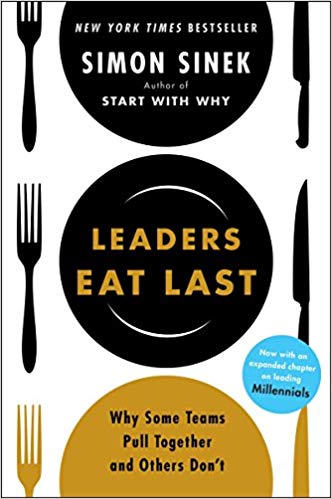
Leaders Eat Last: Why Some Teams Pull Together and Others Don’t by Simon Sinek tells stories about leaders who found success mainly by putting people first. Seeking short term gains and seeking to serve one’s own selfish interests is short-sighted and sure to fail over time. This book will help leaders in all fields be the type of leader they wish they had. This would be a great textbook for any leadership course. Be sure to get a copy for leaders you know.
Forward by George J. Flynn Lieutenant General, U.S. Marine Corps (Ret.)
- An organization’s success or failure is based on leadership excellence and not managerial acumen. These organizations have strong cultures and shared values and understand the importance of teamwork and trust. They understanding the importance of people and relationships. The true price of leadership is the willingness to place the needs of others above your own. You must know your people and realize that they are much more than an expendable resource. Good leaders truly care. Leaders who take care of their people can never fail.
Part 1 – Our Need to Feel Safe
- 1. Protection from Above: We start with a story about a pilot risking his life to save 22 men in Afghanistan. He said he was just doing his job and that empathy for others is the single greatest asset he had to do his job. “They would have done it for me.” Empathy helps you share your glory and help those with whom you work to succeed. This strong foundation leads to success that no amount of money, fame, or awards can buy. Exceptional organizations have cultures in which leaders provide cover from above and the people on the ground look out for each other thanks to empathy.
- 2.Employees Are People Too: By getting rid of time clocks, bells that signaled breaks and lunch, locks on boxes of spare parts, and replacing free anytime phones with asking for permission payphones one leader used trust to turn his company around. People offered to donate vacation days to an employee with family problems. The workers also took better care of the machines. This happens when leaders listen and avoid coercion. They treat workers like family and realize that everyone is someone’s son or daughter.
- 3. Belonging: The authors use the metaphor of The Circle of Safety. It’s like four oxen standing so that no matter which direction the lion comes from it will always be met be horns. After thirteen weeks of boot camp, Marines know that they can trust every other Marine to protect them. It’s important that everyone in an organization feel that way about every other member so that everyone feels as safe as possible. This will result in better collaboration and problem-solving.
- 4. Yeah, but…: Stress can have negative effects on one’s health so it’s important to avoid it as much as possible. The more control a person has the less likely they are to be stressed. Top leaders, therefore, do what they can to give workers control and to acknowledge their efforts. We also know that coming home angry from a job you hate will have a negative impact on your children. You may be better off with no job rather than one you hate.
Part 2 – Powerful forces
- 5. When Enough Was Enough: In order to survive, humans have had to rely on cooperation and mutual aid rather than competition. If we don’t look out for our group, our group won’t look out for us. Conversely, if we don’t take care of ourselves first, we won’t be of much use to others.
- 6. E.D.S.O: Four brain chemicals help us survive. Endorphins are the brain’s pain relievers. They give us a remarkable capacity for physical endurance. Dopamine causes a feeling of satisfaction when we accomplish something. It makes us a goal-oriented species. Together these two chemicals help us get things done. Serotonin gives us the feeling of pride we get when we perceive that others like or respect us. As social animals we need approval. This causes us to give of our selves. Oxytocin is the feeling of friendship, love, or deep trust. Without it, there would be no empathy. You get it when to do something nice for someone. Such behaviors make us happy and help us live longer.
- 7. The Big C: When something goes wrong or you don’t feel safe your body releases cortisol. It’s the chemical that causes feelings of anxiety, discomfort, or stress. It’s like an early warning system. If you work with a group where members don’t care much about one another’s fate cortisol starts to seep through your veins. It inhibits the release of oxytocin, the empathy chemical. One can adapt to regular doses of cortisol, but it isn’t good for one’s health. Here is a story of a company that adopted a no-fire policy. As a result, people communicated more openly and pointed out problems more quickly. Turnover shrank and people felt safe.
Part 3 – Reality
- 9. The Courage to Do the Right Thing: Here we have a story of an aircraft controller who broke the rules and saved many lives. The point is that you have to know when to break rules and that you need rules to keep things running well. Also, relationships aren’t really based on rules.
- 10. Snowmobile in the Desert: Snowmobiles don’t run so well in the desert. Sometimes amazing humans are like snowmobiles in the desert. Sometimes the harder we try to do things right the worse we feel. We need to get the environment right at work and at home and learn how to work together as nothing great was ever accomplished by a single person.
Posted in Book Summaries, Business Books, Leadership Books | Comments Off on Leaders Eat Last: Why Some Teams Pull Together and Others Don’t by Simon Sinek
Friday, September 27th, 2019
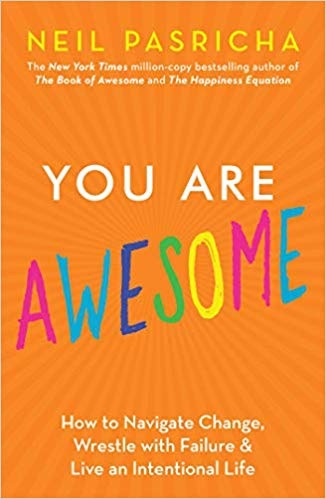
You Are Awesome: 9 Secrets to Getting Stronger and Living an Intentional Life by Neil Pasricha offers excellent advice that we can all use to have a more fulfilled and productive life. The advice here is appropriate for people in business, educators, and students alike. In short, everyone. Be sure to get some copies for your professional development library and get one for yourself.
Introduction: You Need to be More Resilient
- It starts with a very cool fable that demonstrates the notion of resilience. The key is to not let defeats define who you are. Every end is a beginning. Resilience seems to be in short supply, which is why Neil wrote this book. He offers nine research-backed secrets, shared through personal stories on how we can move from shattering to strengthening. If you find yourself off course, this book is for you.
Secret #1 – Add a Dot Dot Dot
- The dot dot dot here is known as an ellipsis which marks incomplete utterances in plays. Compare this to a period known as a full stop, which marks a finished sentence. Neil uses the ellipsis as a metaphor for life were everything is unfinished until you die. He uses the inspirational story of his mother, born the fifth girl in Kenya to a family who wanted a fourth boy. She was self-taught and got the highest score in the nation’s standardized test, which earned her a full scholarship to a white prep school. She just kept going like an ellipsis and looked past the periods.
- The other key lesson here is that like Neil’s mom, the one word you should use over and over at the end of your sentence is yet. As is “I don’t have any better options…yet.”
Secret #2 – Shift the Spotlight
- It’s egotistical to think that “it’s all about you.” It’s foolish to think that people are constantly looking and you and judging you. It’s folly to think the spotlight is on you because it isn’t. Stop caring with other people who are self-absorbed think of you. There is so much beyond your control that you need to simply learn from your failures and move on. Share your failures with others as it will help you seem more human. You will seem more normal, real, and relatable, which will help improve your relationships. If you make self-harming statements you are likely to believe them. Also, avoid exaggerating the size of your problems.
Secret #3 – See It as a Step
- If you think of life as a long stairway you need to realize that you can see the steps taken but the upcoming steps are invisible. Also, realize that we are all really bad a predicting the future. People think that they have changed a lot in the past, but won’t change much in the future. This is probably wrong. When people are down, they often think they will probably stay there. This is the wrong way to think. See failure as a step towards a future that you will be happy with. Neil also recommends that you avoid the endless reports of bad news that our modern media doles out. It’s largely a machine-gun barrage of superficial negativity. He also found that writing a blog was cathartic as it helped him swap dark thoughts for lighter ones. For him, it was the dot dot dot, a shift of the spotlight, and the next step. When you fail, just prepare for this next step, which might be positive.
Secret #4 – Tell Yourself a Different Story
- Shame is an intensely painful feeling or experience that we are flawed and unworthy of love or belonging. It plays a role in how we think of ourselves. Your problem is the story you are telling yourself and you can choose another story like you can choose your attitude. Three questions can help. 1. Will this matter on my death bed? 2. Can I do something about this? 3. Is this a story I am telling myself?
Secret #5 – Lose More to Win More
- Some good things just take time. They take lots of failure, lots of loss, and lots of experience. Wanting to get better is a real gift. It means you keep trying, failing, and learning. If your number of failures exceed those of most people you should be proud of that. Cy Young had the most wins and the most losses. Nolan Ryan had the most strikeouts and the most walks. The more times you step to the mound the more chances you have to win. Go to parties where you don’t know people. Have a failure budget. Can you afford to lose hundreds on something that fails? How about thousands or more? More losses give you more chances to win. If you want good pictures, take more pictures.
Secret #6 – Reveal to Heal
- Physical releases are easier than mental releases. Take time to let go of something and take time to feel grateful and write down at least five gratitudes a week.
Secret #7 – Find Small Ponds
- Would you rather be a big fish in a small pond or a small fish in a big pond? If you choose the former your self-esteem will go up and stay up. Neil got this advice from a dean so instead of applying to a top company he looked for ones that were broken in some way. He got a job where he was a big deal and could make a difference. This concept applies to life. Rather than chase the hot person on the beach, look for the nerd in the library. Just don’t be arrogant or act boastfully while you are in the small pond.
Secret #8 – Go Untouchable
- It seems that every day there are more distractions in our lives. Cellphones are a big culprit while things like meetings at work and a barrage of emails also contribute. When Neil quit Walmart to become a full-time writer he found that he didn’t have the amount of time he anticipated to do creative work. His solution was to create weekly UNTOUCHABLE days where he unplugged and just focused on creative activity. He found his productivity skyrocketed so he now schedules two such days a week sixteen weeks into the future. If he has to shift one of these days he keeps it in the same week.
Secret #9 – Never, Never Stop
- This chapter could have been called “what I learned from my dad.” He emigrated from India to Canada, worked hard, and never gave up. He kept things simple and when he made a decision he didn’t waste time rethinking it. The big idea is that you can only go forward so start going that way and never stop. Thanks, Neil.
Neil Pasricha
- Neil is a New York Times bestselling author of six books including The Book of Awesome and The Happiness Equation. His podcast 3 Books is his quest to uncover the most formative books in the world. He gives 50+ speeches a year including TED Talks and SXSW. He has degrees from Queen’s University and Harvard Business School and lives in Toronto. Reach him on Twitter as @nielpasricha, visit his blog at Neil.Blog, and drop him a line at neil@globalhappiness.org.
Posted in Book Summaries, Business Books, Leadership Books | Comments Off on You Are Awesome: 9 Secrets to Getting Stronger and Living an Intentional LIfe by Neil Pasricha