Author Archive
Thursday, March 28th, 2013
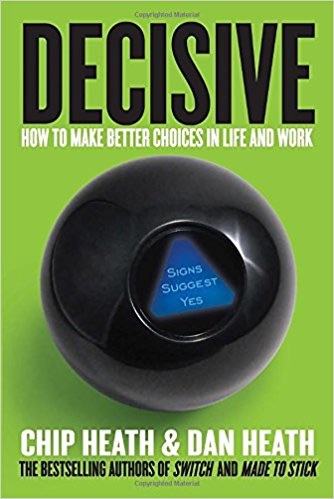
Decisive: How to Make Better Choices in Life and Work by Chip & Dan Heath shares research and cool stories that show how our decisions are disrupted by an array of biases and irrationalities. They go on to introduce a four-step process designed to counteract these problems. Their fresh strategies and practical tools will enable you to make better choices at work and beyond. If you want to increase your chances of making the right decision at the right moment, this book is for you. Click the icon at the bottom of any page to buy this important book for yourself and your key colleagues.
The Heath Brothers
- Chip Heath is a professor at the Graduate School of Business at Stanford University. Dan Heath is a senior fellow at Duke University’s Center for the Advancement of Social Entrepreneurship (CASE). They are the authors of the bestsellers Switch and Made to Stick.
- While working on this book, the authors asked that I forego my usually summary approach and do a more traditional book review highlighting a few useful concepts and to use my educational expertise to show readers how to apply them to their life. I have tried to honor this request and thank them for their input.
Introduction
- Chip and Dan start with the key core difficulties that negatively impact our decision making. We think we know everything there is to know prior to making a decision. We also tend to be overconfident in our knowledge of the future and seek only data that confirms what we believe. We let our emotions get in the way, and often present choices in either/or terms.
- Doug: In education, I’ve seen each of these whenever decisions were made whether by myself as principal or by a collaborative process. It is important to challenge your own thinking and say things like “you may have a point” when a colleague disagrees. Everyone knows that they aren’t always right, but it’s hard for many people to investigate the possibility that they are wrong prior to committing to a decision. They are more likely to dig in and defend their position.
Ask: What Else We Could Do/Buy?
- When dealing with budget issues, you should always ask “what else could we buy” if we didn’t buy the item(s) we are considering? A good example today is what could we buy with all the money we are spending on textbooks and standardized testing?
- The vanishing options test would also allow you to consider what to do with an administrative position when someone leaves. Always ask “how else you could accomplish the person’s function, and is there some part of what they are doing that doesn’t need to be done.” I have found that for administrators, the job will expand to fill the day with tasks that aren’t mission critical.
Posted in Book Summaries, Business Books, Education Books, Leadership Books | Comments Off on Decisive: How to Make Better Choices in Life and Work, Heath Bros.
Sunday, March 10th, 2013
The Little Book of Talent: 52 Tips for Improving Your Skills by Daniel Coyle (© 2012, Bantam Books: New York, NY) is a bit over 100 pages and offers specific tips for developing talent. Daniel relies on abundant research to help you copy the techniques used by the top performers in many fields. In addition to growing your own talents, this book will help parents, educators, and coaches increase the success rate of their students. Every home should have a copy, so click the icon at the bottom of any page to get yours.
Posted in Book Summaries, Business Books, Education Books, Leadership Books | Comments Off on The Little Book of Talent by Daniel Coyle
Sunday, January 27th, 2013
Hello from EduCon 2.5 in Philadelphia. On January 26, 2012 I lead a conversation with thirty educators titled: Leading When the King has no Clothes: What do teachers and leaders do while we wait for policy makers to discover that the test culture they have created is a mistake? Everyone agreed that there are a number of negative results from testing required by the federal government. With that in mind, we went on to suggest things that we could do to minimize the negative impact on students and teachers. The following pages include our work from the perspectives of five different constituents. If you can add anything, send me and email and I will add it. dgreen@stny.rr.com
Posted in Doug's Original Work | Comments Off on What to do until the tests go away – EduCon 2.5
Friday, January 25th, 2013
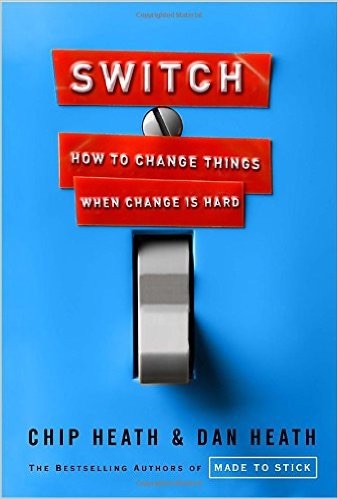
Switch: How to Change Things When Change is Hard by Chip and Dan Heath deals this one of the most important topics faced by any leader and everyone else. They believe that the primary obstacle comes from conflict built into our brains. They explore this conflict between our rational brain and our emotional brain that compete for control. This book will help your two minds work together. It draws on decades of research from multiple fields to shed new light on how you can effect transformative change. Discover the pattern they have found and use it to your advantage. Click below to purchase this important book.
The Heath Brothers
- Chip Heath is a professor at the Graduate School of Business at Stanford University. Dan Heath is a senior fellow at Duke University’s Center for the Advancement of Social Entrepreneurship (CASE). They are the authors of the bestseller Made to Stick and a new book Decisive: How to Make Better Choices in Life and Work also summarized here.
I just added a summery of thier 2018 book The Power of Moments.
Introduction
- All change efforts have something in common: For anything to change, someone has to start acting differently. All change effort boils down to the same mission: Can you get people to start behaving a new way? First surprise: What looks like a people problem is often a situation problem. To change someone’s behavior, you’ve got to change that person’s situation.
One Brain – Two Minds
- Human brains have their emotional side and their rational side. You can think of the two sides as the planner (rational) and the doer (emotional). In this book, the Heaths use an analogy they borrowed from Jonathan Haidt in his book The Happiness Hypothesis. Here, the emotional side is the Elephant and the rational side is the Rider. When the two sides disagree, the six-ton Elephant is going to win. If you want to change things you need to appeal to both the Rider and the Elephant. The Rider does the planning and the Elephant provides the energy. The Rider provides the direction, the Elephant provides the passion.
Posted in Book Summaries, Business Books, Education Books, Leadership Books | Comments Off on Switch: How to Change Things When Change is Hard by Chip and Dan Heath
Wednesday, January 23rd, 2013
How To Deliver a TED Talk: Secrets of the World’s Most Inspiring Presentations (© 2012) by Jeremey Donovan, gives you a step-by-step guide to doing your own inspiring TED-style presentation. If you haven’t seen a TED Talk it’s time to start. Click the icon below to purchase this quick, quality read.
Posted in Book Summaries, Business Books, Education Books, Leadership Books | Comments Off on How To Deliver a TED Talk: Secrets of the World’s Most Inspiring Presentations