Archive for the ‘What can Dr. Doug do for you?’ Category

How to Keep Your Kid’s Brain Moving Over Breaks by Emily Graham

Friday, October 3rd, 2025

Graham
How to Keep Your Kid’s Brain Moving Over Breaks by Emily Graham offers great advice to anyone who has to supervise a student during a school break, which can be as long as a summer break or as short as a weekend. Please share with parents you know.

Introduction

School breaks can be a time of drift or quiet acceleration. Kids need rest — but long
stretches without structure can dull progress, especially in core subjects like reading, math,
or even language learning. Parents don’t need to become teachers to stop the slide — just
good facilitators. With the right rhythms and low-pressure options, you can keep your child
curious and engaged without burning them out or turning summer into school 2.0.

Start With Why Learning Slows Down

Extended time away from school makes it harder for students to maintain academic
footing. Reading comprehension slips. Math skills fade. Kids lose the mental routines that
help them focus and retain information. That’s not because they’re lazy or disengaged,
it’s just how cognitive systems work. If you want to prevent summer learning loss, you need friction — just enough engagement to keep the learning circuits active. A small,
regular push is far more effective than occasional sprints.

Your Role Is to Prime, Not Push

You’re not trying to replicate a classroom. You’re trying to make space for questions,
conversation, and effort. When you read aloud with your child, pause. Ask what they think
will happen next. Try to engage them in learning through small, consistent co-learning
moments. The goal isn’t mastery — it’s momentum. Your presence, your tone, and your
interest shape whether your child sees learning as something to tolerate or something
worth showing up for.

Supplement With Human-Led Online Support

Not every subject clicks in the same way. And not every parent can support every subject
equally — that’s normal. One of the most practical ways to supplement is through online
tutoring. It offers structure without rigidity, and many platforms allow you to adjust timing
based on your child’s schedule. If your child needs extra help with Spanish, for example,
you might try online Spanish tutors that are personalized, flexible, and motivating. Some let
you switch instructors, book trial lessons, and match based on your goals — a supportive,
immersive, and best value for money approach that feels both engaging and effective.

Keep Learning Cadence With Short Practice Windows

One of the simplest shifts you can make is in how you pace repetition. Instead of long,
dense study sessions, spread things out. Short practice blocks — 10–20 minutes a few
times a week — help the brain store and stabilize new knowledge. The key is rhythm, not
rigor. Using a family toolkit that supports retention across math, reading, and writing can
help structure this without having to build your own plan. Let the tools do the heavy lifting
while you focus on showing up.

Include Movement to Reset the Brain

Cognitive overload happens fast — especially for younger kids. But movement resets
attention. That’s not anecdotal; it’s biologically grounded. Stretching, light cardio, even a
dance break has been shown to support focus and mental clarity. If your child is flagging
mid-session, pause. You’ll get more learning value after a reset. In fact, active breaks boost
attention better
than silent sitting or passive distractions. It’s counterintuitive, but stepping
away can make recall stronger.

Follow Their Interests — Especially in Reading

The best summer learning doesn’t feel like learning. It feels like following a question. If
your child loves sports, get them books about athletes. If they like animals, find stories set
in the wild. When reading is centered on choice and interest, motivation spikes. You’re not
trying to enforce a reading log. You’re trying to spark summer reading engagement by
showing them that books are a gateway, not a checklist. Even reluctant readers often
respond well when they’re given options.

Let Loose Structure Do the Heavy Lifting

Some parents go into break mode thinking, “We’ll just play it by ear.” Others build color-
coded schedules that collapse by week two. The sweet spot is somewhere in between:
simple routines that kids can anticipate without strict timelines. Morning reading? Check.
Screen-free hour in the afternoon? Done. That kind of balance between freedom and
structure
helps children hold onto school-year habits without making it feel like
punishment. You’re maintaining momentum — not applying pressure.

You don’t need a master curriculum. You need a few strong rhythms. Parents who build in
light structure, leave room for curiosity, and add small supports — whether it’s a reading
session or a quick language lesson — are the ones who see their kids return sharper, not
slumped. The secret isn’t piling on more work. It’s timing, tone, and matching how kids
learn when the pressure’s off. So as the break rolls on, worry less about doing “enough” —
and more about doing “just right.”

FAQ: Supporting Learning During School Breaks

Q: How much learning time is ideal during a break?
A: For younger students, even 15–30 minutes a few times a week can help. It’s the
regularity, not the volume, that matters most.
Q: What subjects should I focus on?
A: Reading and basic math are the most vulnerable to skill fade. But subjects like language,
art, and science can add fun and variety.
Q: How do I keep my child motivated?
A: Follow their interests. Let them pick the topic, book, or project. Offer small wins and
praise effort, not just results.
Q: What if I’m not confident helping with certain subjects?
A: Consider online tutoring for support. Many platforms offer flexible, subject-specific help
that complements your child’s pace.
Q: Will this really make a difference in the long term?
A: Yes. Children who stay engaged even lightly during breaks often return to school more
confident and ready to learn.
Q: Is school break a good time to start language learning?
A: Yes — it’s an ideal time. Without the pressure of grades or homework, kids can explore a
new language in a more relaxed, engaging way. Even short, consistent sessions can build
real momentum and boost confidence heading into the next school year.

Unlock a world of knowledge and innovation with Dr Doug Green’s insights on education,
productivity, and personal growth—visit today to start your journey towards a smarter
future!

Emily Graham
Emily is the creator of MightyMoms.net. She believes being a mom is one of the hardest jobs around and wanted to create a support system for moms from all walks of life. On her site, she offers a wide range of info tailored for busy moms — from how to reduce stress to creative ways to spend time together as a family. You can email her at emilygraham@mightymoms.net. She lives in Arizona.

Share this:
Share this page via Email Share this page via Stumble Upon Share this page via Digg this Share this page via Facebook Share this page via Twitter Share this page via Google Plus

How To Know if a Computer Science Career Is Right for You by Craig Middleton

Sunday, November 22nd, 2020

Comp Sci Career
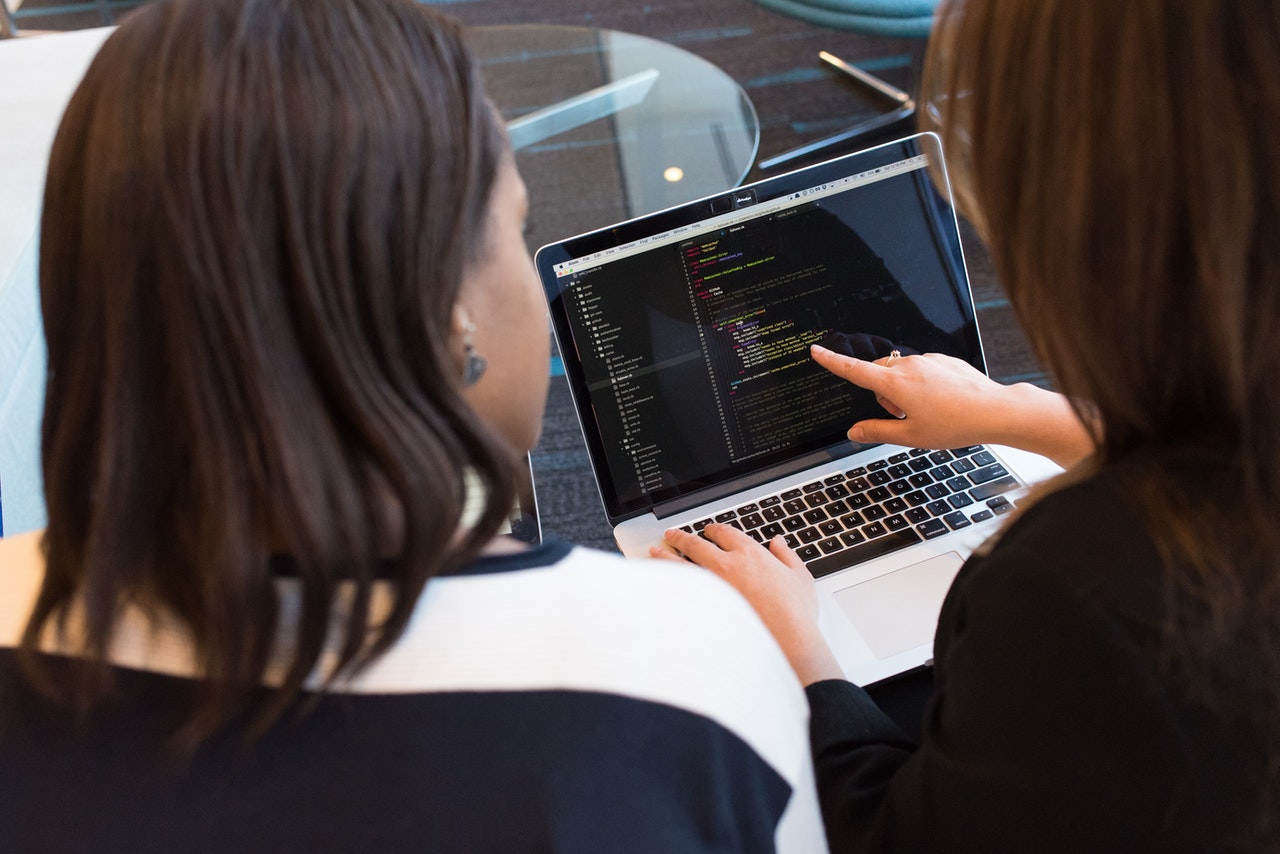
How To Know if a Computer Science Career Is Right for You by Craig Middleton is a reality check for students considering a career in this field. It’s a field where you can typically work anywhere and make good money as long as you can deal with the stress of deadlines. Share this with students you know who are good in math and science.

Introduction

  • Computer science is a field of study that can lead to some pretty appealing careers. However, pursuing this career path requires an immense amount of effort. In order to make the right choice as you enter the field of higher education, it helps to have an idea of what computer science education and careers are actually like and what it takes to make it. Here’s what you need to know in order to make the most informed choice possible.

The Tech Job Market

  • Computer science careers are associated with a paycheck that’s potentially quite high, and that makes pursuing that kind of career a fairly easy choice on paper. More importantly, specializing in computer science can all but guarantee you job opportunities after college graduation. With recent advancements in technology, modern businesses of all kinds and many entrepreneurs need skilled computer science specialists. This ensures that your skills will always be in demand. This kind of expertise, in particular, is so valuable because these skills don’t typically come naturally. This means that fewer people have developed the knowledge and skill required to manage modern technology at a professional level.
  • Taking the necessary steps to make yourself an indispensable asset in this way will be difficult, but it will be well worth it in time. There are plenty of resources online to build up your skills, that in return, will help you stand out from the crowd when applying for jobs. You can take free courses about computer science found at codecademy or open culture. Exploring these options will lead you to a better understanding of yourself and your career goals. If you find that you have a passion and interest in these beginner courses, then you’ll likely gain even more passion for it as you advance through your education and career.

The Importance of Cybersecurity

  • Modern businesses rely on the internet for a variety of increasingly essential purposes. Companies depend on an online presence to maintain a competitive level of marketing, for starters, and online retail is a natural extension of the reach of any retail business. All of these online interactions open up companies to the risk of cyber-attacks because businesses are often targeted by hackers as a result of a perceived financial opportunity or simply a high profile target that can give them some clout in the hacker community. With the rise of apps for every brand under the sun, network and API security are an essential part of protecting not only the business in question but also the users of these apps.
  • Cloud storage is becoming a staple of modern businesses, and this style of file storage, while it’s generally more secure, requires additional cybersecurity protocols. Cybersecurity entails a number of tools and best practices used in tandem, making this field even more inaccessible to the average person, and that makes this kind of skill set indispensable in today’s job market. This role requires not only knowledge and skill, but also the ability to keep calm under pressure, because cyberattacks can be tremendously detrimental and need to be solved quickly.

The Rise of the IT Department

  • The increased dependence of modern businesses on complex technology, both online and off, has led to an increase in the importance and representation of the IT worker. IT, or information technology, workers are a fundamental part of any digital-age business, because these professionals are those tasked with maintaining the various systems at play concerning data. This means that IT workers are on the front lines when and if malfunctions occur, and this is more important now than ever.
  • In many modern companies, malfunctions of all kinds can lead to the loss of valuable time, and it falls to the IT department to resolve these issues quickly and effectively. This requires expertise in understanding the how and why of technical difficulties regarding computers, modems, routers, and networks, and that knowledge can be put to use both to solve problems and to prevent them.
  • As businesses continue to lean on their IT workers, these qualified professionals continue to have job security and often fairly substantial pay. However, the tradeoff is that the job can be quite stressful. The study of computer science is akin to that of medicine. While the subject matter is inherently different, both of these disciplines require an immense amount of knowledge and the ability to put that knowledge to use in high-stakes situations. If you can handle that responsibility and have an innate interest in technology, pursuing this career path can be incredibly lucrative for you.

Another Career Guide and Doug’s Comments

  • Here is a computer network career guide that may also be helpful. As a former High School computer science teacher I have seen students enter and succeed in this field. The best went beyond expectations and branched out to learn programming languages on their own. If you can learn to program using online courses at your own pace you might have what it takes. If you get lost in programming challenges and lose track of time, that’s a good sign that you have the passion required. Thanks, Craig
Share this:
Share this page via Email Share this page via Stumble Upon Share this page via Digg this Share this page via Facebook Share this page via Twitter Share this page via Google Plus

How to Raise Kids Who Aren’t Assholes: Science-Based Strategies for Better Parenting from Tots to Teens by Melinda Wenner Moyer

Monday, October 31st, 2022
Kids Who Aren'T Assholes

How to Raise Kids Who Aren’t Assholes: Science-Based Strategies for Better Parenting from Tots to Teens by Melinda Wenner Moyer can help just about anyone be a better parent. Like her, you are not likely to become a perfect parent with perfect kids, but you can profit from the extensive research and expert interviews she conducted. If you have kids still at home, be sure to get a copy as well as copies for any adult children who have kids.

Introduction

  • Over the years, Melinda has engaged in a great deal of research in order to write parenting articles for major publications. She has found that this effort has made her a better parent. The purpose of this book is to share what she has learned with. More than anything, parents want to raise children who are kind. In surveys of what parents want their children to be, kindness comes before intelligence and work ethic. Parents play a key role, but not the only role in child development so it’s vital that their role is as positive as possible. People who are kind, helpful, and generous are happier, more successful, and make more money. (Doug: Being nice is really a selfish thing to do as if you take care of yourself, you can do more for others.)

Part I Traits
1. “It’s All About ME!” How to Raise Kids Who Aren’t (Overly) Selfish

  • Kids can be very self-centered. This is natural as their frontal lobes haven’t fully developed. Start with helping kids understand their emotions and how to recognize the emotions of others. Kids with good emotional recognition generally experience better outcomes in many areas. You can ask about the emotions of characters when you read to kids or just do it in the daily run of life, including your own emotions. When you discipline a child, include emotions. Explain how emotions affect others.
  • Letting kids help around the house can take more time, but it’s important. Make sure that their tasks go beyond cleaning up their room and helping everyone in the house. Look for opportunities for kids to help in the community and try to let them have some choice. Don’t just bark orders. Explain anything that you ask them to do. Be a role model. Point out the good stuff and the bad stuff that you do.

2. “This Is Too Hard.” How to Raise Kids Who Are Ambitious, Resilient, and Motivated

  • In this chapter Melinda draws on the works of Carol Dweck’s Mindset and Angela Duckworth’s Grit that are both summarized here. It’s key that you compliment kids for effort rather than intelligence. If they think they are smart, they are less likely to take on challenges where they run the risk of looking “not smart.” How hard you try impacts how smart you become. Grit is a combination of passion for something, enough self-control so you work at it on a regular basis, the ability to work through and learn from mistakes, and a belief that what you are doing matters.
  • You should expect your kids to pick at least one extracurricular activity each year and stick with it until the year ends. Unfortunately, some such activities are expensive. Any accomplishment tends to motivate and leads to a success spiral. Kids tend to procrastinate as their pre-frontal cortexes aren’t fully developed. Try to make tasks that seem too difficult seem fun or less scary. Help them recognize and eliminate distractions and create a good working environment. Rewards can stifle intrinsic motivation but are ok as a surprise after something is accomplished. Acknowledge their feelings and give choices when possible, even for chores. They are more likely to be motivated if they feel less controlled.

3. “You’re Dumb and Ugly!” How to Raise Kids Who Don’t Bully – and Who Help Those Who Are Bullied

  • Most parents worry about their kids being bullied, but few give thought to the notion that their kids might do some bullying. Research shows that one in three do some bullying and one in six engage in cyberbullying. Bullying is a continuum, and a kid can be a bully one day and be bullied the next. Bullying is something that is repeated and deliberate, and it involves an imbalance of power. It is often done to boost social stature. Among girls, it often involves exclusion or rumor spreading. (Watch the “Mean Girls” movie with your kids.) Kids often bully as a misguided way to deal with their anger.
  • Cyberbullying may have the same causes, but it differs in that it can happen at a distance any time of day, and it usually leaves a digital footprint that can be shared with parents or teachers. Bullying can also have long-term effects, such as depression and low self-esteem. Parents should talk to kids about bullying so they know it when they see it and know that it is not ok. Encourage them to do what they can to help a victim when they see bullying happen. Help them learn how to deal with anger. There is advice here for what to do if you discover that your child has been bullying others or is being bullied themselves. Schools play a big role here, so make sure your school has a plan or a program for dealing with it.
Share this:
Share this page via Email Share this page via Stumble Upon Share this page via Digg this Share this page via Facebook Share this page via Twitter Share this page via Google Plus

How to Stay Organized as a New Teacher: A Practical Guide to Calm and Control by Emily Graham

Friday, January 30th, 2026

How to Stay Organized as a New Teacher: A Practical Guide to Calm and Control by Emily Graham

Graam
The first year of teaching can feel like a marathon run at sprint speed. Between lesson prep, paperwork, and classroom chaos, organization becomes the only way to keep your energy and clarity intact. The key is to treat organization not as perfection, but as a rhythm that adapts as you grow.

Quick Insights

  • Set up repeatable routines early; they’ll save you when energy runs low.
  • Keep your physical, digital, and emotional spaces equally tidy.
  • Use tech tools only if they actually simplify your workflow.
  • Expect breakdowns; recovery habits matter more than flawless systems.
  • Review and refine every few weeks; organization is iterative.
  • Phase 1: Set Up Your Foundation (Before the Year Starts)

    This stage is about making your classroom and time management predictable.
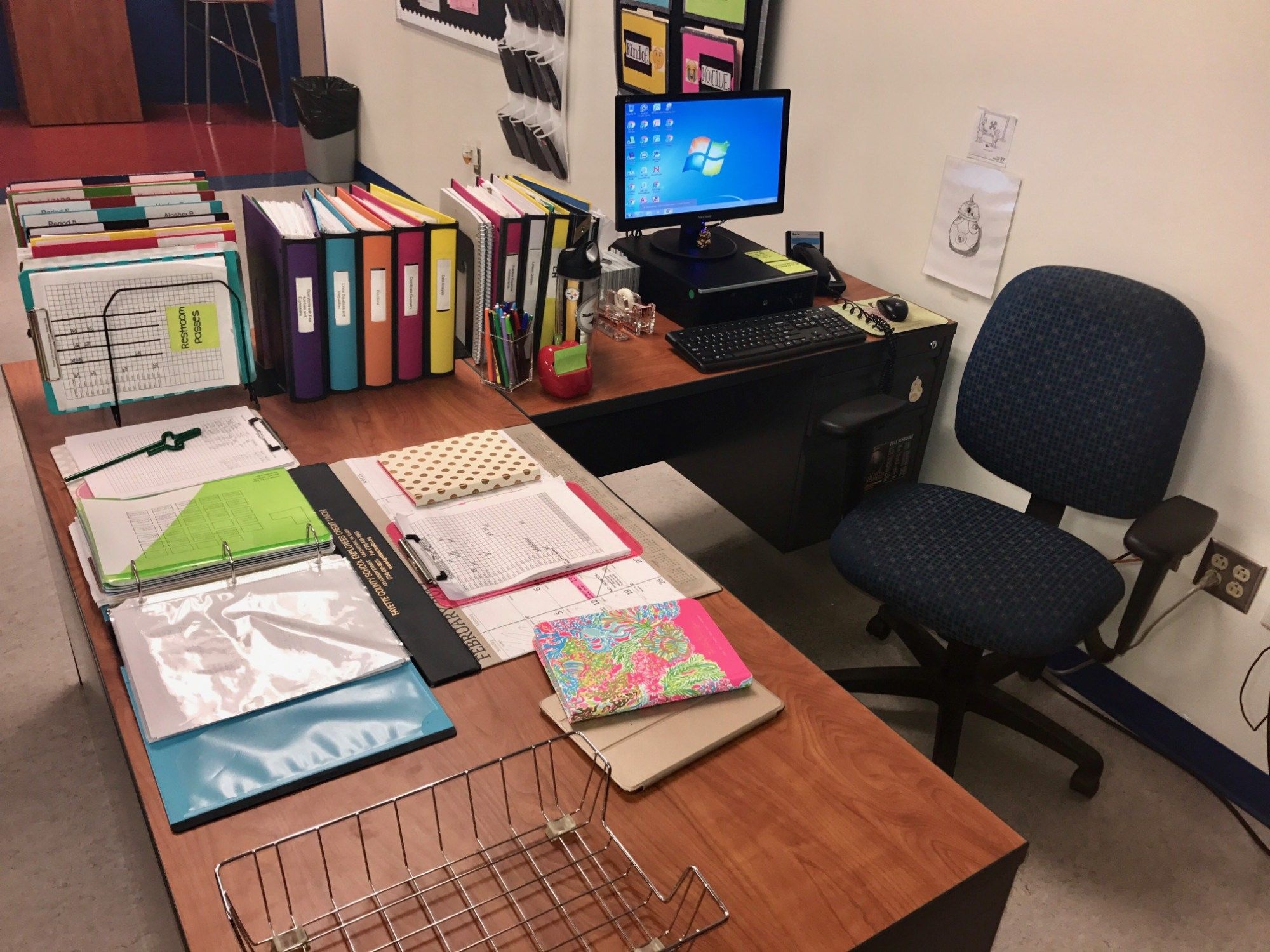
    Think less about decoration, more about logistics. You’re designing a cockpit, not a gallery.

  • Map your classroom traffic: where students move, turn in work, and find materials.
  • Label everything you’ll reuse: bins, folders, lesson binders.
  • Choose a single calendar (digital or paper) and stick to it all year.
  • Build one “command center” binder for lesson plans, rosters, and contact lists.
  • Write a short morning and end-of-day routine on a sticky note; practice it until it is automatic.
  • A clear physical environment reduces cognitive load and prevents small chaos from snowballing.
  • Phase 2: Managing the Day-to-Day (During the Semester)

    Once routines are running, your focus shifts to time orchestration. This phase is where energy management beats color-coded perfection.
    Here’s one reliable approach many new teachers use:

  • Begin each day with a five-minute preview of lessons.
  • Group tasks into blocks: plan, teach, communicate, grade.
  • Protect one “quiet slot” daily to reset and think.
  • End every Friday by clearing your desk and drafting Monday’s to-do list.
  • Graham
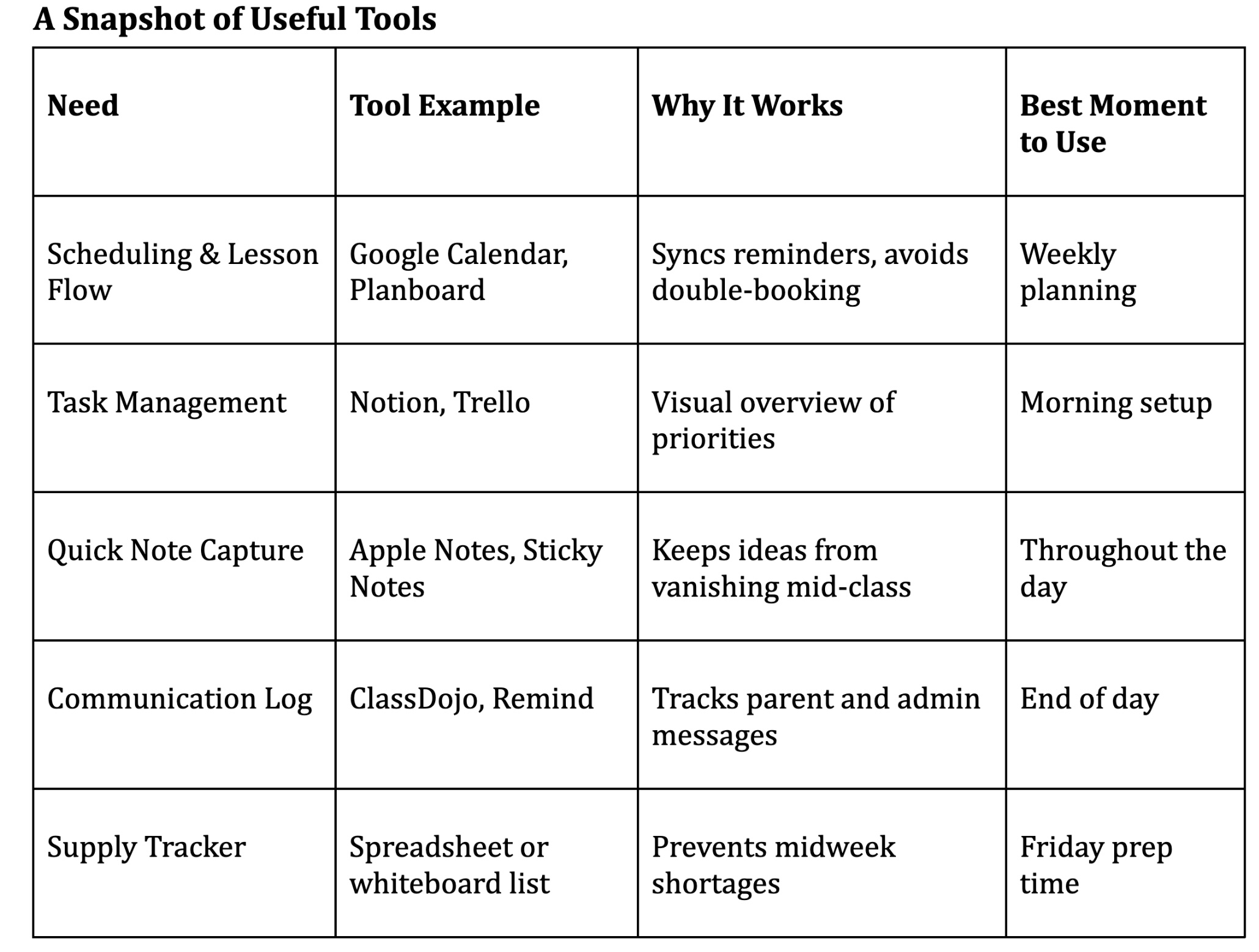
    Each tool should solve one pain point, not add another dashboard to babysit.

    Phase 3: Maintaining the Digital Layer (Weekly Reset)

    Digital clutter drains focus as much as paper piles. Every weekend, dedicate one short block of time to file, rename, and back up your week’s work.

    Scanning and digitizing older lesson plans turns them into living templates for future reuse. Save all documents as PDFs to preserve formatting across systems; and when you need to tweak one, PDF editing capabilities let you adjust without converting the file.
    This small ritual builds a searchable memory of your teaching life instead of a stack of mystery folders.

    Phase 4: When Systems Break (Midyear Reality Check)

    Even with the best plans, every teacher hits the wall: progress reports, testing weeks, surprise meetings. Organization isn’t about preventing breakdowns; it’s about recovering faster when they happen.

    One sentence to remember: “Reset small, not all.” Don’t try to overhaul everything at once. Instead:

  • Clear one surface—your desk or desktop.
  • Identify the one area causing most stress (grading? communication?).
  • Spend 20 minutes creating order there and ignore the rest for now. This micro-reset rebuilds momentum and restores control without burnout.
  • Phase 5: Reinforce Growth and Efficiency (End of Month)

    Reflection turns scattered effort into sustainable improvement. Schedule a short monthly review to check what worked and what didn’t.

    Here’s a simple structure:

  • Note which routines saved you the most time.
  • Archive outdated files and student records.
  • Refresh classroom zones that collect clutter.
  • Ask: “If I had to train someone to use my system, would they understand it?”
  • This step closes the loop; your organization matures alongside your teaching skill.

    FAQ

    1. How do I stay on top of grading without losing weekends?

    Batch similar assignments and use rubrics to speed evaluation. Set a time cap for each grading session—when it’s over, stop. Digital tools like Google Classroom’s comment bank can automate repetitive feedback. Protect one full day each week with no grading at all to recover mental space.

    2. My inbox is out of control. Any fix?

    Use the “touch once” rule: open, act, and archive. Create folders by urgency: today, this week, later. Set aside one email window per day rather than checking constantly. That alone can save an hour daily.

    3. I can’t find balance between planning and teaching.

    Reserve Mondays for long-range planning and midweek for quick adjustments. Keep next week’s materials ready by Friday. Predictable rhythms reduce last-minute scrambling and keep lessons aligned.

    4. What should I do when I feel disorganized and behind?

    Acknowledge it, then start with one visible win. Clear your desktop or file the top ten papers. Order returns through visible progress, not guilt. Momentum is more important than catching up instantly.

    5. How can I keep from reinventing the wheel each semester?

    Create a digital “gold folder” with lesson plans, slides, and resources that worked well. Tag each file by grade and topic. Over time, it becomes your personal library; organized experience ready to reuse.

    Conclusion: Structure Creates Freedom

    Organization isn’t a personality trait; it’s a form of professional kindness to yourself. Every label, folder, and routine you build today buys you future calm. You’ll still face unpredictable days, but they won’t undo you. Over time, your systems will hum quietly in the background, freeing you to do what drew you to teaching in the first place: helping students grow with focus, patience, and presence.

    Emily Graham

    Emily is the creator of MightyMoms.net. She believes being a mom is one of the hardest jobs around and wanted to create a support system for moms from all walks of life. On her site, she offers a wide range of info tailored for busy moms — from how to reduce stress to creative ways to spend time together as a family. You can email her at emilygraham@mightymoms.net. She lives in Arizona.

    Share this:
    Share this page via Email Share this page via Stumble Upon Share this page via Digg this Share this page via Facebook Share this page via Twitter Share this page via Google Plus

    How to Upskill in 2025: 10 In-Demand Skills You Need to Master by Sara William

    Thursday, July 17th, 2025

    UpSkill
    How to Upskill in 2025: 10 In-Demand Skills You Need to Master by Sara William lets you stay ahead in 2025 with these 10 in-demand skills. From AI literacy and digital marketing to emotional intelligence and green skills, learn how to upskill efficiently—no degree required. Start future-proofing your career today.

    Are you thinking about upskilling this year? Good move. Whether you’re chasing a promotion, switching careers, or just trying to stay ahead of the curve, 2025 is the perfect time to level up. The world’s moving faster than ever, and if you’re not learning you’re falling behind.
    But don’t worry. Upskilling doesn’t mean you have to quit your job or spend thousands on a fancy degree. Nope. With the right mindset (and the right skills), you can make serious progress from your couch, your lunch break, or even that endless wait at the airport gate.
    Let’s talk about the 10 hottest skills you need to master in 2025-and how to actually go about learning them.

    1. AI Literacy (Don’t Let the Robots Leave You Behind)

    You’ve heard it everywhere: AI is taking over. But here’s the thing, it’s not taking your job. The person who knows how to use AI is.
    From ChatGPT to image generators to complex automation tools, AI is now in marketing, healthcare, design, education, you name it. Whether you’re a teacher, marketer, or project manager, understanding how AI works (and how to use it smartly) will give you a major edge.

    How to learn it:
    Take a course like “AI For Everyone” by Andrew Ng (Coursera).
    Play around with tools like ChatGPT (wink) or Midjourney.
    Learn the basics of prompt engineering and automation.

    Read up on AI ethics-because being responsible matters too.

    Pro tip: Don’t just use AI. Understand it. Even a surface-level grasp of how it works can make you look like a rockstar in meetings.

    2. Digital Marketing (Because Attention = Currency)

    We’re all scrolling Instagram, TikTok, YouTube, LinkedIn. Brands know this. That’s why digital marketing is booming. If you can create content, run ads, or grow an online community, you’re golden.
    Even better? You don’t need to work in marketing to benefit from this. Maybe you’re a freelancer who wants more clients. Or maybe you run a side hustle. Either way, marketing helps.

    What to learn:
    SEO and content writing
    Email marketing (think Mailchimp or Klaviyo)Paid ads (Facebook Ads, Google Ads, etc.)
    Social media strategy and analytics

    How to learn:
    Google Digital Garage (free and solid)
    HubSpot Academy (certifications included)
    Follow marketers like Neil Patel or Alex Hormozi
    Quick note: If you’re posting but not converting, you’re not marketing you’re just sharing.

    3. Data Analysis (The New Business Superpower)

    Companies love numbers. But what do they really love? People who can make sense of those numbers.
    That’s why data analysis is such a hot skill right now. You don’t have to be a math genius or wear a lab coat. If you can work with tools like Excel, Tableau, or even Google Sheets to pull insights from data you’re already ahead of the pack.

    Start with:
    Excel/Google Sheets (master those formulas!)
    SQL (it’s easier than it looks)
    Power BI or Tableau for data visualization

    Free places to learn:
    DataCamp (has beginner tracks)
    Khan Academy (great for stats basics)
    YouTube (look up “Excel dashboards” and prepare to geek out)

    Why it matters: Data tells stories. If you can tell the right story, people will listen (and pay you well for it).

    Marketing

    4. Cybersecurity Awareness (Be the Human Firewall)

    Let’s be honest, cyber attacks are getting sneaky. It’s not just the IT guys who need to know this stuff anymore.
    Whether you’re working remotely, handling customer data, or just want to protect your own digital life, basic cybersecurity know-how is a must-have in 2025.

    Things to focus on:
    Recognizing phishing emails
    Using secure passwords and 2FA
    Understanding how data is stored and shared
    VPNs, firewalls, and encryption basics

    Learn from:
    Google’s “Cybersecurity for Beginners” (free)
    IBM’s Cybersecurity Basics (Coursera)
    TryHackMe (hands-on learning, fun too!)

    Extra tip: Want to impress your boss? Help your team avoid the next cyber mess.

    Emotional

    5. Emotional Intelligence (EQ > IQ in Most Jobs)

    AI can write code, create content, and answer questions, but you know what it still can’t do? Handle people. That’s where emotional intelligence comes in.
    In 2025, soft skills are hard currency. Teams that communicate well, navigate conflict, and build trust win. And the best part? You can improve your EQ with practice.

    Work on:
    Active listening
    Giving/receiving feedback
    Managing stress and staying calm under pressure
    Reading the room (aka social awareness)

    How to improve:
    Read “Emotional Intelligence” by Daniel Goleman
    Try mindfulness apps like Headspace or Calm
    Ask a trusted friend for feedback on how you handle conflict
    Remember: Being technically skilled is great. Being emotionally skilled? Game-changer.

    6. Remote Collaboration Tools (Work From Anywhere Like a Pro)

    The remote/hybrid work trend isn’t going anywhere. And while working in pajamas is awesome, being effective remotely takes skill.
    Knowing how to use collaboration tools, manage your own time, and stay productive without someone watching over your shoulder, that’s what companies want now.

    Tools to master:
    Slack
    Zoom (use the shortcuts, thank me later)
    Trello, Asana, or Notion for project management
    Google Workspace (Docs, Sheets, Calendar)

    What to learn:
    How to lead virtual meetings
    Time-blocking and calendar management
    Writing clear, concise messages (no more 10-paragraph emails)

    Truth bomb: Remote workers who communicate well get promoted faster. Silence isn’t golden, it’s confusing.

    AI

    7. UX Design Thinking (The User Is Everything)

    Good design isn’t just about looking pretty, it’s about making things work for the user. That’s what UX (user experience) is all about.
    And no, you don’t have to be a designer to use UX principles. Product managers, marketers, developers even HR teams can benefit from understanding how people interact with tech.

    Core concepts to know:
    User personas
    Customer journey maps
    Wireframing and prototyping
    Usability testing

    Where to start:
    Google UX Design Certificate (Coursera)
    Learn Figma basics (tons of free tutorials)
    Follow UX creators on LinkedIn or YouTube

    Why it matters: People won’t use your product if it frustrates them. Great UX = loyalty + trust.

    8. Financial Literacy (So You Don’t Just Make Money—You Keep It)

    Real talk: you can upskill all you want, but if you don’t understand your money, it’ll vanish before payday.
    In 2025, being financially smart isn’t just about budgeting, it’s about investing, understanding taxes, planning for the future, and knowing your worth.

    Learn about:
    Budgeting apps (YNAB, Mint, etc.)
    How taxes work (seriously, it matters)
    Investing basics (ETFs, index funds, etc.)
    Retirement planning (even if you’re 25!)

    Best places to learn:
    YouTube channels like Graham Stephan or The Financial Diet

    “I Will Teach You to Be Rich” by Ramit Sethi (book and Netflix show)
    Podcasts like “Planet Money” or “BiggerPockets”

    Bonus: Financial freedom means you get to choose your work-not be stuck in it.

    9. Green Skills (Because the Planet’s Part of the Plan)

    Sustainability isn’t just a buzzword anymore, it’s a career path. More companies are investing in eco-friendly operations, and that means there’s demand for people who know how to think green.
    Whether you’re in construction, fashion, tech, or agriculture-understanding sustainable practices makes you more valuable.

    Examples of green skills:
    Energy efficiency planning
    Carbon accounting
    Sustainable sourcing
    Environmental policy and regulation knowledge

    Learn with:
    LinkedIn Learning (search “sustainability”)
    edX courses from MIT or Harvard
    Follow companies like Sanitairllc that focus on clean, efficient tech

    Heads-up: Green skills aren’t just for “green jobs.” They’re becoming part of every job.

    10. Creative Thinking (Your Edge in a Robotic World)

    Here’s the truth: automation is fast, smart, and tireless, but it’s not creative. Your imagination, your unique ideas, your out-of-the-box thinking? That’s your unfair advantage.
    Creativity helps you solve problems, design new products, write compelling copy, or even pitch better ideas in meetings. In 2025, creative thinkers aren’t “nice to have” they’re essential.

    To boost your creativity:
    Take improv or storytelling classes
    Try journaling or mind-mapping
    Set constraints (they weirdly help your brain think better)
    Collaborate with people outside your usual bubble

    Fun idea: Do something new every week. New experiences = new neural pathways.
    Quickfire Tips to Start Upskilling Today
    Let’s wrap with some rapid-fire advice to help you actually start (because we all know that’s the hard part):
    ✅ Pick one skill to start. Don’t overwhelm yourself.
    ✅ Block off 30 minutes a day-habit > intensity.
    ✅ Share what you learn online. Build your brand and stay accountable.
    ✅ Take breaks. Learning burnout is real.
    ✅ Apply your new skills in real-life scenarios even small ones.
    Remember, you don’t need permission to grow. And you don’t need a fancy title to start learning. Upskilling is about taking your future into your own hands and having fun doing it.

    Final Thoughts
    Alright, friend, here’s the deal. You don’t need to master all 10 of these skills at once. Seriously. Even picking just one and committing to it over the next few months can open doors you didn’t even know existed.
    The job market in 2025 is looking for people who are curious, adaptable, and ready to grow. That’s you. Whether it’s learning how to use AI, understanding data, or brushing up on your emotional intelligence these skills aren’t just trendy, they’re timeless.

    Sara William is a digital marketing consultant, writer, freelancer, WordPress enthusiast, and coffee lover. Her email is infoguestposters@gmail.com. Also check out her Sanitair website


    Share this:
    Share this page via Email Share this page via Stumble Upon Share this page via Digg this Share this page via Facebook Share this page via Twitter Share this page via Google Plus

    Making Homeschool PE Class Fun by Craig Middleton

    Sunday, May 2nd, 2021

    Disc Golf
    Making Homeschool PE Class Fun by Craig Middleton offers ideas for parents who homeschool their children by choice. His suggestions are also good for parents who want to add exercise options beyond what their kids get at school. His advice on nutrition is also good for all parents. Remember, all parents are teachers weather they homeschool or not.

    Introduction

    • Homeschooling is becoming more popular and can be both stressful and rewarding. (Doug: During the pandemic, many more parents have been homeschooling, but not by choice.) In addition to the core subjects of math, reading, and writing, an often overlooked requirement is Physical Education. Not all states require an organized PE curriculum, but any well-rounded education includes some form of the subject.
    • Going outside to play is a fantastic way to fulfill your state’s requirements while still teaching your children safe behaviors. There’s no need for a formal schedule or events. All you have to do now is get your kids going and have some fun while doing it.
    • Go outside and play with your kids if you live in the country or a neighborhood with playgrounds or popular play areas, or if you have a large yard. Yes, you can send your kids outside to play if they’re old enough, but setting a good example by going outside and being involved with them is even better. To be frank, adults need to get out and exercise more as well. It’s good for mental health and overall health, and it sets a good example for your children. Here are a few ideas to keep things interesting during your home PE sessions.

    Indoor Activities

    • If you are a homeschooler of an older child, you can do more focused activities such as weight lifting, yoga, meditation, and nutritional meal planning. You can even investigate the possible benefits of supplements like protein powder, spices, and vitamins. For the younger kids, think more along the line of games like hopscotch, hot lava, or an obstacle course. Beginning yoga is a fun way to get kids to stretch and control movement. Simon Says a classic that involves listening skills and movement. Sometimes, a good old-fashioned pillow fight will leave you all breathless and in fits of laughter.
    • Don’t skimp on nutritional activities with the younger ones either. Let them help you plan and make simple meals. Hands-on activities will cement the message and teach lasting skills. You don’t necessarily have to stay home either. If it’s a rainy day, consider a trip to the local bowling alley or roller rink. Many towns also have indoor play areas set up with safe games and activities that should be opening soon. They may even offer homeschooler discounts on group admissions.

    Outdoor Activities

    • Everybody needs fresh air. Options for outdoor activities for PE classes are almost endless. Pretty much anything that gets you moving is fair game. Riding bikes can be a great way to get exercise and teach the rules of the road. Relay races and obstacle courses are other favorites with kids of all ages. An excellent way to teach conservation and get some fresh air is to go for a hike in the woods. Have them collect objects like rocks, nuts, or leaves to examine later. Trips to parks or lakes are other fun options. Just remember to practice safety on the water. Don’t forget to take your frisbees and sports gear for impromptu games. You also might find disc golf courses where you live.

    Co-op Activities

    • Most communities have organizations that offer cooperative homeschooling activities, including PE classes. These can be official organizations or simply a few families that get together to play games. These afford more opportunities for team activities like basketball, baseball, and soccer. Many times, recreation centers may offer their spaces free of charge to homeschoolers, giving access to equipment that may be challenging to obtain otherwise. Co-ops are excellent places for you and your kids to make friends and socialize while fulfilling an important educational requirement.

    Organized Sports

    • Most states and communities allow homeschooled children to participate in organized sports through their local school systems. They will still be subject to any tryouts or requirements, but these programs could be a good way to play sports that most homeschoolers can’t provide. They also will fulfill the necessary PE requirements. If the local schools aren’t an option, most cities also offer intermural sports organizations kids can participate in that aren’t associated with public schools. AAU teams also accept homeschooled students.

    Final Thoughts

    • When developing your homeschool curriculum, it’s important to remember some of the non-core subjects like PE, art, and music. Homeschooling can be very rewarding and a great way to give a wonderful education to your children. Make it fun!

    Craig Middleton

    • Craig is a New York City-based retired business consultant, who is an expert in education and cultural trends. He has a Masters of Business Administration and a Masters in Education from St. Johns and loves sharing his knowledge on the side through his writing. If you have any questions or comments you can direct them to Craig at craigmiddleton18@gmail.com.
    Share this:
    Share this page via Email Share this page via Stumble Upon Share this page via Digg this Share this page via Facebook Share this page via Twitter Share this page via Google Plus

    Medical Binder Printables to Keep Your Health Records Organized by Cristina Thorson

    Sunday, November 7th, 2021

    Basic Health Info
    Medical Binder Printables to Keep Your Health Records Organized by Cristina Thorson offers forms you can use to keep track of your medical information so you can easily share it with your physicians rather than just talking about how you feel and neglecting what you can’t remember. Thanks, Cristina.

    Introduction

    • Whether you’re suffering from a chronic condition, wanting to keep your health information in order, or are somewhere in between, keeping a medical binder on hand can be beneficial. Having a medical binder not only helps you stay more organized, but it can also act as the single source of truth in case of an emergency.
    • Thinking about possible “what-ifs” is never fun to do, but making sure you’re prepared for emergencies can make a worst-case scenario a little easier to manage. Use the medical binder printables to start putting together your own health binder. It might save your life one day.

    Basic Health Information Sheet

    • On a basic health information sheet, you should include the standard information that you might need to receive medical treatment. Usually, when you go in for an appointment, the healthcare clinic will need to have this information on file before you receive treatment.
    • The information needed is your full name, emergency contact information, allergies, date of birth, blood type, and any immunization records. Keeping this information up to date and on file can save time if you decide to transfer doctors, or if you start going to a specialized healthcare professional.

    Medication Tracker

    • According to WebMD, about half the American population takes an average of four prescription pills. Some medications have conflicting effects which can have deadly consequences. If you keep track of your own medications, it will make it easier for doctors to ensure that they won’t prescribe anything that will have adverse effects on your health.
    • Documenting your own medications can also help you and your doctor figure out what has worked in the past, and what hasn’t. It can help you avoid repeating medications, especially if you work with a new doctor or you haven’t been to a medical professional in a while.
    • Keeping track of your blood pressure can save you a world of problems. Hypertension (or high blood pressure) has damaging effects over time, and many are unaware that they even have it. To record your own blood pressure, you should purchase a home blood pressure monitor.
    • It’s best to avoid caffeine and exercise at least 30 minutes before you measure, and try to measure at the same time every day. Self-monitoring is actually recommended by the American Heart Association for people with high blood pressure treatments. Even though home monitoring isn’t an adequate substitute for visits, it can be helpful when healthcare professionals are trying to gauge the effectiveness of their treatments.
    • Blood Pressure Log

    • It’s useful to be aware of your own medical conditions before a big life transition, like moving homes, leaving for college, or even planning for retirement. The temporary instability during these time periods may cause medical conditions to flare up. These changes may also influence your healthcare provider or the access to healthcare that you receive.
    • Start surveying the information in advance of these changes so you’re not overwhelmed during the transitionary period. Make sure your information is up-to-date and easily understood. Many use their smartwatches or their phones to log health information, but you could also try an alternative tracking method, like our printable sheets.

    Cristina Thorson

    • Cristina is a part-time content writing intern at Siege and a full-time student at Boston University. She enjoys exploring new pockets of cities, culture, and cat websites (as well as alliterative expressions). In her spare time, she can be found reading books, commenting on movies, and writing anything from advertising copy to feminist satire.
    Share this:
    Share this page via Email Share this page via Stumble Upon Share this page via Digg this Share this page via Facebook Share this page via Twitter Share this page via Google Plus

    Music and Mind – Book Summary

    Tuesday, June 18th, 2024

    Music and Mind
    Music and Mind: Harnessing the Arts for Health and Wellness edited by Renée Fleming features chapters by researchers, medical practitioners, and artists that explain what we know about the healing capabilities of art therapies along with what we still don’t know about the magic of music and other art forms. Leaders and parents should read this to reinforce how they support and encourage access of the arts for all children.

    Introduction

    • Music and Mind has assembled the voices of leading figures in neuroscience and the musical and visual arts, providing an inspiring view of the emerging synthetic possibilities. You will find much here to love and much to encourage your support of and access to the arts. Most of the chapters are summarized here.

    Part I: How and Why: Experts Explain the Basic Science Connecting Arts and Health, Including Origins in Evolution

    Musicality, Evolution, and Animal Responses to Music? by Aniruddh D. Patel – Department of Psychology, Tufts University

    • Music pervades human culture. Music neuroscience is a young field that includes music-based interventions for brain health. While we don’t know what survival benefits music behaviors have, it does seem likely that they have had some. We do know that musical abilities vary widely among adults. Current research on the musicality of humans involves the fields of developmental psychology, ethnographic and cross-cultural studies of music, cognitive neuroscience, genomics, and cross-species research.
    • Synchronizing rhythmic body movements to musical beats emerges in children without formal instruction. Musical ability has some genetic influence, but experience plays a more important role. Singing emerges in every culture and coordinated group singing appears to have psychological benefits. While most people find music rewarding, some are not moved by it. Music can calm infants. The best current bet is that musicality as part of human nature.

    What Does it Mean to be Musical? by Daniel J. Levitin – Psychology Department, McGill University

    • Music is organized sound. Genetic factors are essential for outstanding levels of musical ability. It is also clear that it takes a lot of hard work and practice to realize one’s genetic abilities. We haven’t discovered the specific music genes yet, but most think that we will. Musicality is hard to define and efforts to test for it have been less than effective.

    The Parting Glass by Richard Powers – Pulitzer Prize Winning Novelist

    • Powers is a novelist who reminisces here on music’s ability to make us sad in the absence of real tragedy thus making us more adept in sadness when life calls for the real thing. As an active listener, he sees joy in bird song and the fact that he can stream just about any song ever written as a form of cognitive therapy. The Parting Glass is one of his favorites. Check it out.

    Sound Connects Us by Nina Kraus – Communications Science, Northwestern University

    • Sound is a mnemonic, it helps us remember. Making sense of sound is one of the hardest jobs that we ask our brain to do. We hear pitch, timing, timbre, and loudness simultaneously. Making music strengthens our senses, our bodies, our cognition, and our ability to learn. Listening to music activates the reward circuits in our brain. Musicians are able to focus attention better. They outperform non-musicians on memory tasks. They tend to do better in reading, overall intelligence, and academic achievement.
    • A sound mind is also shaped by athletic activity. Unfortunately, music defies the kind of quantification that science requires. This makes it difficult to study music systematically. There is hope, however, that the study of music will clarify how music and biological health coincide.

    How Music Shows Us What It Means to Be Human: Rhiannon Giddens (Singer, Instrumentalist, and Composer)

    • Music has the inherent power to bring humans together. It is a coping mechanism throughout our history. Many assume that it is a universal language. It creates an emotional pathway for people to help them cope with the ups and downs of life. Regardless of the technology, it’s the emotional aspect that is important. We are not different from each other and music is the key that holds us together.

    Sounding Joy: Christopher Bailey – Arts and Health Lead, World Health Organization

    • This is the story of one man’s blindness and how music and art made it much easier for him to deal with his lost vision. He found that music accelerated his rehabilitation and enhanced his mood. He found that music recreated his world. Unlike sight that only captures light reflected from a surface, sound is an energy that passes through matter and is therefore more palpable. All he had to do was close his eyes to find the healing power of music.

    Can Singing Touch the Heart? Jacquelyn Kulinski – Director of Preventive Cardiology Program, University of Wisconsin

    • We know that exercise is beneficial for health in general and your cardiovascular system in particular. The question here is does singing on a regular basis count as the kind of exercise that produces health benefits? It certainly seems like it should. The author is involved in a longitudinal study to see how singing can benefit health. The results are due in August of 2024 so stay tuned. In the mean time, sing your heart out.

    Rabbit Hole: Roseanne Cash – Grammy Winning Singer and Songwriter

    • Roseanne tells the story of her fight with a rare brain disorder that was treated surgically after it was finally diagnosed. Needless to say her recovery that is still ongoing was aided by the music she performed and wrote with collaborators like Kris Kristofferson and Elvis Costello. Here is a lyric that tells what music can do. “When you sing to the farthest rafter, with your big life full of love and laughter, you pull me up from the rabbit hole.”

    Music For Chronic Pain Management: Joke Bradt – Arts Therapist Department, Drexel University

    • There are a large number of studies that demonstrate music’s efficacy for the reduction of pain. Listening to music reduces self-reported pain, anxiety, and depression. Patients with severe emotional exhaustion, depression, and anger that often accompany chronic pain may also require the service of a music therapist.
    • Making music, improvising, and creating music have all been shown to be beneficial as well. Making music with others offers a sense of support and activates social engagement, which also promotes healing as it combats isolation. Music increases self-efficacy. This gives you the confidence that you can accomplish what you set out to do. You feel like you have more control, which allows you to use less medication.

    Music Across the Continuum of Care: A Hospital Setting: J. Todd Frazier – Center of Performing Arts Medicine, Houston Methodist Hospital

    • The Huston Methodist Hospital offers a continuum of care that features music. For everyone, environmental music shapes the overall public experience. Some patients receive music medicine to support their treatment process. Others receive music therapy to achieve individualized clinical goals. Dynamic teams work across all hospital departments in this effort.
    • Some people learn a new way to speak through singing. It can also be used to help with memory cues. Music therapists work with physical therapists to help people walk. Music can impact the body’s internal rhythms, especially those of the heart. Music can speed up stroke recovery and lower anxiety.

    “I Sing the Body Electric”: Music Psychotherapy in Medicine: Joanne Loewy – Director, Louis Armstrong Center for Music and Medicine

    • Music therapy is an integrative field that has recently gained traction. Entrainment is a central concept. This is where two systems are locked in sync. For this purpose we mean a human body system or systems and something external like a system making music. An example is the way a lullaby can comfort a crying infant. This can facilitate medical procedures.
    • Music therapy has been shown to help with Alzheimer’s, stroke, and early dementia among others. Syncing one’s breathing can help with COPD. It can help with relaxation and even act as a very safe sedative. It can lessen anxiety such as that associated with radiation. Treatments are safe, effective, and inexpensive. Musicians themselves are often candidates due to issues like job insecurity and drug use.
    Share this:
    Share this page via Email Share this page via Stumble Upon Share this page via Digg this Share this page via Facebook Share this page via Twitter Share this page via Google Plus

    Navigating Your Career Path: The Power of a Professional Development Plan by Emily Graham

    Thursday, October 3rd, 2024

    Graham
    A professional development plan is a strategic tool that guides your career trajectory toward success. It empowers you to take charge of your growth by providing a structured approach to achieving your professional goals. Embracing this plan can dramatically enhance your effectiveness and satisfaction in your
    career.

    Understanding the Role of Self-Assessment in Career Growth

    Self-assessment plays a crucial role in any career development plan, serving as the bedrock for genuine professional growth. By critically evaluating your skills and weaknesses, you not only pinpoint areas that need enhancement but also recognize your strengths to capitalize on them. This process facilitates the setting of tailored, realistic goals that align with your broader career ambitions. Continuous self-reflection helps you adapt to changes in the professional environment, keeping your career trajectory on track.

    Balancing Work and Life for Professional Success

    Maintaining a work-life balance is essential, not only for personal well-being but also for peak professional performance. This balance helps prevent burnout and sustains your mental and emotional health, enabling you to excel at your job. Effective strategies like taking regular breaks, setting clear boundaries, and managing your time can keep both your career and personal life thriving. Ultimately, a harmonious work-life balance boosts productivity and fosters innovation in your professional endeavors.

    Advancing Your Career by Earning a Degree Online

    Earning a degree online can be a powerful way to advance your career while maintaining the flexibility to work and manage personal commitments. With a wide range of programs available, online education allows you to gain specialized knowledge and skills that can enhance your qualifications and make you more competitive in the job market. Pursuing an online EdD degree, in particular, enables you to influence curriculum development and policy, as well as evaluate instructional and assessment methods to improve learning outcomes, making a lasting impact on the education system.

    Networking and Joining Professional Associations

    Networking is a powerhouse tool for career advancement, opening doors to new opportunities and insights through robust professional relationships. Participating in conferences, joining professional associations, and engaging in online communities are effective strategies for expanding your professional network. Membership in professional associations also grants access to exclusive educational resources and industry insights. These networks can lead to pivotal career opportunities, including job offers and collaborations that can significantly propel your career forward.

    Leveraging Feedback for Career Advancement

    Receiving constructive feedback is invaluable for both personal and professional development. Feedback from peers and mentors provides perspectives that pinpoint both strengths and areas for improvement, often highlighting unseen opportunities for growth. Embracing this feedback and integrating it into your development strategy can dramatically enhance your career trajectory. Continually refining your skills in response to feedback ensures ongoing improvement and success in your professional life.

    Developing Adaptability

    In today's dynamic professional landscape, adaptability is essential for career progression. Embracing new challenges, learning cutting-edge skills, and innovating within your field can distinguish you from your peers. Staying open to change not only prepares you for the evolving demands of the job market but also turns potential challenges into opportunities for growth. Cultivating a flexible approach to your career can lead to new roles and responsibilities that enhance your professional journey.

    Continuous Learning and Certification as Career Boosters

    Committing to lifelong learning is crucial for staying relevant and competitive in any field. Engaging in ongoing education through workshops, certifications, and keeping abreast of industry trends ensures you meet the evolving challenges in your sector. Certifications, in particular, underscore your dedication to your profession and can open doors to advanced career opportunities. Making continuous learning a cornerstone of your professional development guarantees
    you are always ready for the next step in your career.

    How Side Projects and Hobbies Can Enhance Your Career

    Your personal interests and side projects can significantly enrich your professional skill set. These pursuits not only develop transferrable skills like creativity and problem-solving but also enhance your professional profile. For instance, managing a personal blog can sharpen your communication skills, while community service can bolster your leadership capabilities. Integrating hobbies and side projects into your career planning not only fosters personal satisfaction but also elevates your professional prospects.

    Implementing a professional development plan can be transformative, offering a clear route to personal and professional fulfillment. By actively managing your career development, you ensure continuous progress and adaptability in a competitive world. This proactive approach is key to unlocking your full potential and achieving long-term career success.

    Enhance your educational practices with professional development resources
    from Dr. Doug Green, perfect for educators, administrators, and parents.

    Emily Graham
    Emily is the creator of MightyMoms.net. She believes being a mom is one of the hardest jobs around and wanted to create a support system for moms from all walks of life. On her site, she offers a wide range of info tailored for busy moms — from how to reduce stress to creative ways to spend time together as a family. You can email her at emilygraham@mightymoms.net. She lives in Arizona.

    Share this:
    Share this page via Email Share this page via Stumble Upon Share this page via Digg this Share this page via Facebook Share this page via Twitter Share this page via Google Plus

    Noise: A Flaw in Human Judgement by Daniel Kahneman, Oliver Sibony, & Cass Sunstein

    Sunday, September 5th, 2021
    Noise

    Noise: A Flaw in Human Judgement by Daniel Kahneman, Oliver Sibony, and Cass Sunstein details how noise and bias result in errors in judgment. From our courts to fields as diverse as medicine and insurance they show how noise leads to unfair and harmful results. They also provide ways to identify noise and techniques that any organization can use to reduce it. This book is a must for any professional development library. (10-15 minute read)

    Introducion: Two Kinds of Error

    • Whenever you look at human judgments, you are likely to find noise. From the courtroom to medicine to forecasts to forensics and personal decisions our lives are full of noise. This book will help you recognize it and give some tips for getting rid of at least some of it. Start with an analogy that features targets and groups of shooters to see the difference between noise and bias If shots are scattered all over the target, that’s noise. It the shot are all in the lower right, that’s bias.

    Part I: Finding Noise

    1. Crime and Noisy Punishment

    • We start with the noise associated with crime and the sentencing of the guilty parties. In 1973, Marvin Frankel, a famous judge, realized that people committing the same crime were getting vastly different sentences depending on who the judge was. Judges gave harsher sentences when they were hungry and the day after their team lost. Blacks got harsher sentences and people are less likely to be granted asylum when it’s hot. The sentencing reform act of 1984 helped narrow the differences, but the Supreme Court struck it down in 2005 and discrepancies increased again. Female and Democrat judges are more lenient.

    2. A Noisy System

    • Here we encounter he basic tool called the noise audit that all organizations need to consider. Its essence is to have many people look at the same information and make independent judgments. The variance in these judgments will give you a sense of the magnitude of the noise in the system. The authors use the median difference from the mean in the audit as a measure of noise. Keep in mind that errors do not cancel out, they add up. In many cases, the person making a judgment might as well be chosen by lottery. It’s important not to confuse judgment with taste or opinion. It’s important to have people with different perspectives when you are trying to solve a problem.

    3. Singular Decisions

    • Singular decisions are those that don’t recur with any great frequency. Getting married or buying a house are examples. While they are not free from the factors that produce noise, the definition of noise does not apply and you can’t do a noise audit. Practices that reduce error for recurrent decisions should be just as effective when it comes to singular decisions.
    Share this:
    Share this page via Email Share this page via Stumble Upon Share this page via Digg this Share this page via Facebook Share this page via Twitter Share this page via Google Plus