Author Archive

How to Create Engaging Local Events for Kids That Build Community by Emily Graham

Friday, May 15th, 2026

Graham
For program directors, coordinators, and family engagement leads at children’s education organizations, local event planning can quietly turn into a turnout-only exercise: families arrive, watch, and leave with few new connections. The core tension is that good intentions and a full room don’t automatically create community engagement, especially when activities position kids and caregivers as an audience instead of participants. When that happens, even well-run events struggle to become memorable event experiences that reinforce learning and belonging. The shift comes from designing events around clear participation strategies that make interaction feel easy, inclusive, and worth repeating.

Understanding Attendee-First Event Design

  • At its core, engaging event design means building the day around what families do, not what they watch. It focuses on attendee-experience principles that help kids and caregivers feel welcomed, useful, and comfortable joining in. It also accounts for the reality that engagement means something different for each person, so participation needs more than one pathway.
  • This matters because interaction is what turns a one-time outing into a relationship with your program. When people contribute, they remember names, trade tips, and leave with a reason to return. That repeat energy is what grows a supportive community around learning.
  • Think of a literacy night with “choose-your-role” stations: kids read to a buddy, caregivers swap book ideas, and volunteers guide quick games. A simple roadmap to stay organized keeps those moments intentional instead of accidental. Shared identity tools like shirts and badges can reinforce those participation cues instantly.
  • Use Custom Event Shirts to Spark Belonging and Participation

  • When your event is designed around what kids and families actually do and feel, small touchpoints can reinforce that sense of “we belong here.” Customized merchandise, especially event shirts, but also mugs or koozies, can work as interactive giveaways or participation rewards that create a shared experience on the spot. A matching shirt makes volunteers easy to spot, and it can also prompt kid-friendly moments: earning a shirt after completing an activity, or getting one stamped or signed as they join in. Later, the item becomes a lasting reminder that sparks conversations in the community long after the event ends.
  • When you design t-shirts, focus on clarity and comfort: a simple, bold design people will actually wear, and a range of sizes and styles so everyone feels included. It helps to work with a custom t-shirt design and printing service that offers lots of styles and brands, a simplified design process, clear pricing, and free shipping, so even small runs feel manageable when you need to find the right fit.
  • Plan Hands-On Activities and Local Partnerships That Stick

  • The most memorable children’s education events replace “watching” with doing, and give families a real way to contribute. Use this menu to mix interactive learning activities with local partnerships, then reinforce belonging with the same visual cues you used with event shirts (teams, roles, and shared identity).
  • 1. Build a 3-station “try-it” circuit: Choose three 8–10 minute, hands-on participation stations (example: “test,” “make,” “teach-back”) so kids move, create, and explain. Keep each station to one clear outcome and one tool bin so setup stays simple. Rotate families in small groups and give each group a color or symbol that matches your volunteer shirts so kids instantly know where to go and who can help.

    2. Turn learning into a take-home build: Swap crafts that become clutter for projects kids will actually use: a mini weather tool, a seed-starting cup, a paper “circuit” card, or a simple storybook they illustrate. Add a one-page “continue at home” prompt with 2 challenges and a share-back question for caregivers. This works because the learning continues after the event, and the family leaves with a tangible reminder tied to your community.

    3. Add a “kid expert” moment every 20 minutes: Schedule short, repeating microphone-free shares where 2–3 kids demonstrate what they made or discovered (“Show your bridge and one thing you changed”). Put a volunteer in a clearly marked shirt as the “kid-wrangler” to coach shy participants and keep it positive. This boosts confidence, makes the room feel participatory, and spreads ideas between families.

    4. Invite partners from start to finish, not just for a table: Ask a library, museum educator, garden club, or local trade professional to co-design one station and one follow-up action (a free pass, a reading list, a family meetup). The idea that partners should be a priority from start to finish helps events feel less like a one-off and more like a pathway into ongoing community connection. Give partners a clear “why,” a simple role, and a timeboxed commitment.

    5. Run one “micro-mission” that requires strangers to collaborate: Try a neighborhood scavenger hunt for shapes, signs, or local history clues; a group build challenge with limited materials; or a map-based “add your family’s favorite place” wall. Use mixed-family teams and hand each team a sticker sheet or stamp card; finishing requires asking at least one other family for input. These community-building strategies turn casual attendance into meaningful connections.

    6. Use an age-banded activity that develops focus, not just excitement: Include one calm, skill-building option (pattern puzzles, observation games, or mirror-drawing shapes) for younger kids and sensory breaks for everyone. UNICEF’s play-based example of the happy mirror shows how simple materials can build perseverance and observation in ages 4 to 6, perfect for a quiet corner station. Label this area clearly and staff it with your most patient volunteers.

  • A strong event plan makes room for different energy levels, clear roles, and real collaboration, while still staying doable on a tight timeline and budget. With these pieces in place, it’s much easier to troubleshoot the usual engagement hurdles like low motivation, limited resources, or uneven turnout.
  • Questions Parents Ask About Kids’ Community Events

    Q: How do I get kids to participate instead of just watching?

    A:
    Give them a role within the first two minutes, like “material manager,” “timer,” or “reporter.” Offer a tiny choice that matters, such as picking a team color or deciding which tool to try first. When kids know what they’re responsible for, they stay engaged longer.

    Q: What if I only have a week and almost no budget?

    A:
    Keep it simple: one main activity, one backup, and a clear start and stop time. Free venues and donated supplies often appear once you can explain the purpose of the event in one sentence. Ask partners for one specific contribution, not a full program.

    Q: How can I prevent uneven turnout from ruining the experience?

    A:
    Design activities that work for 6 people or 60 by using repeatable mini-rounds and flexible group sizes. Recruit two “float” volunteers who can merge tables, reset materials, and welcome late arrivals.

    Q: When should I worry about check-in lines hurting the vibe?

    A:
    If families are waiting long enough to get restless, switch to a simplified process right away. A good benchmark is that an event check-in system can process most attendees quickly, so set up a paper list as a backup and keep the greeting warm.

    Q: Can I still build community if families don’t know each other?

    A:
    Yes, but you have to structure the first interaction. Use a low-pressure prompt like “find another family and compare answers,” and give a shared goal they can complete together.

    Turn One Kids’ Event Into Stronger Neighborhood Community Connection

  • Planning local kids’ events can feel risky when time is tight, turnout is uncertain, and motivation varies from family to family. A start-small, learn-fast mindset keeps actionable event planning focused on community connection and steady event implementation rather than perfect plans. When that approach becomes the norm, participation grows through trust, and the children’s educational impact shows up in new friendships, shared routines, and pride in where families live. Start small, learn fast, and let consistency do the recruiting. Choose one simple event to run in the next two weeks, then adjust based on what families actually respond to. Those small repetitions build the resilient, connected neighborhood kids need to thrive.
  • Emily Graham

  • Emily is the creator of MightyMoms.net. She believes being a mom is one of the hardest jobs around and wanted to create a support system for moms from all walks of life. On her site, she offers a wide range of info tailored for busy moms — from how to reduce stress to creative ways to spend time together as a family. You can email her at emilygraham@mightymoms.net. She lives in Arizona.
  • Share this:
    Share this page via Email Share this page via Stumble Upon Share this page via Digg this Share this page via Facebook Share this page via Twitter Share this page via Google Plus

    How Homeschool Families Can Build Music Practice Into the Weekly Rhythm by Ekta Saha

    Wednesday, May 13th, 2026

    Music is often one of the first subjects skipped in homeschooling. Not because parents don’t value it – most do, deeply – but because teaching music can feel overwhelming. You’re already managing subjects like math, reading, science, and history. Adding music lessons on top of that can seem like too much.

    But here’s the good news: you don’t have to be the music teacher.

    Your role is simply to create a routine where music becomes a regular part of your child’s week. The actual teaching can come from different places – online lessons, tutors, apps, videos, or classes. What matters most is building a system that helps your child keep showing up and practicing consistently.

    The real question is: how do you make music a regular part of the week without it becoming stressful?

    Music

    Why This Actually Matters

    Before getting into the how, it’s worth being clear about the why – because the research
    on music education in childhood is genuinely striking.

    A large-scale longitudinal study published in Frontiers in Neuroscience found that structured music lessons significantly enhance children’s cognitive abilities – including language-based reasoning, short-term memory, planning, and inhibition and that these improvements directly translate into better academic performance across other subjects.

    A review published in Frontiers in Psychology synthesised decades of research and found that children who undergo musical training show better verbal memory, improved reading ability, stronger executive function, and that learning an instrument in childhood may even predict academic performance and IQ in young adulthood.

    And it goes further than academics. A Department of Education study of 25,000 middle and high school students found that consistent involvement in instrumental music correlates with significantly higher maths proficiency by grade 12. Schools with music programs also have attendance rates of 93.3%, compared to 84.9% in schools without.

    For homeschool families, who already choose education precisely because they believe
    in personalised, intentional learning, music isn’t a nice extra. It is, as one educator puts
    it, “not just a luxury – it’s a powerful tool for supporting overall development.”

    The One Thing Most Families Get Wrong

    The most common mistake homeschool families make with music isn’t skipping it. It’s treating it like a special event.

    Music practice that only happens when there’s extra time, or when a lesson is scheduled, or when someone feels motivated – doesn’t build skill. It builds frustration. Kids don’t progress, parents feel guilty, and eventually the instrument moves to the corner and stays there.

    Studies show that short, consistent practice sessions are more effective than occasional marathon ones. And the keyword is consistent. Not long. Not intense. Consistent.

    The best homeschool schedules aren’t rigid hour-by-hour timetables – they’re rhythms. They’re organized around anchors in the day rather than clock times: after breakfast, before lunch, after the dog walk. Music fits into that rhythm exactly the same way. It just needs a designated anchor, not a formal lesson plan.

    The Weekly Music Rhythm: A Practical Framework

    Think of the weekly music time across three distinct modes. Not every session needs to
    do all three. But across a week, all three should happen.
    1. Listening – passive exposure to music, building the ear
    2. Playing – active instrument practice, building skill
    3. Exploring – open, unstructured musical play, building love

    Here’s how they fit into a week.

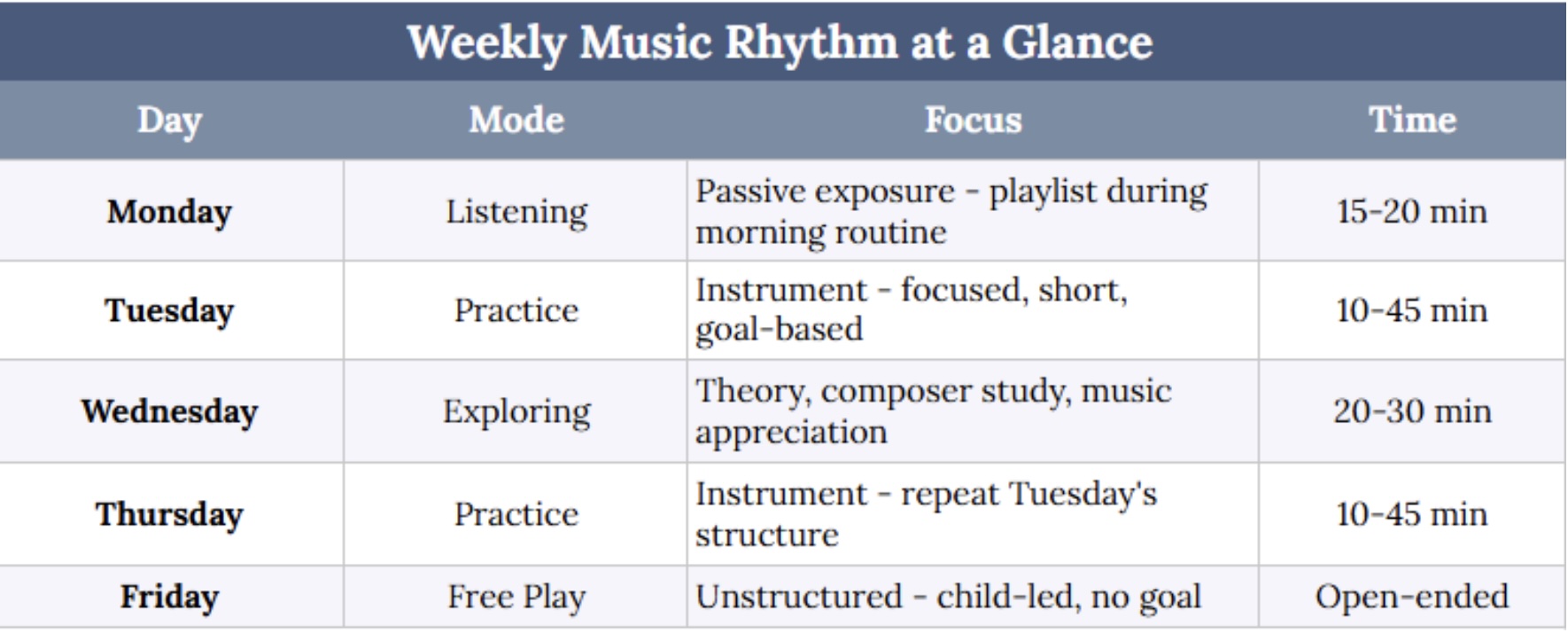
    Monday – Listening Day

    Start the week by simply playing music. This is the lowest-friction entry point possible: no instruments, no lessons, no prep.

    Put something on during breakfast, during a nature walk, or while your child colours or reads. Daily listening counts as music education – it trains the ear, builds familiarity with rhythm and structure, and develops musical taste long before a child ever touches an instrument.

    Rotate intentionally across the week and month. Classical one morning, jazz another, folk, blues, world music. Ask one question: “What do you notice about this music?” Then leave it alone. You’re not running a seminar. You’re opening a door.

    Time required: 15-20 minutes, entirely passive.

    Practical tip: Create a rotating playlist – one new composer or artist per week. By the end of the year, your child has been introduced to 52 musical voices.

    Tuesday and Thursday – Practice Days

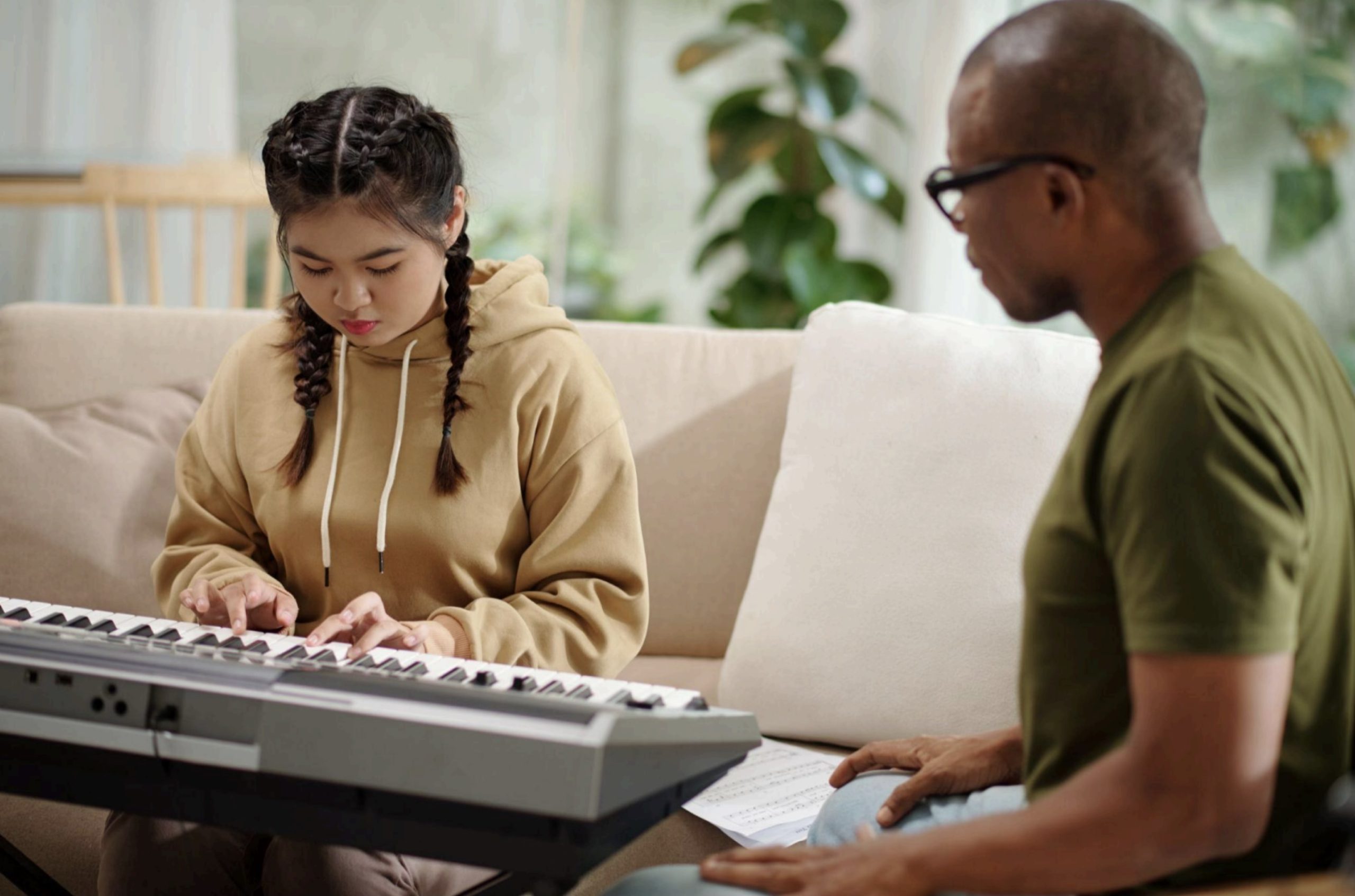
    These are the active instrument days. The goal is focused, short, consistent repetition – not marathon sessions.

    How long depends on age, and getting this right matters more than most parents realize:

    ● Ages 5-8: 10-15 minutes per session, 3-4 days a week. Young children fatigue quickly – physically and mentally. Short is not a compromise; it’s the correct approach.
    ● Ages 8-12: 15-30 minutes per session, 4 days a week. Students who consistently reach 75-100 minutes of practice per week progress significantly faster than those who don’t.
    ● Teens: 30-45 minutes per session, 5 days a week. At this stage, the quality of focused practice matters more than total time.

    For younger children, especially, the repetition method often works better than a set timer. Instead of “practice for 10 minutes,” try “play that section 5 times.” Put five marbles in a bowl and move one across each time they complete it. The tactile – countable goal is easier for young children to engage with than an abstract time limit. What makes a practice session good versus bad isn’t length – it’s focus. Phones off, TV off, one clear goal per session. Even 15 focused minutes beats 45 distracted ones. Time required: 10-45 minutes depending on age.

    Practical tip: Anchor practice to a fixed point in the day – right after lunch, or before screens in the afternoon. Predictability is what turns practice from a battle into a default.

    Wednesday – Theory and Listening Together
    Music

    Wednesday is a lighter day – no instrument required. This is where you weave in the broader context of music: a short video about how a symphony works, a story about a composer’s life, a simple music theory concept like what makes a major chord sound happy and a minor chord sound sad.

    You do not need to read music, play an instrument, or explain musical terms confidently to do this. You are not the teacher on Wednesday. YouTube, documentaries, and dedicated music appreciation curricula are the teacher. You are just the one who presses play and sits beside your child.

    This is also a natural day to ask your child what they want to explore. What kind of music do they like? What instrument have they always wanted to try? What song do they wish they could play? Following that thread, even briefly, keeps music feeling chosen rather than assigned.

    Time required: 20-30 minutes.

    Practical tip: The Naxos Music Library and SmartMusic are two widely-used resources for guided music listening and theory for home learners.

    Friday – Free Play and Exploration

    Friday is unstructured. No assignment, no goal, no right answer. Your child picks up the instrument (or doesn’t) and just plays.

    This matters more than most people think. Kids who only practice because they have to, often lose interest over time. But kids who also get to explore, experiment, and enjoy music for fun are much more likely to stick with it.

    Free play is where curiosity grows. When a child spends time figuring out a song on their own, just because they want to, they’re building something lessons alone can’t teach – a personal connection to music.

    Time required: As long or as short as they want.

    Practical tip: Leave the instrument out and accessible on Fridays. The barrier of getting it out of the case is often enough to prevent spontaneous play.

    The “I’m Not Musical” Problem – And Why It’s Not the Problem You Think

    One of the most freeing things a homeschool parent can hear is this: you do not need to be musical yourself to give your child a rich music education.

    Your child doesn’t need you to be a music expert. They just need your support, consistency, and encouragement to keep music part of the weekly routine. But there is one thing children do need from a real music teacher: feedback on their playing.

    It’s easy to go months inside a homeschool music routine without anyone ever giving specific, honest feedback on what a child is actually doing wrong – and wrong technique, left uncorrected, becomes a habit.

    This is the exact gap that Wiingy fills well. Parents can connect their child with experienced music tutors for one-on-one lessons and personalized feedback. Even occasional sessions can give children the expert guidance they need to keep improving with confidence.

    You handle the rhythm. Let an expert handle the refinement.

    Weekly Music Rhythm at a Glance
    Music

    Total weekly commitment: roughly 1–2.5 hours, spread across five lightweight
    touchpoints.

    How to Fill the Social Gap in Homeschool Music

    One real limitation of homeschool music education is what some call the ensemble gap: traditional schools offer choirs, bands, and orchestras. Playing alongside others teaches listening, timing, and musicianship in ways solo practice simply cannot replicate.

    The fix isn’t complicated, but it does require intention:
    ● Search for local homeschool music co-ops or youth ensembles in your area
    ● Arrange small informal “jam sessions” with other homeschool families
    ● Look into community youth orchestras or church choirs that welcome homeschoolers
    ● For older students, online ensemble platforms now allow students to record and layer parts together remotely

    To combat the ensemble gap, look for local youth groups or set up your own small jam circles with other families. If you can’t find anyone in person, try finding groups to collaborate with online. This is worth prioritising – not weekly, but at least once a month.

    When the Routine Falls Apart

    Homeschool schedules should work for you, not the other way around. Illness, travel, a particularly intense week in another subject, a child going through a motivation dip – all of these will interrupt the music rhythm at some point.

    The rule when that happens is simple: don’t try to catch up. Just restart. Music doesn’t have to happen every single day to make a difference. Missing a week doesn’t mean you failed. One of the benefits of homeschooling is flexibility. The goal
    isn’t perfection – it’s creating a year where music stays part of your child’s life more often than not.

    If your child keeps resisting practice for weeks, it’s worth paying attention to. It doesn’t always mean they should quit. Sometimes learning becomes difficult right before real progress happens. But it may mean something needs to change – the instrument, the teaching style, or the way practice is structured.

    The Bigger Picture

    Music

    3.7+ million children are currently homeschooled in the U.S – approximately 6.73% of all school-aged children, a figure that has more than tripled since 1999. These families are already doing the hard work of building an education from scratch, one week at a time.

    Music is one of the most valuable parts of a child’s education. Not just because it can create musicians, but because regular exposure to music helps improve focus, creativity, emotional growth, and overall learning.

    You don’t need a perfect system. You don’t need to be musical. You need a weekly rhythm with enough consistency that music becomes a feature of your family’s life rather than something you keep meaning to get to.

    Pick your anchors. Put the instrument out. Press play on Monday morning.

    The rest follows from there.

    The instrument in the corner doesn’t need a perfect lesson plan. It needs a family willing to make space for it.

    Ekta Saha is the Lead Content Marketer at Wiingy, an online tutoring platform offering personalized 1-on-1 lessons in music, languages, and math. With an MBA in Marketing, she specializes in educational content strategy, digital PR, and research-backed storytelling to help learners discover new skills and opportunities. Outside of work, she enjoys learning piano, singing, and exploring indie and acoustic music. You can email her at ekta.saha@wiingy.com.


    Share this:
    Share this page via Email Share this page via Stumble Upon Share this page via Digg this Share this page via Facebook Share this page via Twitter Share this page via Google Plus

    The New Way Students Are Preparing For Real Healthcare Work by fatjoe publishing

    Saturday, May 9th, 2026

    healthcare
    Via Pexels

    The New Way Students Are Preparing For Real Healthcare Work by fatjoe publishing

    Healthcare has changed. Not just the technology, the systems, or the patient expectations, but the way people prepare to enter the field. For years, many students believed there was only one “proper” path into healthcare: study for a long time, collect a degree, and then finally step into the working world.

    That path still matters for certain careers, of course. But it is no longer the only route worth respecting.

    Today, more students want training that feels connected to real life. They want skills they can actually use. They want to know what a clinic feels like, how patients communicate when they are nervous, how medical teams stay organised, and how small mistakes can create big problems. That kind of preparation needs more than theory. It needs practice, structure, and a clear understanding of what healthcare work really demands.

    Why Classroom Knowledge Is Only One Part Of The Journey

    You can learn a lot from textbooks. Medical terms, procedures, safety rules, body systems, admin processes, these things matter. They give you the foundation. But healthcare is not lived on paper.

    In a real setting, you have to think while moving. You have to listen carefully, follow instructions, stay calm, and communicate clearly with people who may be scared, frustrated, or in pain. That is where many students realise that knowledge and confidence are not the same thing.

    The strongest training programmes understand this. They do not treat students like empty notebooks waiting to be filled. They help you connect what you learn to what you will actually do. That means learning why a process matters, not just memorising the steps. It means understanding how your role fits into the bigger picture of patient care.

    The Value Of Learning In Real Medical Environments

    Healthcare work has a rhythm. Phones ring. Patients arrive early. Files need updating. A doctor asks for something urgently. Someone needs reassurance. Someone else needs privacy. The day rarely moves in a perfect straight line.

    That is why practical exposure matters so much. When you train in a way that reflects real medical environments, you begin to build habits that employers value. You become more comfortable with responsibility. You learn how to stay professional when the day gets busy. You start noticing the small details that separate a prepared student from someone who still needs constant direction.

    This is also where programmes like Kino College can be a positive example, because career-focused healthcare education works best when it helps students move beyond theory and into practical readiness. The goal should not only be to pass. The goal should be to feel useful, capable, and prepared when the real work begins.

    How Career Support Helps Students Move From Training To Employment

    Training is important, but what happens after training matters too. Many students finish a programme and then feel stuck because they do not know how to present themselves to employers. They may have skills, but no confidence in interviews. They may know the work, but not how to explain their value.

    Good career support helps bridge that gap. It can guide you with your CV, interview preparation, job expectations, workplace behaviour, and professional communication. These things may sound small, but they can change how quickly you move from student to employee.

    Healthcare employers are not only looking for people who have completed a course. They want people who are dependable, teachable, organised, and ready to work with patients in a respectful way. If your training helps you build those qualities, you are already stepping into the field with a stronger foundation.

    Choosing Training That Matches The Real World

    Before choosing a healthcare programme, look past the shiny promises. Ask better questions. Will you get practical experience? Will the training prepare you for real workplace pressure? Will you understand both patient care and the admin side of the job? Will someone help you think about employment after you complete your studies?
    The new way of preparing for healthcare work is not about rushing. It is about learning with purpose. You want training that respects your time, builds your confidence, and helps you become the kind of person a medical team can rely on.

    Because in healthcare, preparation is not just about getting a certificate.

    It is about being ready for people.

    Share this:
    Share this page via Email Share this page via Stumble Upon Share this page via Digg this Share this page via Facebook Share this page via Twitter Share this page via Google Plus

    Writing to Learn by William Zinsser

    Friday, May 8th, 2026

    Book
    Writing to Learn by William Zinsser explains the power of writing for learning and promoting clear thinking. He takes us on a tour of the disciplines, showing that writing should not be left to English teachers. It’s clear that creating written explanations of your knowledge will not only help you internalize it, but it will also reveal the holes in your knowledge. This book contains delightful examples of excellent writing from many disciplines. It was a joy to read.

    Preface

    • Writing is a form of thinking. It’s not necessary to be a writer to write well. Clear writing is the logical arrangement of thoughts. We write to find out what we know and what we want to say. This is a book full of great ideas for writers.

    Part I: 1. Hermes and the Periodic Table

    • This chapter tells how William used Latin, which transported him back to the classical world, rather than chemistry, to get into Princeton. He found Latin to be anything but dead, as thousands of its roots are alive and well in English. He then tells of his time at Princeton during World War II, where he took the fast track through courses and was only a few credits short when he joined the Army and headed to Europe. A few courses he took in Florence earned him his Princeton degree.
    • After the war, he began his career trying to write clearly at The New York Herald Tribune. He also became a logic nut. Writing is a basic skill for getting through life, yet many adults are terrified of the prospect. Writing is thinking on paper. Anyone who thinks clearly should be able to write clearly. That is what this book is about.

    2. Writing Across the Curriculum

    • The key concept is that teaching writing should not be left only to English teachers. This may be the most difficult pedagogical task. Motivation is crucial to writing, but assigned tasks in most schools don’t offer much. Writing is learned by imitation, but we eventually move on to our own style. William stresses the idea that once you dash off a draft, it will need a lot of editing to polish it into a respectable finished product.
    • Teachers of other subjects need to find exemplars of literature in their fields to share with students. Everyone loves a good story and every discipline should have some. Even in technical subjects, the best writers are good at writing for the lay person and every subject can be made interesting.

    3. A Liberal Education

    • After 13 years at the and 11 more as a freelance writer, William ended up at Yale, where he edited the Yale Alumni Magazine with a circulation of 100,000 Yale undergraduates and graduate alumni. During that time he drew on two sources of energy, confidence and ego. If you don’t have confidence in what you are doing, you might as well not do it.
    • There is no subject that can’t be made accessible in good English with careful writing and editing. Write good, clean sentences and organize them into a coherent shape. You need to write, rewrite, and prune to hammer out a clear and simple product. Clear writing is a corollary to clear thinking, and therefore a key to learning. You will learn a lot about a subject writing about it that you can’t learn any other way. There are examples of good writing here.
    Share this:
    Share this page via Email Share this page via Stumble Upon Share this page via Digg this Share this page via Facebook Share this page via Twitter Share this page via Google Plus

    Creative After-School Ideas to Spark Kids’ Growth Without Stress by Emily Graham

    Wednesday, May 6th, 2026

    STEM

    Creative After-School Ideas to Spark Kids’ Growth Without Stress by Emily Graham

    offers great after school advice of any parent or care giver who is at home when kids arrive or before dinner. Thanks Emily.

    Busy parents seeking after-school activities and educators supporting families often hit the
    same wall: plenty of after-school engagement options exist, but few feel like creative enrichment
    for children without creating new logistics headaches. Between family scheduling struggles,
    limited program fit, and the real mix of child development challenges in any group, it’s easy for
    afternoons to turn into a tug-of-war between “productive” and “peaceful.” The result is a routine
    that looks full on paper yet still leaves kids under-stimulated or overwhelmed. A calmer, more
    flexible approach can still support creativity and meaningful growth.

    Understanding Alternative Learning After School

    When typical programs do not fit, alternative learning simply means choosing experiences that
    still teach, but in a different shape. It can be maker time, outdoor challenges, family projects, or
    student-led clubs that feel natural to your child. The key idea behind creative learning is that
    kids grow when learning stays active, playful, and connected to real interests.

    This matters because many families need options that do not depend on perfect schedules,
    fees, or limited seats. Demand is huge, with 30 million school-aged children needing care and
    enrichment while far fewer are enrolled. Flexible choices can still build focus, communication,
    and confidence without adding pressure.

    Think of it like swapping a fixed menu for a buffet. One child thrives in a quiet “tinker corner” and another lights up leading a mini team challenge. Educators can share simple prompts, and parents can pick what fits the day. A low-prep sticker design craft is a great place to start.

    Make Custom Stickers: A One-Week Art-and-Tech Project

    When kids get the chance to learn in unconventional ways, they often shine brightest in projects
    that feel personal and playful. Designing and creating their own stickers is a simple, hands-on after-school activity that sparks creativity and makes room for self-expression, whether they’re turning drawings into mini “collections,” celebrating a favorite fandom, or capturing your family’s inside jokes. It can also grow into something bigger: a themed sticker club with friends, or even a tiny entrepreneurial project where they design sets for classmates or special occasions. If you’re intimidated by the “tech” side of the art, it’s easy with this custom sticker maker that
    incorporates templates, graphics, text, and straightforward drag-and-drop editing to create
    printable designs.

    Pick Outside-the-Box Activities and Start in 15 Minutes

    When kids get a short menu of options (instead of an open-ended “What do you want to do?”),
    they’re more likely to start, and stick with it. Use the ideas below like a cafeteria line: pick one
    for today, then rotate.

  • 1. Turn a hallway into a movement math game: Tape a big sheet of paper to the wall,
    add numbers, and give your child sticky notes to “vote” or “build” answers by physically
    moving them into place. A quick, low-prep movement-oriented math activity works because kids stay engaged with their whole body, not just a worksheet. Setup plan: paper + tape + sticky notes + marker, then a timer for two 6-minute rounds.
  • 2. Do a “real-world STEM” mini build: Pick one household problem and prototype a fix,
    like a paper bridge for toy cars, a spill-proof snack container, or a shade structure for a
    plant. The best STEM exploration for children is hands-on so kids can test, tweak, and try again without a big lecture. Setup plan: a “build bin” (tape, cardboard, scissors, string)
    plus a note card that says: Goal, Materials, Test, Improve.
  • 3. Start a tiny neighborhood service sprint: Choose one task that can be finished in
    20–30 minutes: assemble hygiene kits, write thank-you notes to school staff, or pick up
    litter on one block with gloves and a bag. Youth volunteering opportunities work better
    when they’re specific and time-boxed, kids feel the win quickly. Setup plan: text a friend
    to join once a week and keep a simple “service log” page your child can decorate with
    their own sticker labels.
  • 4. Try “museum-at-home” creative arts education: Give kids three prompts, observe,
    copy, remix, using any image (book art, a poster, family photo). They spend 5 minutes
    noticing details, 5 minutes sketching the main shapes, and 5 minutes remixing it into
    their style. Setup plan: one pencil, one marker, and one “limited palette” rule (only two
    colors) to reduce decision overload.
  • 5. Launch a kid-sized micro-business test (no money needed): Help your child offer
    something small: a sticker pack for locker labels, pet-sitting flyers, or “desk reset” help
    for a parent’s home office. Keep it educator-friendly by using existing curriculum planning ideas at home too, price, cost, and customer feedback can be a quick mini- lesson, not an extra burden. Setup plan: 10 minutes to define the offer, 5 minutes to make one simple sign, then one “customer interview” at dinner.
  • 6. Make an “after-school choice board” that protects homework time: Create a 2×2
    grid: Create, Build, Help, Earn, and list two activities under each (stickers count as
    Create + Earn if they sell or gift them. Decide in advance: one square per day, plus a
    clear stop time so evenings don’t spiral. This tiny routine also makes it easier to talk
    about cost, safety, age fit, and how much supervision each choice really needs.
  • After-School Ideas Parents Ask About Most

    Q: What should I look for when choosing an after-school program or activity?
    A:
    Start with three filters: your child’s interest, the adult-to-kid supervision reality, and the “gets us home calm” factor. Ask, “Will this feel doable on a tired Tuesday?” If you are comparing programs, choose the one that clearly states routines, behavior expectations, and how they communicate with families.

    Q: How can I keep kids safe if I’m juggling work and dinner?
    A:
    Pick activities that match your supervision bandwidth, not your ideals. Use a simple check-in
    routine: start time, location, and a 5-minute “show me what you made” at the end. If tech is
    involved, keep devices in shared spaces and use a visible timer.

    Q: What activities actually fit different age groups without causing meltdowns?
    A:
    For younger kids, prioritize short bursts and clear steps, like build, test, tweak. For older kids, add choice and ownership, like planning a mini service project or a small “offer” they can improve weekly. When in doubt, scale down materials and scale up structure.

    Q: How do I manage costs without sacrificing quality?
    A:
    Treat cost like a design constraint and set a monthly cap before you browse. Free or low-cost
    options can still be high-impact, especially when they build skills schools care about as the
    average ACT score has dropped to 19.8. Libraries, recycled supplies, and swaps with other families often cover most needs.

    Q: When should I prioritize homework versus hobbies?
    A:
    Use a predictable order: snack, 10 to 20 minutes of movement or making, then homework,
    then a short wrap-up choice. That “starter” activity can reduce resistance and make work time
    smoother. If grades are slipping, shorten hobby time but keep it daily to protect motivation.

    Grow Confidence With One Low-Stress Creative After-School Choice

    After school can feel like a tug-of-war between keeping kids productive and protecting their
    downtime, especially when programs, costs, and schedules compete for attention. The steady
    path is a simple, low-pressure mindset: keep motivating parental involvement, focus on
    implementing creative learning through play and practice, and stay open to exploring diverse
    activities as interests change. When families and schools take this approach, supporting child
    growth through activities becomes more consistent, and building children's confidence starts to
    show up in small, everyday wins. One small, consistent activity beats a packed schedule every
    time. Choose one new activity this week and watch how it evolves with your child’s energy and
    curiosity. That’s how skills, resilience, and connection grow in ways that last.

    Emily Graham

    Emily is the creator of MightyMoms.net. She believes being a mom is one of the hardest jobs around and wanted to create a support system for moms from all walks of life. On her site, she offers a wide range of info tailored for busy moms — from how to reduce stress to creative ways to spend time together as a family. You can email her at emilygraham@mightymoms.net. She lives in Arizona.

    Share this:
    Share this page via Email Share this page via Stumble Upon Share this page via Digg this Share this page via Facebook Share this page via Twitter Share this page via Google Plus