Author Archive
Tuesday, March 12th, 2019
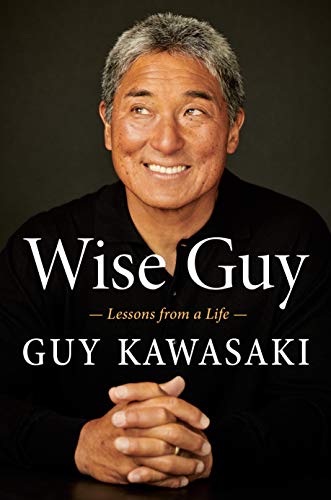
Wise Guy: Lessons From a Life by Guy Kawasaki uses his unique experience with Apple and other tech companies along with his life beyond work to distill wisdom he has gathered to date. His stories are engaging and this book can save you a lot of pain as you strive to be a better leader and a better person. It may well help you have a happier life. As a devoted parent, he has created a valuable book for parents. I strongly recommend it.
Preface
- Rather than an autobiography or a memoir, this book is a compilation of the most enlightening stories of Guy’s life. It’s lessons, not history. Perhaps Guy’s stories can help you live a more joyous, productive, and meaningful life. If Wise Guy succeeds, that will be a pretty good story.
1. Immigration
- Guy’s great-grandparents from his father’s side emigrated from Hiroshima, Japan to Hawaii to avoid military service during the Russo-Japanese War. They worked on farms for $1 a day. Guy’s maternal grandfather also immigrated from Japan where he met his wife. Guy got his name from Guy Lombardo, a famous bandleader from Canada who his father knew. While his parents didn’t go to college they read a lot and were very fond of music. After three tries his father was elected to the state senate where he served twenty years.
- Guy grew up in a poor section of Honolulu. His neighborhood was a melting pot at the time, but Japanese-Hawaiians were looked down on. His parents worked hard and placed a high value on education. Guy believes that by living in America, he was able to accomplish a great deal more than if he grew up in Japan, which wasn’t likely in Hiroshima. The wisdom here is to change a losing game or one that is going nowhere. This might require moving like Guy’s family did.
2. Education
- Guy believes that education is the great catalyst and equalizer. He credits his sixth-grade teacher for telling his parents that he shouldn’t take the typical path through Hawaii’s public schools. This meant great personal financial sacrifice for his parents. Guy found that his best teachers were also the toughest in that they always had high expectations. The advice here is to seek out people who will challenge you. If you are a teacher or the boss, you aren’t doing any favors by lowering your standards. The future cost of short-term kindness is great.
- Guy suggests that you also teach respect for authority and avoid trying to overprotect children. Sometimes being scared can teach an important lesson. Kids should know that people aren’t good or bad. Most of us have done good and bad things. Life offers a lot of contradictions. When it came time to go to college Guy wanted to go to Occidental where he could play football. His father told him no and that if he was going to pay for college Guy was going to Stanford. Guy got into Stanford even though his grades and SATs were not so great because at the time his Asian heritage made him a desirable minority. Guy recommends going away to college so you can meet people from different backgrounds.
3. Inspiration
- Guy was motivated to work hard so he could afford a nice car. He believes that it doesn’t matter what motivates you as long as you are motivated. He also recommends If You Want to Write: A Book About Art, Independence, and Spirit by Brenda Ueland for inspiration even if your goal is to do something other than writing. After getting robbed twice in high school Guy vowed to work hard so he could avoid public transportation and high crime neighborhoods.
- When he told his father that a passerby thought he was a gardener because he looked Japanese his father told him to get over it. Don’t look for insults and don’t let other people get to you. Condoleezza Rice told him “don’t ever see yourself as a victim because then you will start acting like one.” You must believe that you control your own fate. Be sure to read Mindset by Carol Dweck. You can do some unbelievable things, but you have to use the right tool. It’s ok to quit something as long as you reboot and restart. This chapter ends with the text of the speech he gave to the graduates at Menlo College in 2012. It’s full of good advice.
4. Apple
- Guy worked at Apple from 1983 to 1987 and from 1995 to 1997. These two “tours of duty” made him what he is today. When he first saw MacWrite and MacPaint he was dumbfounded by how cool the Macintosh was. His job was to convince software companies to produce products for the Mac. He was an evangelist. Guy felt that the cool aspect of the Mac made his job easy, but he worked hard and was smart enough to succeed. There are no perfect candidates for a job, only successful candidates who make their shortcomings irrelevant. A lot of people get jobs because they know someone. Don’t worry about that, just deliver.
- Working for Steve Jobs required that you prove yourself every day. He demanded excellence and kept you at the top of your game. It was sometimes unpleasant and always scary, but it drove you to do your finest work. Steve demanded honesty and saw it as a test of competence and character. It’s also easier than lying. Trust but document. It’s good to cover your ass when you are bending the rules. Guy recommends Drive: The Surprising Truth About What Motivates Us by Daniel Pink. Pay and perks are nice but look for a job where you can learn new skills, and work autonomously towards a meaningful goal. This chapter concludes with the top eleven lessons Guy learned at Apple.
Tags: Guy Kawasaki, Wise Guy
Posted in Book Summaries, Business Books, Education Books, Leadership Books | Comments Off on Wise Guy: Lessons From a Life by Guy Kawasaki
Monday, February 11th, 2019
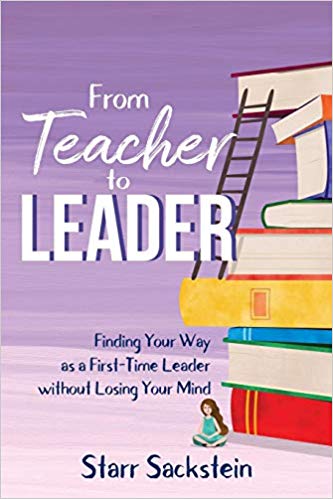
From Teacher to Leader: Finding Your Way as a First-Time Leader—Without Losing Your Mind by Starr Sackstein recounts her first year as an administrator. This story of a remarkably gifted teacher’s journey into administration after her first year is a great read. Starr’s reflections, research efforts, and writing skills have resulted in a valuable resource for teachers considering a jump to administration and experienced administrators alike. She lives up to her desire of becoming the kind of leader she would want to have. As an educator since 1969 and an administrator for 30 years, I find her advice to be spot on. Make sure that you and your professional development library has a copy.
Forward
- The forward by Dan Rehman, Superintendent West Hempstead Union Free School District tells the story of how Starr was hired as the district’s director of Humanities. While she clearly had the necessary qualities, she lacked the necessary certification, which Starr and the district were finally able to work around. Dan paints her as enthusiastic, goal focused, persistent, self-aware, creative, innovative, willing to take risks, and reflective. What else could you ask for in a leader?
- While she loved her nine years teaching journalism in New York City, (16 years total) she struggled with boredom and dissatisfaction with administrative decisions, and began experimenting with grading less and helping students began a flurry of reflection and problem-solving. She questioned what learning should look like. She became an administrator to become a mentor for new teachers. This book tells the story of her first year, mistakes and all.
- Each chapter also ends with some valuable Daily Reflections for Change that you can do.
1. To Leave or Not to Leave
- As a teacher, there is no single right way to know when to leave. Possible reasons are boredom or complacency with your work, urge to share your expertise with others, or someone suggesting that you make the move. (Doug: They also make more money.) Once you start to think about it the more you need to look for administrative programs. Ideally, you find one where you can take a few courses as a non-matriculated student to get your feet wet. Interview working administrators to get a better idea of what the job entails. Read some of the books Starr suggests and look for Twitter chats on leadership.
- Thirteen years into teaching Starr was able to take on a “hybrid” role as part teacher and part teacher coach. She felt that still doing some teaching gave her more credibility with the people she coached as she was still doing the things that she was trying to get them to do. Teachers could visit her classroom and she could still continue to try new things.
- Before you start looking for jobs create a description for your ideal job. Starr provides one here based on her desires and skills. Once you have your goals spelled out you can better articulate them in interviews. While no two people take the same path to administration, Starr’s path covers the basics that all teachers need to consider. She suggests that you are not there to fix teachers but to help them further develop the skills they already possess. Stay humble, be present, listen, collaborate, and be patient.
2. Teacher Leadership as a Precursor to School Leadership
- Consider the job description and ask a lot of questions about the school culture and needs to make sure the job is a good fit. Before transitioning grow your content or pedagogical expertise and serve on committees. Apply to present at local, regional, or national conferences on topics important to you. Adult learners are different from students. How so? Nothing is worse than discounting ideas elicited from others. It’s a surefire way to make your team resent you.
3. The Ache of the Shift
- Starr became very aware of the void that had been created inside by not being in the classroom. She worked to rebrand her decision as an extension of her teaching career and not as a replacement for it. She spends time in classrooms. Plans with teachers and offers to co-teach when it is appropriate. As a new team leader, you will definitely experience isolation. For the most part, it will continue because you are no longer part of us. Now you are one of them. Leadership doesn’t have to be the dark side. It can be light, optimistic, and supportive, but it definitely takes time to get your team to believe you are one of them. To get feedback Starr uses anonymous Google forms. Be ready with “Plan B” in the event your day changes unexpectedly. Starr also offers advice on attire here. Learning—in the classroom and in life—happens moments forced her to figure things out. You are going to have to do a lot of learning so it helps if you enjoy learning. Exhibit the behaviors you’d like to see.
Posted in Book Summaries, Education Books, Leadership Books | Comments Off on From Teacher to Leader: Finding Your Way as a First-Time Leader—Without Losing Your Mind by Starr Sackstein
Saturday, February 2nd, 2019
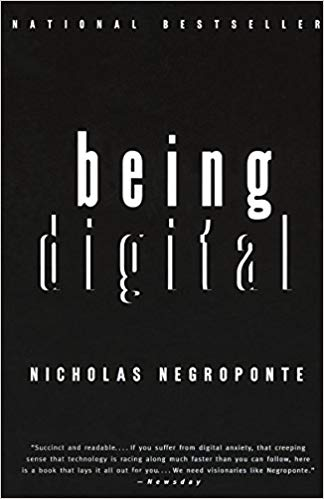
Being Digital by Nicholas Negroponte Twenty Three Years Later – It’s amazing how his vision at the time matches today’s reality. If you are looking for something cool to read, you won’t be disappointed with this classic that is still available online.
Introduction
- In 1995 Nicholas Negroponte, the founding director of the MIT Media Lab, published Being Digital. While reorganizing my library recently I picked it up and started reading it again. As I read I was amazed at how prescient his thinking was at the time. I felt that he had a very clear vision of where advances in computer technology and the Internet would take us. Much of what he predicted has come to pass while some of what he predicted has yet to happen. If he got anything wrong, I couldn’t find it to any significant degree.
Death of the Videocassette
- He saw the death of the videocassette and its associated rental businesses. He also saw services like Netflix coming due to the bandwidth of fiber and how it would be a game changer in terms of delivering content with copper serving as a stepping stone. He saw that advertising would be personalized as well. He also foresaw computers that would resemble thick pieces of paper like modern tablet computers.
- He was sad that most of the research directed at the advance of television was aimed at refining the display and increasing sizes as opposed to improving the artistry of content. He saw no reason not to expect 10,000 lines of resolution. He also predicted that computers and televisions would merge into a single device, which they have for many people as they are no longer dependent on the time of day when they want to watch something. He understood that using a lot of different fonts was a bad idea. In this case, less is more.
As For Schools
- He saw schools changing to become more like museums and playgrounds where children would assemble ideas and socialize with other children all over the world. While I’ve seen bits of this in some innovative schools, for the most part, we have a way to go to realize this vision.
- The Internet would create a totally new, global social fabric. With the Internet, schools could spend less time shoving facts into kids’ minds and more time engaging them in designing and building like they do in the maker spaces found in innovative schools. He decried the force-feeding of students’ left brains in schools that diminish the arts and other extracurriculars. Unfortunately, this has only gotten worse thanks to test-based reforms forced on schools by the federal government.
From Bits to Atoms
- He thought it was amusing that when ink is squeezed on to dead trees bits become atoms again. He saw the then-burgeoning field of multimedia as bridging the gap between science and art. He saw a day when most adults would also be computer literate. He predicted that virtual reality would allow you to put your arms around the Milky Way, swim in the human bloodstream, or visit Alice in Wonderland.
- He foresaw digital appliances with no edge at all like high-end cellphones and tablets. He saw that size would be driven by the size of pockets and watches. He said the wristwatch would migrate from a timepiece to a mobile command-and-control center as it has on my wrist thanks to my Apple Watch.
Posted in What can Dr. Doug do for you? | Comments Off on Being Digital by Nicholas Negroponte Twenty Three Years Later
Sunday, January 27th, 2019
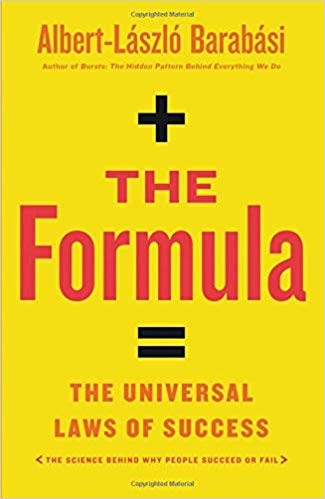
The Formula: The Universal Laws of Success by Albert-László Barabási explains how his team discovered these laws and how they can apply to your life and the lives of those you touch. While successful people throughout the ages had no idea of why they succeeded, you don’t have to. This is certainly one of the most important books I have summarized to date. Be sure to get a copy for your school.
Introduction
- Albert and his team gathered data on people who achieved success in as many fields as possible. The assumption is that success leaves a trail of data points behind it such as publications, museum exhibits, sales, and even sports statistics. The idea was to find a series of recurring patterns that drive success in most areas of human performance. This is not about success as judged by the individual as that leaves no trail. As a result of this effort, we have the universal laws of success..
1. The Red Baron and the Forgotten Ace
- This starts with the story of Manfred von Richthofen, Germany’s ‘Red Barron’ who shot down eighty allied planes during World War I. His success was magnified by the German government and he did what he could to blow his own horn. His fame lives on thanks to Charles Schultz and Snoopy. Contrast him to René Fonck, a French pilot who may have shot down as many as 127 German planes. Fonck is an example of outstanding performance without success. He is like the opposite of Kim Kardashian. This reminds us that success and fame are very different. Albert tells stories of other people who did something first only to see a latecomer get the credit. Success, therefore, is about how you and your performance is perceived by others.
2. Grand Slams and College Diplomas
- The First Law: Performance drives success, but when performance can’t be measured, networks drive success. It’s time to see the largely invisible networks that shape our success.
- First we see that some areas like academic performance with metrics like SAT scores and GPAs and tennis with its precise ranking system are much different from most fields where accurate performance metrics don’t exist. The interesting finding here is that ambition along with performance seems to be important. Students who are rejected by top colleges like Harvard do just as well as students who go there due to their ambition. This suggests that the schools don’t really matter. It’s the student who matters.
3. The $2 Million Urinal
- Now we look at a field where there is no easy metric to judge performance, the field of fine art. Here what matters most is your network. This network is composed of curators, art historians, gallery owners, dealers, agents, auction houses, and collectors. At the center of the story is a toilet simply signed by Marcel Duchamp that sold for $2 Million dollars. Albert also points out that the Mona Lisa didn’t become the world’s most famous painting until it was stolen and wasn’t found for two years. This shows the importance of context. There is a trove of data here that contains information about where artists have shown their works. Again we see that the ambition to have your works shown in top galleries along with persistence and expanding your network are key attributes. Like students ambitious enough to apply to Ivy League schools, artists ambitious enough to promote their works to top galleries are the ones more likely to succeed.
Posted in Book Summaries, Business Books, Education Books, Leadership Books | Comments Off on The Formula: The Universal Laws of Success by Albert-László Barabási